8.3% from Jan-Nov → Sharp Drop to 1.4% Next Year
Semiconductors and Electronics Including Electric Devices Also Limited to 1.5%
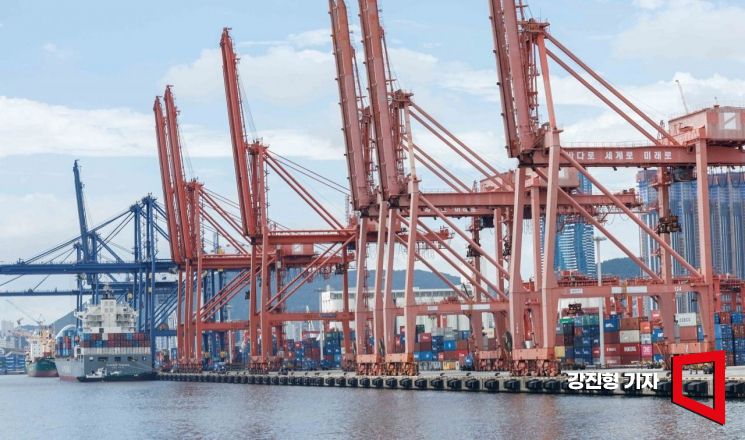
A corporate survey revealed that the export growth rate next year will be only 1.4%. This means that export momentum could decline to one-sixth of this year's growth rate of 8.3% from January to November, as announced by the Korea Customs Service. Exports of automobiles and steel are expected to contract, and the export growth rate of the electrical and electronics sector, including semiconductors, is also expected to remain around 1.5%.
The Korea Economic Association commissioned market research firm Monoresearch to conduct a 2025 export outlook survey targeting 150 companies in 12 major export-driven industries among the top 1,000 companies by sales. On the 22nd, it announced that the expected export growth rate was 1.4%. The 12 major export-driven industries are semiconductors, general machinery, cars, petrochemicals, steel, petroleum products, shipbuilding, car parts, displays, bio-health, computers, and mobile communication devices.
By industry, the outlook was highest for bio-health (5.3%), general machinery (2.1%), petrochemicals and petroleum products (1.8%), electrical and electronics (1.5%), and shipbuilding (1.3%). Industries expected to contract were cars and parts (-1.4%) and steel (-0.3%).
Companies that expect exports to decline next year cited the main reasons for sluggish exports as ▲economic downturn in major export target countries (39.7%) ▲strengthening of protectionism such as tariff burdens (30.2%) ▲weakened price competitiveness due to rising raw material and oil prices (11.1%). Companies expecting export growth next year pointed to ▲strengthening product competitiveness through new product development (27.6%) ▲improved price competitiveness due to won depreciation (27.6%) ▲diversification of export countries (18.4%).
More companies also expect export profitability (profit levels) to worsen next year compared to this year. Among respondents, 32.6% forecast that export profitability will deteriorate next year, while 20.6% expected improvement. About half of the companies (46.8%) responded that export profitability would be similar to this year.
Industries with many forecasts of worsening export profitability included shipbuilding (50.0%), electrical and electronics (45.4%), and cars and parts (42.9%). The factors for deterioration were ▲increased tariff burdens due to strengthened protectionism (46.9%) ▲price reductions due to intensified export competition (20.5%) ▲rising raw material prices (12.2%).
Companies expecting exports to decline next year are considering measures to respond to sluggish exports such as ▲diversification of export markets (47.6%) ▲cost reduction including operating and labor costs (23.8%) ▲strengthening foreign exchange risk management (15.9%).
Companies foresee a bleak export outlook for the United States and China next year. The regions expected to have the most difficult export conditions for Korean companies next year were the U.S. (48.7%) and China (42.7%). The Korea Economic Association explained, "Since the election of Donald Trump as U.S. president, the intensification of U.S.-China conflicts has reflected companies' concerns that export conditions to the U.S. and China, Korea's major export countries, will deteriorate."
Government policies to strengthen export competitiveness were identified as ▲stabilization of the foreign exchange market (31.5%) ▲minimizing export damage due to strengthened protectionism (22.8%) ▲tax support related to raw material imports (18.0%) ▲stable supply measures for raw materials, etc. (11.4%) ▲support for pioneering new export markets (11.0%).
Lee Sang-ho, head of the Economic and Industrial Division at the Korea Economic Association, said, "If the second Trump administration actually imposes universal tariffs next year, export conditions could worsen further. The government should focus on creating an environment to enhance export competitiveness by stabilizing the foreign exchange market and minimizing export damage caused by strengthened protectionism, and the National Assembly should strive to enact legislation that boosts export vitality rather than regulations that weaken corporate vitality."
© The Asia Business Daily(www.asiae.co.kr). All rights reserved.

















