Decrease in Young Workforce in Construction Industry... Lowest Among 10 Industries
"Negative Perceptions of the Construction Industry Widespread"
The proportion of young workers in their 20s and 30s engaged in the construction industry has significantly decreased, revealing a clear trend of workforce aging.
According to Statistics Korea on the 20th, as of May, the number of young workers employed in the construction industry was 131,000. This is 37,000 fewer than the same period last year.
Among the fields chosen by young people as their first job after graduation, the construction industry ranked the lowest among 10 industrial sectors, including the service industry.
According to the Korea Construction Policy Research Institute, as of June this year, out of 1,009,144 construction technicians nationwide, only 158,503 (15.7%) were in their 20s and 30s. Even including those in their 40s, it did not reach half (42.6%).
On the other hand, construction technicians in their 50s and 60s (578,192) accounted for 57.3% of the total.
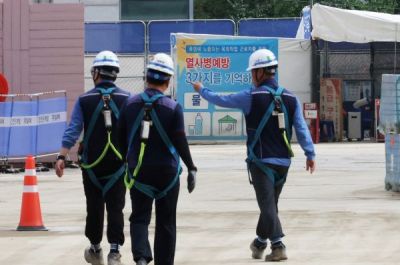
According to the "Construction Industry Youth Talent Acquisition Strategy" announced by the Korea Research Institute for Construction Industry (KRICI) on the 12th, the average age of construction technicians, which was 38.1 years in 2004, increased by 13 years to 51.2 years as of the first half of this year. Considering that the average age of all workers in South Korea last year was 43.8 years, the speed of aging can be felt.
KRICI explained, "The deepening shortage of young workers is influenced not only by changes in the national population structure but also by fixed perceptions about the construction industry."
A survey conducted by the Construction Industry Vision Forum and KRICI targeting 406 young employees and university students active in the construction industry showed that the satisfaction rate with their major among university and graduate students currently enrolled in construction-related departments was 72.0%. The most important factor was salary, followed by work-life balance (WLB), organizational culture, growth potential, and working space and environment.
However, in the construction industry, it was confirmed that about 4 out of 10 young employees are considering changing jobs. Above all, the image of the construction industry has worsened over the past year, and 93% of respondents said that improving the industry's image is necessary. When asked about future prospects, 37% answered negatively, and 41% chose neutral.
KRICI stated, "University (graduate) students majoring in construction-related fields showed high satisfaction with their majors but tended to have negative perceptions about jobs after graduation," adding, "Both students and employees had negative perceptions about job conditions across the construction industry."
The government plans to help resolve the labor shortage in the construction industry by expanding visas for foreign skilled workers. They are working on easing long-term stay requirements for highly skilled foreign workers and raising the hiring limits for skilled workers by construction companies.
The Ministry of Justice recently improved the skilled worker (E-7-4) visa system to expand the number of hires per company. The Ministry of Land, Infrastructure and Transport plans to pilot the introduction of general skilled worker (E-7-3) visas next year to secure workers such as formwork carpenters, rebar workers, and concrete workers. The construction industry reportedly requested the introduction of about 300 general skilled worker visas per occupation, including concrete workers and rebar workers.
© The Asia Business Daily(www.asiae.co.kr). All rights reserved.
![Clutching a Stolen Dior Bag, Saying "I Hate Being Poor but Real"... The Grotesque Con of a "Human Knockoff" [Slate]](https://cwcontent.asiae.co.kr/asiaresize/183/2026021902243444107_1771435474.jpg)















