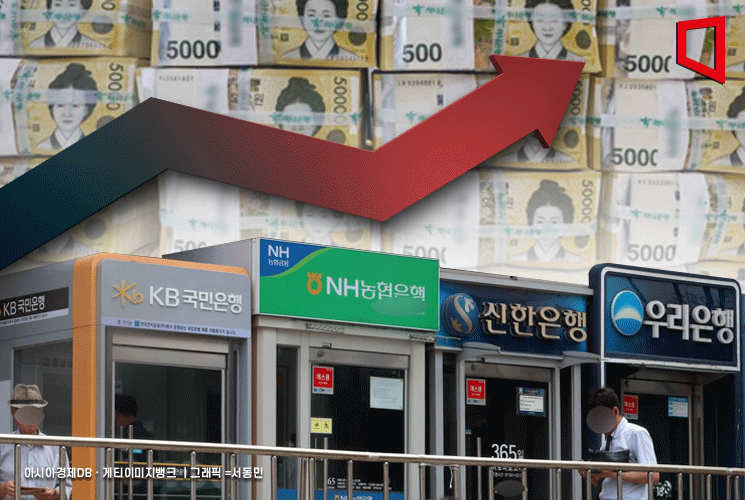
The won-dollar exchange rate has surged to levels seen during the global financial crisis, raising concerns that the high exchange rate could hinder the value-up efforts of domestic financial holding companies. A decline in the won's value could lead to increased foreign exchange losses, resulting in deteriorated financial soundness. This is directly linked to dividend capacity, heightening shareholders' anxieties. Ahead of the new year, major financial holding companies appear to be deeply troubled by the compounded challenges of political and economic instability caused by martial law effects and the exchange rate.
According to the financial sector on the 20th, the exchange rate surpassed 1,450 won the previous day, triggering warning signals for the value-up of financial holding companies. The won-dollar exchange rate exceeding 1,450 won is the first time in 15 years since March 16, 2009, during the global financial crisis. With the psychological threshold of 1,400 won becoming the 'new normal,' there are even short-term forecasts that the exchange rate could break through 1,500 won.
As expectations grow that the high exchange rate will continue for the time being, value-up plans of major financial holding companies have also been stalled. To fulfill the shareholder return policies promised by financial holding companies, they must manage the Common Equity Tier 1 (CET1) ratio, but a sharp rise in the exchange rate makes managing the CET1 ratio burdensome. The CET1 ratio is a key indicator of a financial institution's soundness, calculated by dividing common equity capital by risk-weighted assets (RWA). Since RWA is based on the won, a sharp rise in the exchange rate increases foreign currency loan assets, which lowers the CET1 ratio. Typically, a 10 won increase in the exchange rate is estimated to reduce the CET1 ratio by about 0.02 percentage points (2 basis points).
As of the third quarter, the CET1 ratios of the four major financial holding companies range from 11% to 13%, namely ▲KB Financial Group (13.85%) ▲Shinhan Financial Group (13.13%) ▲Hana Financial Group (13.17%) ▲Woori Financial Group (11.96%). A CET1 ratio above 13% indicates a willingness to actively pursue shareholder returns, and major financial holding companies aim to maintain above 13% to demonstrate their commitment to shareholder returns.
KB Financial Group stated, "We are striving to manage RWA to maintain the CET1 ratio in the mid-13% range," adding, "Since exchange rate fluctuations have a significant impact on the real economy, we recently held an emergency meeting to review the status of support projects for small business owners and discuss measures to provide funds in preparation for credit tightening caused by economic slowdown."
Since all four major financial holding companies are included in the 'Korea Value-Up Index,' other financial holding companies are also strengthening RWA management to defend their CET1 ratios. A representative from a commercial bank said, "There is no suitable method other than reducing risk assets to maintain the CET1 ratio," and added, "We are also considering measures such as reducing loans to small and medium-sized enterprises or small business owners with high delinquency rates to manage year-end indicators."
Meanwhile, financial authorities are making every effort to stabilize the exchange rate by postponing the introduction of the stress buffer capital regulation, which was scheduled for this year, to the second half of next year, and by excluding market risk from exchange rate fluctuations arising from non-transactional, non-hedged overseas assets such as banks' overseas subsidiary investments from the calculation of risk-weighted assets.
A financial holding company official said, "The most important indicator in value-up is the CET1 ratio, so we will focus on managing this indicator," adding, "We will closely monitor exchange rate trends to ensure that value-up plans are executed without disruption."
© The Asia Business Daily(www.asiae.co.kr). All rights reserved.

















