"Price Stabilization Effect Decreases Over Time"
GBC Designated Despite Low Necessity
Need to Reduce Scope if Maintained
An analysis has emerged suggesting that the effect of Seoul's land transaction permission zones on stabilizing the housing market is minimal, indicating the need for their removal. It was also recommended that if lifted, the designation should be narrowed down to localized areas such as redevelopment complexes where price surges are expected.
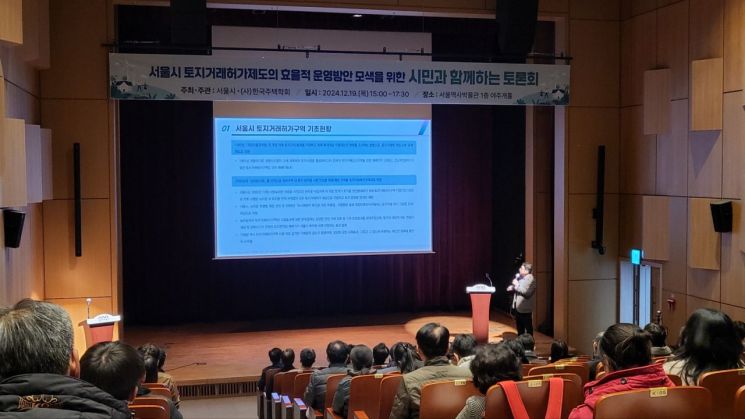 On the 19th, a citizen forum on "Exploring Efficient Operation Plans for the Seoul Land Transaction Permission System" is being held at the Seoul Museum of History in Jongno-gu, Seoul.
Professor Chang-Moo Lee of Hanyang University stated at the ‘Citizen Forum for Exploring Efficient Operation Plans of Seoul’s Land Transaction Permission System’ held on the 19th at the Seoul Museum of History in Jongno-gu, Seoul, “From the perspective of the entire Seoul city, the housing market is heavily influenced by macro financial factors and real estate policies, so the price stabilization effect of the land transaction permission system was minimal.”
This phenomenon was similarly observed in the land transaction permission zones around the ‘International Business Complex (GBC)’ area in Jamsil, Seoul. Professor Lee explained, “Immediately after designation, there was a stabilization effect on transaction volume and sale prices within the regulated area, but this gradually weakened, and from the fourth year onward, there was no significant effect.” He added, “The upward trend in sale prices within the zone before the regulation in June 2020 was mainly due to an increase in actual residential demand rather than speculative demand inflow,” and said, “It was a market situation where it was ambiguous whether the designation was necessary.”
Professor Lee emphasized, “In situations where asset value is expected to rise due to development prospects, price increases occur significantly regardless of the designation of land transaction permission zones,” and “Since there is no evidence that the Seoul housing market was stabilized, questions arise about increasing the total area of the zones.”
The land transaction permission system was introduced to prevent speculative transaction demand and maintain a stable market order centered on actual demanders. Currently, 65.25㎢ in Seoul, mainly around development project areas, are designated as land transaction permission zones. This accounts for 10.8% of Seoul’s total area (605.24㎢). However, contrary to its purpose, as the system’s implementation has prolonged, issues such as infringement on property rights have intensified. Especially in the area near GBC, unlike other development project areas, the designation was extensive, leading to fairness controversies.
In this regard, Professor Kyu-Hyun Ji of Hanyang Cyber University said, “Many of Seoul’s land transaction permission zones cause excessive inconvenience to residents due to prolonged project progress, so zone adjustments and removals should be considered.”
Improvement measures for the system were also proposed. Professor Lee suggested, “If maintained, efficient management that reduces the spatial scope of regulated areas is necessary, and if lifted, the designation should be narrowed down to localized zones such as rapid integrated planning redevelopment complexes where price surges occur.” Jun-Hee Han, Head of Policy Research at the Korea Real Estate Board, said, “Establishing removal guidelines is most important,” and added, “Especially since the impact of designating land transaction permission zones in GBC, a core area of Seoul, extends beyond Seoul’s real estate market to the entire domestic market, designation and removal decisions should consider this.”
© The Asia Business Daily(www.asiae.co.kr). All rights reserved.
![Clutching a Stolen Dior Bag, Saying "I Hate Being Poor but Real"... The Grotesque Con of a "Human Knockoff" [Slate]](https://cwcontent.asiae.co.kr/asiaresize/183/2026021902243444107_1771435474.jpg)















