'Producer Price Index for November (Provisional)'
Up 0.1% from Previous Month, Rising for the First Time in Four Months
Producer prices turned to an increase after four months as industrial electricity rates and other costs rose.
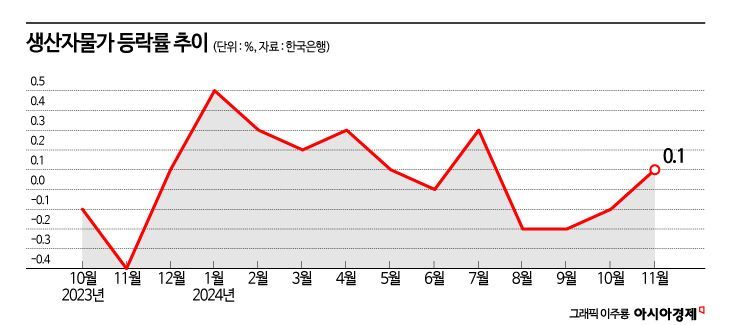
According to the "November Producer Price Index (provisional)" released by the Bank of Korea on the 20th, the producer price index last month rose by 0.1% compared to the previous month. The producer price index had declined for three consecutive months after falling 0.2% in August, but turned to an increase after four months.
Producer prices in November rose due to increases in industrial electricity and other costs. The electricity, gas, water, and waste sector rose 2.3% month-on-month due to increases in industrial electricity (7.5%) and steam (0.1%). Manufactured goods also rose 0.1% month-on-month as coal and petroleum products (1.6%) and food and beverages (0.3%) increased.
On the other hand, agricultural, forestry, and fishery products fell 3.6% month-on-month due to decreases in agricultural products (-5.1%) and livestock products (-2.8%). Services declined 0.1% month-on-month as financial and insurance services (-1.0%) and transportation services (-0.1%) decreased.
Compared to the same month last year, producer prices in November rose 1.4%, expanding the increase from the previous month (1.0%). This was influenced by industrial electricity rising 12.2% and residential city gas rising 7.3% year-on-year in the electricity, gas, water, and waste sector. Among agricultural, forestry, and fishery products, prices of rice (-8.3%), green onions (-33.4%), chicken (-12.2%), and duck meat (-32.0%) declined.
The domestic supply price, calculated by combining import prices with producer prices, rose 0.6% month-on-month as raw materials (1.8%), intermediate goods (0.6%), and final goods (0.1%) all increased. Compared to the same month last year, it rose 1.8%.
Lee Moon-hee, head of the Price Statistics Team at the Bank of Korea’s Economic Statistics Bureau, explained the 0.5 percentage point difference between the domestic supply price and producer price increase rates by stating, "Import prices based on customs clearance in November rose more sharply than producer prices due to the rise in the won-dollar exchange rate and the increase in international oil prices in October," adding, "This marked the highest level in seven months since the 1.0% increase in April."
The total output price, measured by combining export prices with producer prices, rose 0.6% month-on-month as manufactured goods (0.9%) increased despite declines in agricultural, forestry, and fishery products (-3.4%). Compared to the same month last year, it rose 2.8%.
Lee said, "The recent rise in the exchange rate is reflected in import prices based on the won, and it is expected to be reflected in producer prices, consumer prices, and domestic prices with a time lag," adding, "The timing of reflection will vary by item."
© The Asia Business Daily(www.asiae.co.kr). All rights reserved.
![Clutching a Stolen Dior Bag, Saying "I Hate Being Poor but Real"... The Grotesque Con of a "Human Knockoff" [Slate]](https://cwcontent.asiae.co.kr/asiaresize/183/2026021902243444107_1771435474.jpg)















