US Dollar-KRW Exchange Rate Surpasses 1450 Won Amid US Interest Rate Cut Slowdown
Soars to 2008 Global Financial Crisis Levels
Uncertainty Grows Despite Foreign Exchange Authorities' Stabilization Measures, Could Exceed 1500 Won
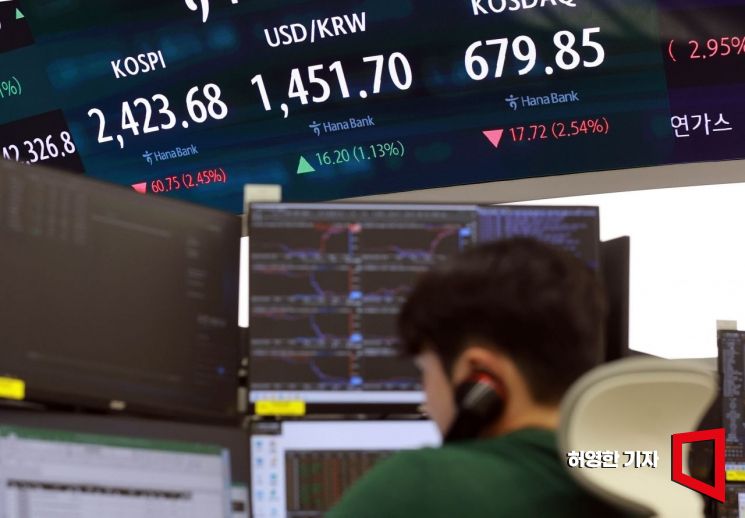 As the U.S. Federal Reserve (Fed) hinted at slowing the pace of interest rate cuts, the New York stock market plunged sharply, and the domestic stock market also opened with a significant decline. The KOSPI started the session down 57.88 points (2.33%) at 2426.55, and the KOSDAQ also opened more than 15 points lower. Various indices are displayed in the dealing room of Hana Bank's Euljiro headquarters in Seoul. Photo by Heo Young-han
As the United States slows down the pace of interest rate cuts, the won-dollar exchange rate surged past the previous global financial crisis level of 1,450 won. Although foreign exchange authorities have taken market stabilization measures, the won-dollar exchange rate is expected to soar to 1,500 won due to the combined uncertainties of U.S. monetary policy and domestic political instability.
Exchange Rate Surges to Global Financial Crisis Levels
On the 19th, in the Seoul foreign exchange market, the won-dollar exchange rate closed at 1,451.9 won at 3:30 p.m., up 16.4 won from the previous trading day. The exchange rate opened at 1,453.0 won, up 17.5 won from the previous day, and fluctuated around 1,450 won. This is the first time in 15 years and 9 months since March 2009, near the end of the global financial crisis, that the won-dollar exchange rate has exceeded 1,450 won.
The U.S. Federal Reserve (Fed) significantly influenced the Korean foreign exchange market by announcing it would slow the pace of future benchmark interest rate cuts. According to the dot plot released when the Fed cut rates by 0.25 percentage points early that day, the expected rate cut next year is limited to 0.5 percentage points, half the 1 percentage point cut forecasted in the September dot plot.
Fed Chair Jerome Powell stated, "As inflation expectations have risen again, the median interest rate forecast has also increased somewhat," adding, "If inflation strengthens further, the pace of rate cuts could slow even more." Following Powell's remarks, the dollar index, which measures the dollar's value against the currencies of six major countries, surpassed the year's high of 108.
Lee Min-hyuk, an economist at KB Kookmin Bank, analyzed, "The Federal Open Market Committee (FOMC) results early this morning were interpreted as quite hawkish," and "As the dollar showed ultra-strong performance, the exchange rate also hit a new high."
Concerns of Further Rise Despite Authorities' Volatility Mitigation Efforts
As the exchange rate surged, foreign exchange authorities repeatedly issued market stabilization statements. Choi Sang-mok, Deputy Prime Minister and Minister of Economy and Finance, held a macroeconomic and financial meeting (F4 meeting) that morning and said, "We will continuously operate a 24-hour financial and foreign exchange market monitoring system and will boldly and swiftly implement additional market stabilization measures against excessive volatility."
Yoo Sang-dae, Deputy Governor of the Bank of Korea, also emphasized at a market situation review meeting that morning, "If external uncertainties combine with domestic political situations to excessively increase financial and foreign exchange market volatility, we will promptly implement market stabilization measures." Bank of Korea Governor Lee Chang-yong also stated at a briefing on inflation target management the previous day that he would respond firmly if exchange rate volatility increases.
Additionally, foreign exchange authorities announced that to reduce volatility in the foreign exchange market, they will extend the foreign exchange swap transaction with the National Pension Service until the end of next year and increase the limit from the existing $50 billion to $65 billion. Authorities expect that the foreign exchange swap transaction can absorb the National Pension Service's demand for spot foreign exchange purchases during foreign exchange market instability, contributing to market stabilization.
Despite the authorities' successive volatility mitigation efforts, the market expects the exchange rate could temporarily break through 1,500 won. This is due to the increased domestic political and economic instability following the emergency martial law and impeachment crisis, combined with uncertainties in U.S. monetary policy. The depreciation rate of the Korean won is greater than that of major currencies such as the Chinese yuan, Japanese yen, and European euro, which is seen as reflecting this anxiety.
Min Kyung-won, an economist at Woori Bank, forecasted, "Demand for the safe-haven dollar is expected to continue amid increasing uncertainty over U.S. monetary policy next year," adding, "With foreign investors continuing net selling in the domestic stock market, the exchange rate could rise to 1,500 won in the short term."
NH Investment & Securities predicted that the dollar index would maintain a strong trend until the first half of next year. Researcher Kwon Ah-min of NH Investment & Securities said, "The previously suggested average exchange rate for the first half of next year was 1,380 won, but we are revising it upward to the low 1,400 won range," and added, "We believe the pressure of won weakness combined with dollar strength is likely to continue at least until the first half of next year."
© The Asia Business Daily(www.asiae.co.kr). All rights reserved.
![Clutching a Stolen Dior Bag, Saying "I Hate Being Poor but Real"... The Grotesque Con of a "Human Knockoff" [Slate]](https://cwcontent.asiae.co.kr/asiaresize/183/2026021902243444107_1771435474.jpg)















