The Supreme Court en banc has ruled that 'conditional bonuses,' which are paid only to employees employed at a specific point in time or only after fulfilling a certain number of working days, must all be included in the ordinary wages. However, the Supreme Court added that for legal stability and protection of trust, the new legal principle should be applied only from the calculation of ordinary wages after this date.
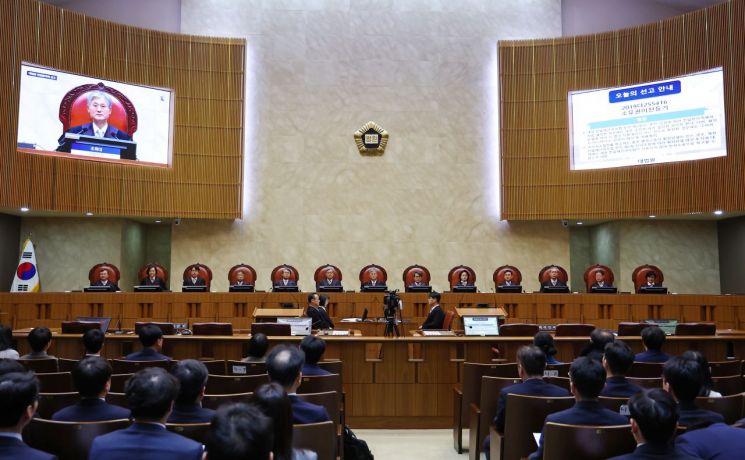 Chief Justice Cho Hee-dae and other Supreme Court justices entered and took their seats in the Grand Courtroom of the Supreme Court in Seocho-gu, Seoul on the afternoon of the 19th for the plenary session ruling. Photo by Yonhap News
The Supreme Court en banc (Presiding Justice Oh Kyung-mi) ruled on the 19th in the final appeal of a wage claim lawsuit filed by workers or retirees of Hyundai Motor Company and Hanwha Life Insurance against their companies. This changes the previous Supreme Court precedent (December 19, 2013), which took 'fixity' as a conceptual indicator of ordinary wages and excluded bonuses paid on the condition of employment status or working days from ordinary wages.
The Supreme Court stated, "According to the previous precedent, the judgment of ordinary wages was influenced by the concept of fixity without legal basis, and ordinary wage status was easily denied due to the addition of conditions," adding, "The scope of ordinary wages was unjustly narrowed, and lawful compensation for overtime work was not properly provided." It further clarified, "By abolishing the concept of fixity, wages that are regularly and uniformly paid as compensation when a worker fully performs the prescribed work correspond to ordinary wages regardless of the presence or achievability of conditions."
The Supreme Court also stated that, according to the previous precedent, performance bonuses based on 'work performance' generally lack the nature of compensation for prescribed work and therefore still do not qualify as ordinary wages. Only the minimum payment unrelated to work performance is considered compensation for prescribed work according to this ruling.
By excluding 'fixity' as having no legal basis in the concept of ordinary wages, the Supreme Court en banc reestablished a broader concept of ordinary wages. Going forward, companies must calculate employee allowances and severance pay based on this standard.
However, since this ruling fundamentally changes the wage system, the Supreme Court decided to apply it only from the calculation of ordinary wages 'after the date of the ruling,' considering its special nature. Therefore, the interpretation of ordinary wages according to the newly changed legal principle will be applied retroactively only to Hyundai Motor Company, Hanwha Life Insurance, and related parallel cases involved in this matter. The Supreme Court explained, "This measure is intended to preserve the future-oriented purpose of this precedent change while also considering the significant ripple effects and protection of trust under the previous precedent, as well as the rights relief of the parties involved."
© The Asia Business Daily(www.asiae.co.kr). All rights reserved.
![Clutching a Stolen Dior Bag, Saying "I Hate Being Poor but Real"... The Grotesque Con of a "Human Knockoff" [Slate]](https://cwcontent.asiae.co.kr/asiaresize/183/2026021902243444107_1771435474.jpg)















