Milk is an essential food item on our dining table. Especially, domestically produced milk is a representative fresh food. Fresh foods refer to vegetables, fruits, fish, and other foods distributed in a fresh state, and it is no exaggeration to say that the freshness of food determines its quality and is directly linked to safety. Additionally, domestic milk undergoes pasteurization and homogenization processes and is distributed within 2 to 3 days. From milking at the farm to reaching the consumer, the entire process is maintained under refrigeration to provide the best freshness.
Recently, the '2024 Food Consumption Behavior Survey Results Presentation' by the Korea Rural Economic Institute, particularly the 'Dietary Behavior and Food Policy' data, is worth noting. The score given by Korean consumers for food safety was 80.9 out of 100 points, showing a continuous increase. Especially, in the safety evaluation of domestic and imported foods, domestic foods scored 78 points while imported foods scored 57 points, indicating that the safety evaluation score for domestic foods was relatively higher.
In the comparison of willingness to pay between domestic agricultural and imported general agricultural products, for five major food categories (agricultural products, seafood, livestock products, processed foods, and dining out (ingredients)), when the price of domestic agricultural products is set at 100, the willingness to pay for imported general agricultural products ranged from 88.1 to 89.1. This shows that consumers have a higher preference and trust for domestic agricultural products.
Domestic milk is produced under strict quality control throughout the year, guaranteeing not only freshness and safety but also excellent quality. This is supported by the '2024 First Half Raw Milk Inspection Results,' which compiles and reports milk collection performance and raw milk inspection results by city and province every half year for use as national statistics.
Looking at the hygiene grades of raw milk collected in the first half of 2024, the proportion of somatic cell count grade 1 was 71.88%, an increase of 0.75% compared to the previous year, and the proportion of bacterial count grade 1 was 99.62%, maintaining excellent figures as in the previous year. In particular, analyzing the somatic cell count grades of raw milk over the past three years showed steady improvement: 67.90% in the first half of 2022, 71.13% in the first half of 2023, and 71.88% in the first half of 2024.
Meanwhile, according to the raw milk hygiene grade standards announced by the Ministry of Food and Drug Safety, the bacterial count 1A grade requires fewer than 30,000 bacteria per 1ml of raw milk, and the somatic cell count grade 1 requires fewer than 200,000 cells. This is at the same level as advanced dairy countries like Denmark and stricter than Germany (bacterial count 100,000 or less, somatic cell count 400,000 or less) and France (bacterial count 50,000 or less, somatic cell count 200,000 or less).
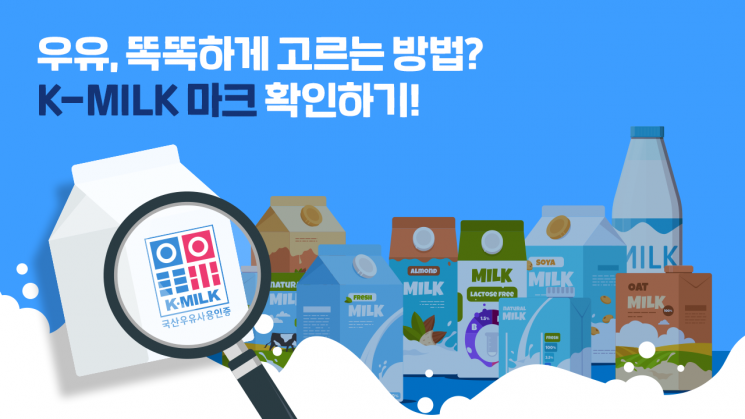
Therefore, to purchase good milk, it is advisable to check the ingredient names and content information indicated on the milk packaging or look for the K-MILK mark, a certification mark for the use of domestic milk. This mark guarantees that the product uses fresh and safe domestic milk.
© The Asia Business Daily(www.asiae.co.kr). All rights reserved.
![Clutching a Stolen Dior Bag, Saying "I Hate Being Poor but Real"... The Grotesque Con of a "Human Knockoff" [Slate]](https://cwcontent.asiae.co.kr/asiaresize/183/2026021902243444107_1771435474.jpg)















