Statistics Korea 'Social Trends in Korea 2024'
Increasing Trend of 20-40s Without Marriage Experience
Men Surpass Women in Unmarried Rate
The proportion of never-married singles is increasing. One in four men in their 40s was unmarried, and the unmarried rate rose sharply. Half of men in their 30s were found to be unmarried.
According to the "Social Trends in Korea 2024" released by Statistics Korea on the 19th, the proportion of never-married singles aged 20 to 40 who have never experienced marriage has continuously increased over the past 20 years since 2000. In particular, the unmarried rate of men in their 40s rose rapidly. In 2020, the unmarried rate of men in their 40s was 23.6%. The unmarried rate of women in the same age group was 11.9%, about half that of men. The increase in the unmarried rate was also steeper for men in their 40s at 6.7 times compared to women at 5.7 times.
 One in four men in their 40s was unmarried, and the unmarried rate also rose sharply. Half of men in their 30s were found to be unmarried. Getty Images
In other age groups as well, the unmarried rate of men surpassed that of women. Half (50.5%) of men in their 30s were unmarried, exceeding the 32.8% unmarried rate of women in their 30s. The unmarried rate of men in their 20s was 95.1%, with the vast majority not married. This rate steadily increased from 79.7% in 2020. However, the rise in unmarried rates among those in their 20s and 30s is seen as a phenomenon caused by delayed marriage timing and should be distinguished from 'lifetime unmarried' after the 40s, when marriage becomes practically difficult.
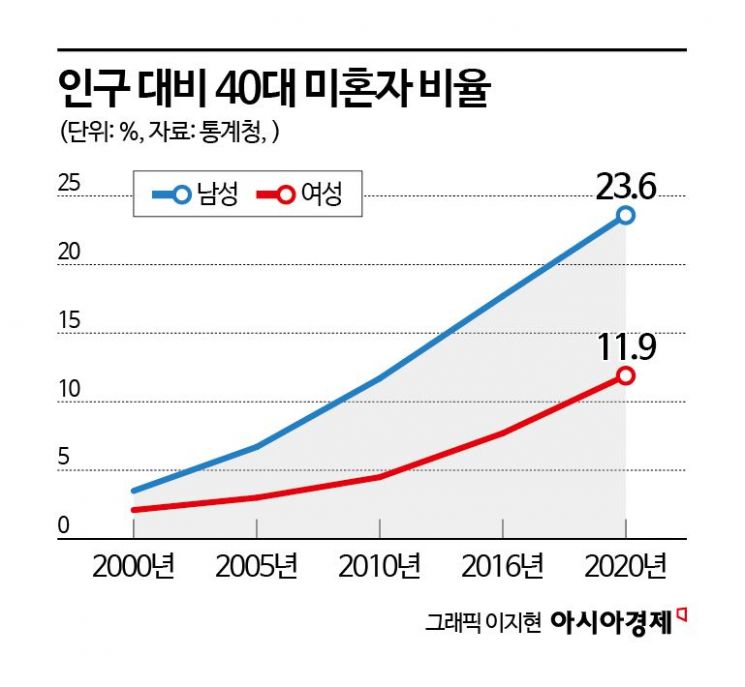
Differences by gender also appeared in education and values. Unmarried men showed lower rates of college graduation and employment compared to married men. Conversely, unmarried women had higher rates of college graduation and employment. The gap in college graduation rates was most pronounced in the 40s for both men and women. This means that as age increases, men with lower education and women with higher education find it more difficult to marry.
Among never-married individuals aged 19 to 34, the proportion who believed "one should get married" was lower than that of those with spouses. The positive attitude toward marriage gradually decreased from the 20s to the 40s. Never-married individuals aged 19 to 34 showed positive attitudes toward non-traditional family forms and sharing household chores. Those in their 40s who were unmarried showed more positive attitudes toward cohabitation without marriage or not having children.
The intention to marry was around 80% for men aged 19 to 34, higher than the 70% range for women. Regardless of gender, better economic status, higher education level, and better subjective health status were associated with stronger intentions to marry. Never-married individuals with marriage intentions reported higher life satisfaction and happiness indicators than those without such intentions.
© The Asia Business Daily(www.asiae.co.kr). All rights reserved.
![Clutching a Stolen Dior Bag, Saying "I Hate Being Poor but Real"... The Grotesque Con of a "Human Knockoff" [Slate]](https://cwcontent.asiae.co.kr/asiaresize/183/2026021902243444107_1771435474.jpg)
















