The conflict between the ruling and opposition parties over the appointment of the three vacant National Assembly-recommended Constitutional Court justices is intensifying. The Democratic Party of Korea insists that the appointment process should be completed promptly to accelerate the impeachment issue. On the other hand, the ruling party declared its absence from the confirmation hearings, arguing that the National Assembly, which initiated the presidential impeachment, recommending justices undermines fairness and thus follows a policy of 'non-appointment.'
Park Chan-dae, the floor leader of the Democratic Party, warned at the policy coordination meeting held at the National Assembly on the 19th, saying, "The People Power Party is refusing both the National Assembly's impeachment session and the Special Committee on the Confirmation Hearing for Constitutional Court Justices (Confirmation Special Committee)." He added, "If the ongoing unrest by the remnants of the co-conspirators of the chief instigator of the rebellion is not swiftly suppressed, it will cause fatal damage to the economy, diplomacy, and security."
The reason Park has been raising the tone of his remarks day after day is due to concerns that the appointment process for the National Assembly's share of Constitutional Court justices may be delayed more than expected. The longer the impeachment trial is delayed, the greater the likelihood that the judicial risks of Lee Jae-myung, the Democratic Party leader, will surface before the early presidential election. Conversely, the ruling party's strategy is to delay the impeachment trial as much as possible to highlight Lee's judicial risks, thereby preparing for the presidential election more advantageously.
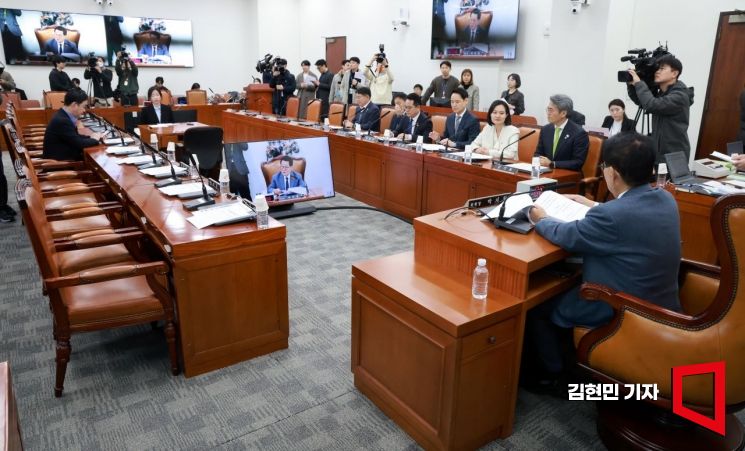 On the 18th, Park Ji-won, the chairman, is speaking at the Special Committee on Personnel Hearings for the Election of Constitutional Court Justices held at the National Assembly. Ruling party lawmakers were absent from this meeting. Photo by Kim Hyun-min
From the opposition's perspective, whether Acting President and Prime Minister Han Duck-soo consents to the appointments is also a variable. The Democratic Party plans to hold confirmation hearings over two days, on the 23rd and 24th, for the three candidates, centered around Park Ji-won, the chairman of the National Assembly's Confirmation Special Committee, and then process the appointment consent bills in the plenary session as early as the 27th. However, even if the appointment consent bills pass the National Assembly solely by the opposition party, if Acting President Han refuses the appointments, there is no way to enforce them.
The Democratic Party is also considering pushing forward with a 'six-member trial.' In a six-member system, the quorum for decisions can be met, making deliberation and rulings theoretically possible. Kim Jung-won, the Secretary-General of the Constitutional Court, stated at the National Assembly's Legislation and Judiciary Committee that "deliberations are possible with six members." However, this could lead to future controversies over 'legitimacy.' Given the gravity of a presidential dismissal, the ruling party could argue the ruling is unconstitutional.
The longer time is drawn out, the more disadvantageous it is for the opposition. They judge that if Lee's judicial risks expand before the impeachment trial, it will inevitably have a negative impact on the presidential election campaign. Lee is currently facing a first trial for violating the Public Official Election Act, where he was sentenced to 'disqualification from candidacy (1 year imprisonment, 2 years probation),' and is awaiting the second trial. However, the Seoul High Court, which is handling the second trial, sent a notice of receipt of litigation records to Lee but reported that it was not delivered due to reasons such as 'no one answering the door.'
© The Asia Business Daily(www.asiae.co.kr). All rights reserved.

















