There has been a call to address the independence and expertise of corporate boards as a key agenda item for boards of directors.
Samil PwC Governance Center recently announced on the 19th that it has published the "2024 Board of Directors Trend Report" containing such content. This report was prepared based on corporate governance reports disclosed by 482 KOSPI-listed companies (non-financial) with total assets exceeding 500 billion KRW as of May this year.
In particular, step-by-step tasks to strengthen the functions of the board were presented, including the establishment of essential policies and procedures for board duties, enhancement of board independence and expertise, and structural efforts to improve governance. According to the report, to perform various roles in a complex management environment, the board must, in the short term, check whether policies and procedures for key board tasks are well established.
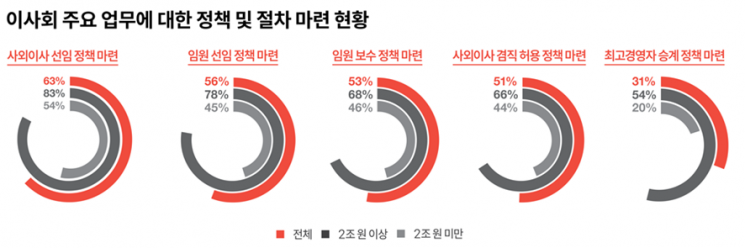
However, a significant number of companies have not established policies and procedures for highly important matters such as the appointment policy for outside directors, executive compensation policy, and policy allowing outside directors to hold concurrent positions. There was also a large disparity depending on the size of the company. In the case of the policy allowing outside directors to hold concurrent positions, only 44% of companies with assets under 2 trillion KRW had established policies and procedures.
The ratio of outside directors, which typically represents board independence, was 59%, remaining at the level required by the Commercial Act. This is much lower compared to the United States (94%) and the United Kingdom (85%). Furthermore, the utilization rate of various systems recommended by governance best practices to ensure board independence was also low. For example, the adoption rates of cumulative voting (3%), executive officer system (2%), and lead outside director system (8%) were all below 10%.
To enhance the transparency and independence of director candidate selection, the current Commercial Act mandates the establishment of an outside director candidate recommendation committee for listed companies with assets of 2 trillion KRW or more. However, most companies appear to comply only at the legal minimum level. The installation rate of director candidate recommendation committees covering both outside and inside directors was 51% overall. The installation rate for companies with assets under 2 trillion KRW was even lower at 31%.
The importance of continuous education to enhance board expertise is also increasing. Job and governance-related education is recommended for new outside directors. The proportion of companies providing education to outside directors was 74%, but there was a significant difference depending on company size (94% for companies with assets over 2 trillion KRW, 64% for those under 2 trillion KRW). Especially, companies under 2 trillion KRW without an audit committee had a low education implementation rate of 51%. The report pointed out that "companies not providing education explain that outside directors already possess sufficient expertise or that they provide materials on board agendas and key issues regularly instead of education, indicating a need for awareness improvement."
Jang On-gyun, head of the Samil PwC Governance Center, emphasized the importance of related policy support, stating, "Amid heated discussions on the current amendment to the Commercial Act, to enhance the effectiveness of the board, various market participants need to engage in multifaceted discussions and build consensus on the purpose, benefits, and practical approaches of the system." The detailed contents of the report can be found on the Samil PwC Governance Center website.
© The Asia Business Daily(www.asiae.co.kr). All rights reserved.
![Clutching a Stolen Dior Bag, Saying "I Hate Being Poor but Real"... The Grotesque Con of a "Human Knockoff" [Slate]](https://cwcontent.asiae.co.kr/asiaresize/183/2026021902243444107_1771435474.jpg)
















