Despite Factors of Decline Such as Impeachment, Loan Regulations, and Economic Recession
Rising Factors Like Supply Shortage and Increasing Housing Market Entrants Grow
Jeonse Prices Nationwide Rise 1.2%...Possibility of Transfer to Sale Price Increase
Housing Permits and Construction Start Down About 30% Compared to Average Years
In 2025, nationwide housing prices are expected to decline by 0.5%, but Seoul is projected to rise by 1.7% and the metropolitan area by 0.8%. It is analyzed that due to factors such as housing supply shortages, interest rate cuts, and rising monthly rent prices, the market will turn bullish from the mid-year onward.
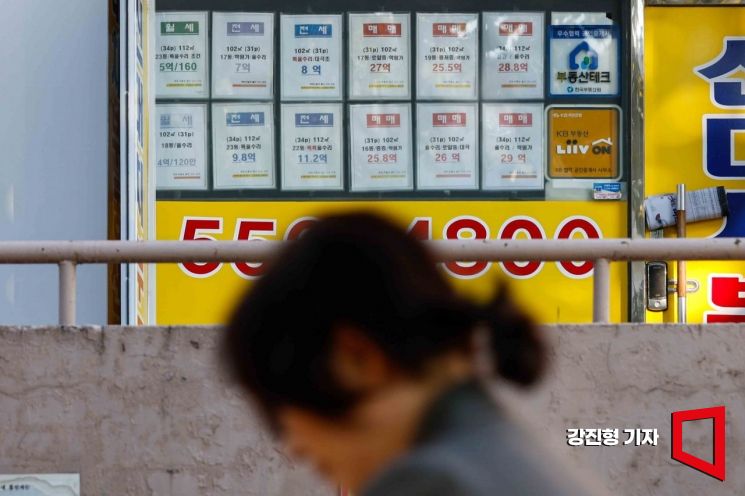 On the 24th, as apartment transactions shrink due to loan regulations and other factors, listings continue to accumulate. A real estate agency in Gangnam, Seoul, has flyers for sale and jeonse listings posted. Photo by Kang Jin-hyung
On the 19th, the Korea Research Institute for Human Settlements held a seminar titled "2025 Housing Market Outlook and Policy Directions" at the Korea Chamber of Commerce and Industry. Despite factors causing housing price declines such as impeachment, economic recession, and strong loan regulations, the institute predicted that due to upward factors like interest rate reductions, an increase in the population entering the housing market, and accumulated supply shortages, prices will rise in the metropolitan area and some major cities.
The institute stated, "The economic recession is expected to accelerate in the first half of the year, and the abnormally high mortgage interest rates and loan regulations are likely to continue until the first half. However, with a sharp increase in the population entering the housing market in their 30s, the possibility of interest rate cuts, and normalization of mortgage loans and project financing, the housing market is likely to return to a thawing mood from the mid-year onward."
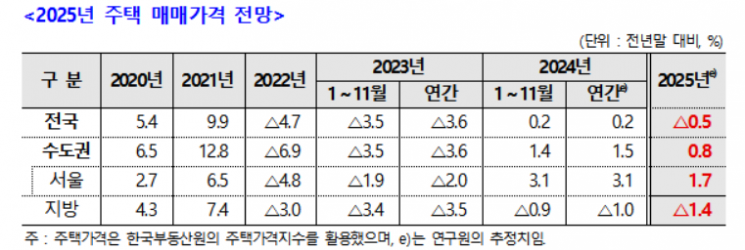
Looking at next year's housing supply status, the number of permits is estimated at 330,000 units, marking a decline for the third consecutive year. From an annual average of 540,000 units between 2017 and 2021, the figures dropped to △522,000 units in 2022 △429,000 units in 2023 △350,000 units in 2024.
Next year's housing starts are estimated at 300,000 units, an increase from the previous year, but supply shortages have accumulated over the past 2-3 years. Housing starts decreased from an annual average of 521,000 units between 2017 and 2021 to △383,000 units in 2022 △242,000 units in 2023 △260,000 units in 2024.
The population reaching age 30, entering the housing market, has increased to 750,000 since last year, which is expected to boost demand for monthly rent and jeonse (long-term lease). The population reaching age 30 is estimated at 735,000 next year. This is a jump from an annual average of 670,000 between 2017 and 2021 to 740,000 between 2022 and 2024.
The government estimates next year's housing demand (3rd Long-term Comprehensive Housing Plan) at 427,200 units nationwide. In contrast, the supply (completed units) is estimated at 318,800 units, resulting in a shortage of about 108,400 units compared to demand.
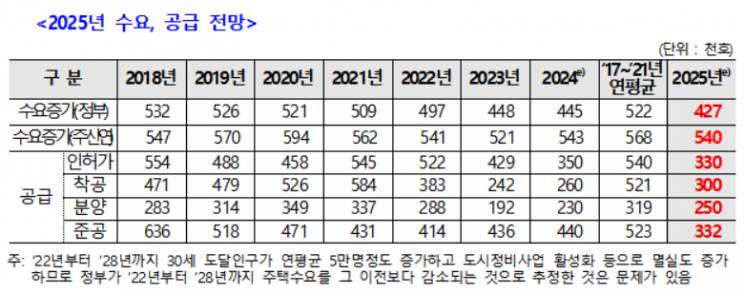
The Korea Research Institute for Human Settlements presented housing price forecasts using a model considering economic growth rate, housing supply-demand index, and interest rate changes. Compared to the previous year, Seoul is expected to rise by 1.7%, the metropolitan area by 0.8%, but non-metropolitan areas will decline by 1.4%, resulting in a nationwide housing price drop of 0.5%.
The institute noted, "Although many media reports suggested that the impeachment process would negatively impact housing prices in the first half of next year, during President Roh Moo-hyun's time, there was almost no effect, and during President Park Geun-hye's time, the price increase slowed for 2-3 months but soon recovered."
Next year's housing transaction volume is expected to be around 630,000 units, similar to this year. The institute explained, "This volume corresponds to about 3.1% of the total housing stock. Considering that during normal trading periods without overheating or recession, the volume was around 900,000 units or 4-5%, this year's and next year's transaction volumes are about 70% of the normal trading period."
Jeonse prices next year are projected to rise by 1.2% nationwide, 1.9% in the metropolitan area, 1.7% in Seoul, and 0.1% in provincial areas. It is analyzed that the rise in jeonse prices is likely to drive up housing prices.
With a significant decrease in apartment and non-apartment move-in volumes, the upward trend in monthly rent and jeonse prices due to supply shortages is expected to continue. The institute also forecasts that monthly rent prices will maintain an upward trend due to sustained low move-in volumes.
Next year's apartment move-in volume is estimated at 266,022 units nationwide, about 100,000 units fewer than this year's 363,921 units. Compared to the 10-year average (2014-2023) of 350,724 units, it is also about 90,000 units less. By region, Seoul has 35,915 units, the metropolitan area (including Seoul) 128,224 units, and provincial areas 137,798 units.
The institute analyzed that since the inauguration of the Yoon Suk-yeol administration, a supply shortage of more than 500,000 units will accumulate by the end of next year. In the private market, due to the project financing (PF) crisis, procurement interest rates have risen, making it difficult to start housing construction projects. Although the public sector, including LH, is increasing supply, it is insufficient compared to the demand increase of about 450,000 units annually.
Although the government is easing various regulations and expanding public land designations, there are calls to first resolve housing finance-related regulations, which are the core cause of the supply decrease.
The institute stated, "It is essential to prioritize normalizing abnormal housing finance regulations that only increase the burden on actual buyers and shrink supply, and to promptly improve issues such as construction costs, PF tightening, and excessive donation requirements that greatly suppress private supply. The focus should be on shortening the public land development procedures so that housing supply in the 3rd new towns can be realized as soon as possible."
© The Asia Business Daily(www.asiae.co.kr). All rights reserved.



















