Trump Continues Remarks on Canada Annexation
Calls It "51st State" and "Governor Trudeau" on SNS
Cabinet Conflict in Canada Over 25% Tariff Responsibility
President-elect of the United States, Donald Trump, has continuously expressed the idea that Canada should be incorporated into the United States. On the 18th (local time), Trump posted on the social networking service (SNS) Truth Social, "Why can no one answer why the U.S. provides over $100 million in subsidies annually to Canada? It makes no sense," and claimed, "Many Canadians want Canada to become the 51st state of the U.S." He added, "They could save significantly on taxes and military protection costs. I think it's a great idea," followed by "51st state!"
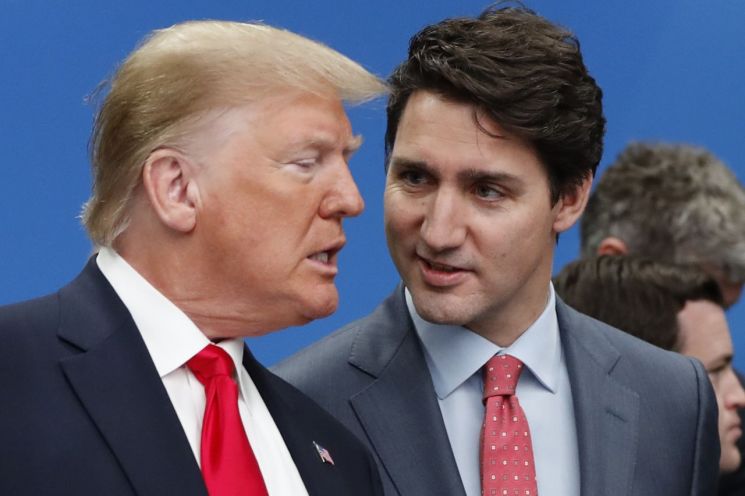 In 2019, U.S. President Donald Trump (left) and Canadian Prime Minister Justin Trudeau are having a conversation. Photo by AP
President-elect Trump has been making daily claims that Canada should be incorporated as the 51st state of the United States. On the 10th, he also wrote on Truth Social, "I was pleased to have dinner recently with Governor Trudeau of Canada." This referred to his meeting with Canadian Prime Minister Justin Trudeau on the 30th of last month, but he referred to the head of a country as a governor.
He also criticized former Canadian Deputy Prime Minister and Minister of Finance Chrystia Freeland, writing, "Canada was shocked when the Minister of Finance under Governor Justin resigned or was dismissed." Referring to Prime Minister Trudeau as 'Governor' is not a simple mistake but can be seen in the same context as his claim that Canada should become the 51st state of the U.S.
Earlier, on the 25th of last month, Trump stated, "Crime and drugs are entering the U.S. through Mexico and Canada," and declared, "I will impose a 25% tariff on all products imported from the two countries until the problem is resolved." In response to this, Freeland, who had clashed with Prime Minister Trudeau over retaliatory measures, resigned on the 17th, causing turmoil.
Due to the U.S. tariff threat and cabinet conflicts, the value of the Canadian dollar has fallen to its lowest level since the early days of the COVID-19 pandemic. According to Bloomberg News, on the 17th, the Canadian dollar dropped 0.5% to 1.43 Canadian dollars per U.S. dollar. This is the lowest since March 2020, when the COVID-19 pandemic began. Douglas Porter, Chief Economist at the Bank of Montreal, told the news agency, "There are concerns that the (Canadian) currency will remain somewhat weak until the tariff front eases or economic news emerges that helps support the currency."
© The Asia Business Daily(www.asiae.co.kr). All rights reserved.

















