Improved Accessibility to Seoul... Yeoncheon’s Premier Paleolithic Festival Achieves Record Success
Increased Sales in Food and Lodging Businesses... More Visitors at Yeoncheon and Jeongok Stations
Yeoncheon-gun, the northernmost county of Gyeonggi Province, marks the first anniversary of the opening of Seoul Metropolitan Subway Line 1. With the subway opening, public transportation usage has become more active, and the number of visitors to Yeoncheon has increased, revitalizing the local economy. Along with raising Yeoncheon’s domestic and international recognition, tourists are flocking to local attractions such as Jaein Waterfall, Paleolithic sites, Horogoru Fortress, and Hantan River Camping Site. The “Roofless Museum” Yeoncheon-gun has emerged beyond a border area into a tourism city where pristine nature breathes life. Yeoncheon-gun is making every effort to develop tourism resources and expand infrastructure, aiming to increase the resident population by leveraging Line 1 as a catalyst.
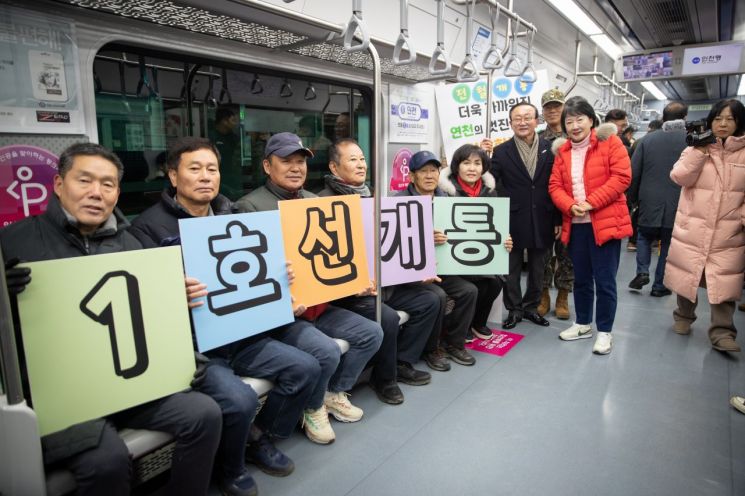 Kim Deok-hyun, the governor of Yeoncheon County, participated in the event of boarding the first train bound for Incheon on Line 1 Gyeongwon Line with the residents of Yeoncheon County on the 16th. Photo by Yeoncheon County
According to Yeoncheon-gun on the 18th, from January to October, the total number of users at Yeoncheon Station, Jeongok Station, and Cheongsan Station was recorded at 1,631,068.
Yeoncheon Station had the highest number of users at 821,560, followed by Jeongok Station with 724,413. Cheongsan Station was used by 85,096 people. The average daily users were 2,823 at Yeoncheon Station, 2,489 at Jeongok Station, and 292 at Cheongsan Station. Analysis of the three stations in Yeoncheon-gun showed that Yeoncheon Station (7,829 residents) had more users than Jeongok Station (17,617 residents), which has a larger population.
Regarding the length of stay of visitors to Yeoncheon, it was found that they stayed an average of 4 hours, ranging from 2 to 6 hours. With the subway opening increasing the number of visitors, the local economy is also positively impacted. From January to October this year, 1,739,425 tourists visited Yeoncheon, an increase of 77,006 compared to 1,662,419 during the same period last year. Sales in commercial districts of nine towns and townships, including Yeoncheon-eup and Jeongok-eup, also increased.
In particular, Yeoncheon-eup enjoyed a 13.39% increase compared to before the opening, fully benefiting from being the terminal station. Yeoncheon-eup (Chatan-ri) recorded sales of 9.1 billion KRW from December 2022 to July 2023 before the subway opened, but sales rose to 10.3 billion KRW after the subway opening, an increase of 1.2 billion KRW. During the same period, sales in Jeongok-eup also increased by 2.37%, from 35.9 billion KRW to 36.7 billion KRW. Cheongsan-myeon saw a 9.72% increase, from 16 billion KRW to 17.5 billion KRW.
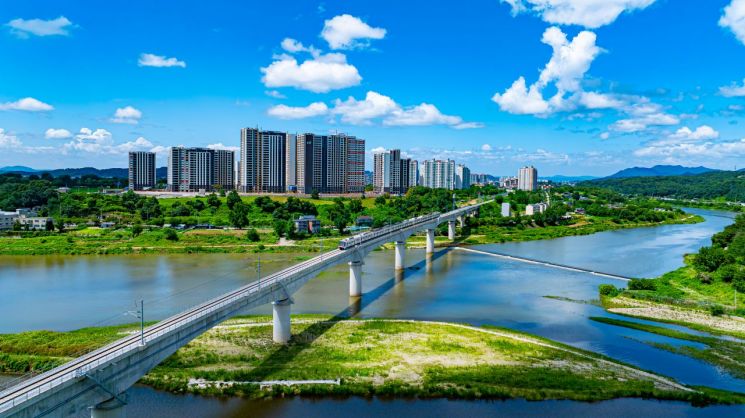 A train on Seoul Metropolitan Subway Line 1 is passing over the Hantan River Railroad Bridge. Photo by Yeoncheon-gun
The increase in sales around subway stations is seen as a positive outcome of the subway opening, attributed to the rise in floating population, and is analyzed to have helped revitalize the local economy through increased sales of local shops.
Various festivals representing Yeoncheon-gun, such as the Paleolithic Festival and Yulmu Festival, also recorded record-breaking success. The 31st Paleolithic Festival, held for the first time after the subway opening, sold 55,308 tickets, a 240% increase compared to 22,979 tickets in 2023. Income from admission and experience fees also rose by 222% compared to 2023. Before the subway opening, a significant number of visitors used cars (private vehicles) to attend the festival, but after the opening of Line 1, public transportation usage increased from 2.6% to 16.9%. The 6th Goryeo Ginseng Festival held in October this year also succeeded with record-high sales.
The Goryeo Ginseng Festival, previously held at the Jeongok-ri archaeological site, was held for the first time this year at Yeoncheon Station Plaza to coincide with the subway opening. Improved accessibility for visitors increased festival participation, and sales reached 295 million KRW, a record high. Additionally, the number of visitors to the Imjingang Dapsari Garden in Jung-myeon reached 201,928, a 22% increase compared to 164,000 visitors last year. With the subway opening, the Imjingang Dapsari Garden in Jung-myeon has firmly established itself as a representative local tourist attraction, and the “World Peace Garden Project” is underway.
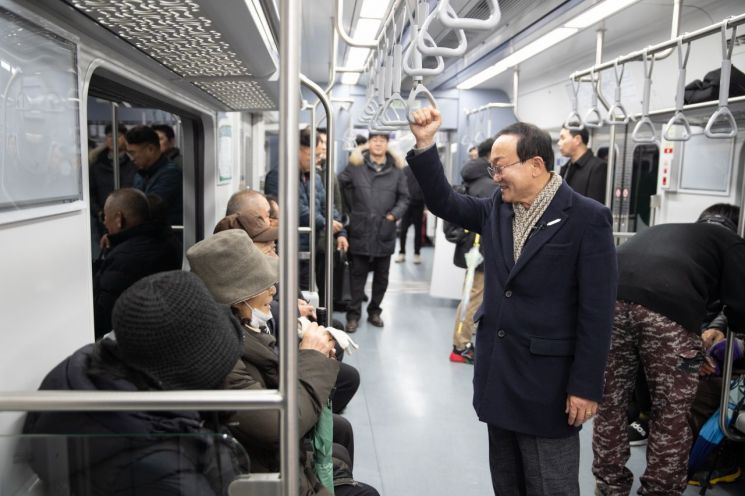 Kim Deok-hyun, the governor of Yeoncheon County, boarded the first train bound for Incheon on Line 1 Gyeongwon Line on the 16th and talked with residents of Yeoncheon County. Photo by Yeoncheon County
The resident population within the region is also on the rise. From January to June this year, the total resident population in Yeoncheon was recorded at 1,513,607. The monthly figures show a steady increase: 186,857 in January, 224,897 in February, 242,715 in March, 267,712 in April, 304,642 in May, and 286,784 in June. Yeoncheon-gun plans to expand transportation networks such as operating shuttle buses connecting subway stations and major tourist sites and develop customized content considering various users.
Yeoncheon-gun is the only designated Second Home special zone among the 31 cities and counties in Gyeonggi Province. The Second Home policy allows a one-household-one-home resident in the metropolitan area to acquire an additional house in Yeoncheon-gun while still being recognized as a “one-household-one-home” owner, providing tax benefits on capital gains tax, comprehensive real estate tax, property tax, and more. Yeoncheon is gaining attention as the optimal area for Second Homes due to its proximity to Seoul and connection via Seoul Metropolitan Subway Line 1.
In line with this, Yeoncheon-gun plans to actively promote various population inflow policies and increase the settled population, focusing on middle-aged and older adults approaching retirement. Alongside this, the county aims to build tourism infrastructure linking sightseeing, dining, and entertainment to revitalize the local economy and establish Yeoncheon as a UNESCO dual-heritage cultural and tourism city.
Kim Deok-hyun, Mayor of Yeoncheon-gun, said, “We expect the influx of tourists, which is key to increasing the resident population, to continue rising due to the subway opening. We plan to actively implement population inflow policies that can maximize the effect of population inflow and focus on increasing both the resident and settled populations.”
Mayor Kim added, “Leveraging Seoul Metropolitan Subway Line 1 as a catalyst, we will accelerate the implementation of major projects for Yeoncheon’s sustainable development.”
© The Asia Business Daily(www.asiae.co.kr). All rights reserved.
![Clutching a Stolen Dior Bag, Saying "I Hate Being Poor but Real"... The Grotesque Con of a "Human Knockoff" [Slate]](https://cwcontent.asiae.co.kr/asiaresize/183/2026021902243444107_1771435474.jpg)

















