Veto Expected on Six Bills Including Grain Management Act
Government "Reviewing Until the End... Decision According to Law"
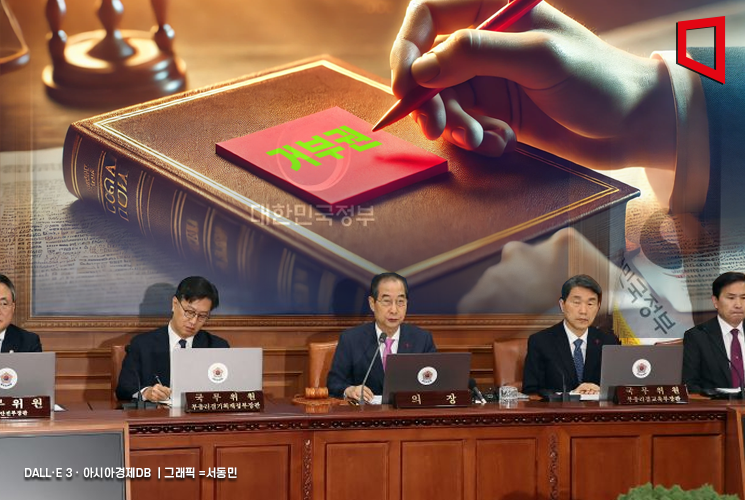
The government will hold an extraordinary Cabinet meeting on the morning of the 19th, presided over by Acting President and Prime Minister Han Deok-su. The meeting will decide whether to exercise the veto power on six contentious bills passed by the opposition-led National Assembly, including the Grain Management Act.
According to the Prime Minister's Office on the 18th, the government will convene the extraordinary Cabinet meeting at 10 a.m. on the 19th at the Government Seoul Office.
At the extraordinary Cabinet meeting, the government plans to review whether to exercise veto power on the four agricultural laws?the Grain Management Act, the Agricultural and Fishery Products Price Stabilization Act, the Agricultural and Fishery Disaster Countermeasures Act, and the Agricultural and Fishery Disaster Insurance Act?as well as the National Assembly Testimony and Inspection Act and the National Assembly Act amendments.
The deadline to exercise veto power on these bills is the 21st.
Acting President Han is highly likely to exercise veto power on the six bills, including the Grain Management Act, on that day.
A senior official from the Prime Minister's Office said, "There is a perception that it is inappropriate to suddenly change the stance when the relevant ministries, such as the Ministry of Agriculture, Food and Rural Affairs, have opposed these bills until now."
The four agricultural laws, including the Grain Management Act, stipulate that the government must compulsorily purchase surplus rice and pay the difference if the grain market price falls below the average of previous years. However, the Ministry of Agriculture, Food and Rural Affairs has opposed these laws, citing enormous fiscal burdens and the risk of oversupply of specific crops.
Additionally, the amendment to the National Assembly Testimony and Inspection Act mainly prohibits individuals or companies from refusing to submit materials requested by the National Assembly on the grounds of personal information or trade secret protection, which faces strong opposition from the business community. The amendment to the National Assembly Act, which abolishes the automatic referral system for supplementary budget bills (tax law amendments), is opposed by the Ministry of Economy and Finance.
If Acting President Han exercises veto power, it is expected that impeachment pressure from opposition parties such as the Democratic Party will increase.
Hwang Jeong-ah, spokesperson for the Democratic Party, said after the party's Supreme Council meeting on the same day, "Exercising veto power on the six bills, including the Grain Management Act, is an abuse of authority," adding, "He must choose whether to remain a co-conspirator in a rebellion or to serve as a public servant of the people."
In response, a senior official from the Prime Minister's Office told reporters on the same day, "We will review (whether to exercise veto power on the six bills) until the last moment," and added, "We will make a final decision based on the Constitution, laws, the future of the country, and the perspective of the people."
Regarding speculation that the Democratic Party may initiate impeachment if Acting President Han exercises veto power, the official said, "We will make a judgment according to the Constitution and laws."
© The Asia Business Daily(www.asiae.co.kr). All rights reserved.
![Clutching a Stolen Dior Bag, Saying "I Hate Being Poor but Real"... The Grotesque Con of a "Human Knockoff" [Slate]](https://cwcontent.asiae.co.kr/asiaresize/183/2026021902243444107_1771435474.jpg)















