First National Assembly Political Affairs Committee Inquiry Since Martial Law Incident
Kim Byunghwan: "Economic Situation Different from Past Impeachment"
Lee Bokhyun: "Urgent Resolution Needed for National Governance Issues"
Swift Preparation and Announcement of Support Measures for Small Business Owners and Self-Employed
Kim Byung-hwan, Chairman of the Financial Services Commission, and Lee Bok-hyun, Governor of the Financial Supervisory Service, revealed that they learned about President Yoon Seok-yeol's plan to declare martial law only after the fact, and that the specific details were conveyed through Deputy Prime Minister and Minister of Economy and Finance Choi Sang-mok. Regarding the economic situation, which is becoming increasingly uncertain amid the martial law incident followed by the impeachment political turmoil, they stated that it is different from past impeachment situations and that the country’s 'governance' issues need to be resolved swiftly. They also announced plans to promptly prepare and announce measures to support small business owners and vulnerable groups who are facing increased difficulties due to the aftermath of the martial law incident.
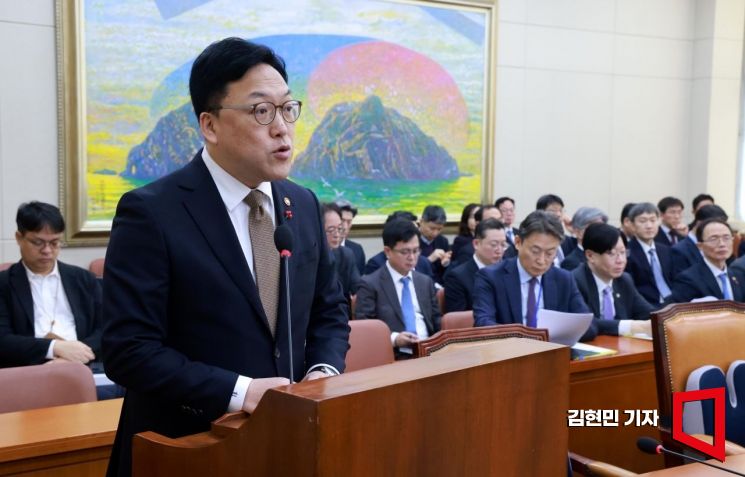 Financial Services Commission Chairman Kim Byung-hwan is giving an urgent briefing on current issues at the National Assembly's Political Affairs Committee on the 18th. Photo by Kim Hyun-min
Kim, the head of the financial market control tower, and Lee appeared on the 18th at the National Assembly’s Political Affairs Committee’s urgent inquiry session, held for the first time after the martial law incident, to explain and convey their positions to lawmakers from both ruling and opposition parties.
When asked by lawmakers from both sides when he learned about the declaration of martial law, Chairman Kim said, "I found out from the broadcast," and stated that he was "not notified to attend" the Cabinet meeting held just before the martial law declaration.
He added, "Since it was an unexpected measure, I was very surprised and was primarily concerned about the market," and explained, "I was informed around 10:50 p.m., right after seeing the news, that an emergency macroeconomic and financial issue meeting (F4 meeting) would be held. I drove from my home near Yeonhui-dong to attend."
The F4 meeting held at 11:40 p.m. on the 3rd at the Bankers’ Hall in Jung-gu, Seoul, was attended by Deputy Prime Minister and Minister of Economy and Finance Choi Sang-mok, Financial Services Commission Chairman Kim Byung-hwan, Financial Supervisory Service Governor Lee Bok-hyun, and Bank of Korea Governor Lee Chang-yong.
Lee, who has been considered one of President Yoon’s closest aides, stated, "Looking back, I think something that should never have happened did occur." Regarding the timing of learning about the martial law declaration, he said, "Around 11 p.m. on the 3rd." As for how he came to know about it, he recalled, "I’m not exactly sure, but I remember Deputy Prime Minister Choi convened the financial team around 11:30 p.m. I had personal matters at home, so I couldn’t be contacted directly. The secretarial team took action first, and I went to the meeting venue by company car."
He further explained, "All four of us who attended the F4 meeting either learned from the media or became aware of the situation around 11 p.m. on the 3rd. Deputy Prime Minister Choi didn’t know what it was either and was dragged into the Cabinet meeting. When the topic of martial law came up, he stormed out, thinking that market stabilization measures were necessary, and called the financial heads."
"Economic Situation Different from Past Impeachments... Swift Resolution of National Governance Issues Needed"
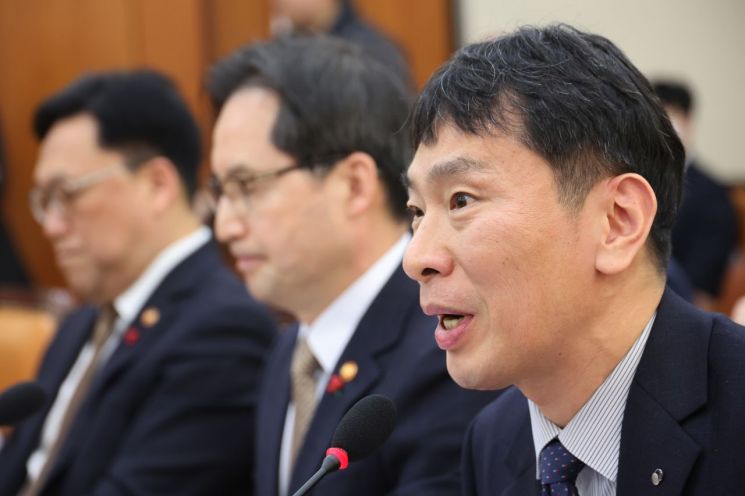
Both leaders expressed that the current economic situation, following the martial law incident and leading into the impeachment political turmoil, is challenging and must be resolved quickly according to the procedures set by the constitution and laws.
In response to a question from Kang Hoon-sik, a member of the Democratic Party of Korea, about how the current situation differs from the two previous impeachment phases, Chairman Kim explained, "In 2004 (during former President Roh Moo-hyun’s impeachment), the external conditions were favorable due to China’s situation, and in 2016 (during former President Park Geun-hye’s impeachment), the semiconductor cycle was good. Considering external influences, there are risks like the Trump risk now, so the current situation is not easy," highlighting the difficulties of the current economic environment.
Kang also pointed out the seriousness of the current situation, noting that "during former President Park Geun-hye’s impeachment, uncertainty was actually removed, and indicators rose." He expressed concern about the worsening investment and consumer sentiment, as well as structural problems in the semiconductor industry caused by the U.S. CHIPS Act and the Inflation Reduction Act (IRA), making it difficult to have a positive outlook.
Chairman Kim acknowledged, "It is true that the current situation is not easy," but added, "Foreign investors are watching how Korea overcomes these processes." He emphasized, "Short-term market stabilization is possible, but management of the fundamental aspects is important." Governor Lee also responded to the point that the impeachment turmoil is increasing economic uncertainty by saying, "If national governance issues are resolved quickly, the economy and financial markets will stabilize somewhat."
They said that support measures for small business owners and self-employed people, who are facing increased difficulties due to the martial law aftermath, will be announced within this month. Chairman Kim, responding to a question from Han Chang-min of the Social Democratic Party about whether there are countermeasures for the struggling livelihood economy, said, "We are negotiating with the banking sector to ease burdens and will announce the measures this month." Regarding the sharp rise in default rates on Sunshine Loans, he said, "We are preparing next year’s work plan and are devising measures to supplement it."
Questions Raised About Financial Supervisory Service Governor’s Actions on Martial Law Day... Appropriateness of Large-Scale Department Head Personnel Changes Amid National Turmoil Also Criticized
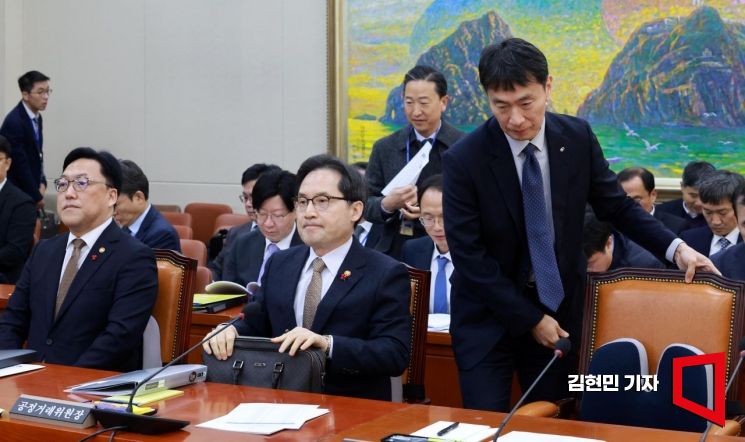 Lee Bok-hyun, Governor of the Financial Supervisory Service, is attending an emergency inquiry on financial authorities held by the National Assembly's Political Affairs Committee on the 18th. Photo by Kim Hyun-min
Criticism also continued regarding Governor Lee’s actions on the day martial law was declared and the large-scale personnel reshuffle carried out amid national turmoil. Governor Lee left work early on the 3rd, the day martial law was declared, due to personal reasons.
In response to questions from Min Byung-duk of the Democratic Party and Yoo Young-ha of the People Power Party about the reason for leaving early, he explained, "I left early around 3 to 4 p.m. due to personal reasons. I had moved the day before, and my wife was very ill." Regarding allegations that he met a prominent ruling party figure on the day of martial law, he denied, saying, "I did not meet anyone."
He defended the large-scale personnel reshuffle of department heads at the director-general level and above, carried out amid the national turmoil, as an appropriate measure.
When Kim Hyun-jung of the Democratic Party pointed out that the Financial Supervisory Service decided on a large-scale personnel reshuffle amid significant political and economic turmoil following the martial law incident, Lee explained, "There are nine deputy governor positions, but four were vacant. There was continuity by promoting team leaders in charge of the relevant tasks to director positions."
Governor Lee also emphasized that he took preemptive personnel measures due to concerns about a leadership vacuum in the financial authorities with only six months left in his term. He said, "After my term expires in June next year, it will take until September or October next year for the financial authorities’ leadership to be set up. Until then, for the next 10 months, I placed appropriate personnel to manage the market. If I had not taken personnel measures, we would have just watched the market for the next 10 months."
Earlier, on the 10th, the Financial Supervisory Service conducted a large-scale reshuffle of department head positions. Among 75 department head positions in headquarters and support departments, 74 (91.4%) were reassigned through transfers and promotions. Notably, more than half of the headquarters department heads were newly promoted.
© The Asia Business Daily(www.asiae.co.kr). All rights reserved.
![Clutching a Stolen Dior Bag, Saying "I Hate Being Poor but Real"... The Grotesque Con of a "Human Knockoff" [Slate]](https://cwcontent.asiae.co.kr/asiaresize/183/2026021902243444107_1771435474.jpg)

















