Debate Over 9-Member System... "For Reliability of Impeachment Trial Results"
Key Issue Is Lee Jae-myung's Judicial Risk... Three Trials to Be Concluded Within 6 Months
The ruling and opposition parties continue their tense standoff over the appointment of constitutional court justices allocated to the National Assembly. While the ruling party insists that no additional justices should be appointed under the acting presidential authority system, the opposition party intends to quickly form a full panel of nine justices to conduct the impeachment trial of President Yoon Seok-yeol.
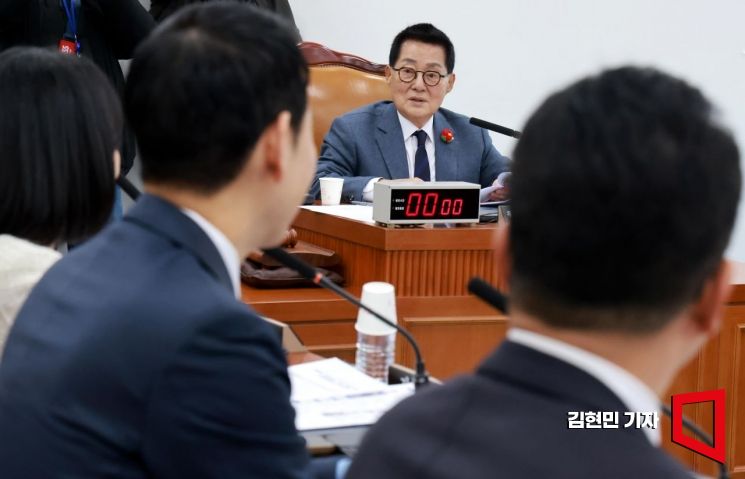 On the 18th, Park Ji-won, the chairman, is speaking at the special committee for the Constitutional Court justice confirmation hearing held at the National Assembly. Ruling party lawmakers were absent from this meeting. Photo by Kim Hyun-min
On the 18th, the Democratic Party of Korea held a solo session of the Special Committee on the Confirmation Hearing for Constitutional Court Justices (Confirmation Special Committee) at the National Assembly in Yeouido, Seoul. The Democratic Party appointed Representative Park Ji-won as the chairperson of the Confirmation Special Committee, expressing their determination to complete the appointment process within this month. According to Article 47 of the National Assembly Act, the Confirmation Special Committee shall have one chairperson, but until one is appointed, the eldest member among the committee members acts as chairperson. Representative Park, aged 82 this year, is the eldest among the 22nd National Assembly members. Accordingly, he assumed the chairmanship of the Confirmation Special Committee in accordance with the National Assembly Act.
The People Power Party has announced its intention to abstain from both the Confirmation Special Committee and the confirmation hearings for constitutional court justices. Kwon Seong-dong, acting leader and floor leader of the People Power Party, argued that under the presidential vacancy, Prime Minister Han Deok-soo, acting as president, cannot appoint constitutional court justices. At a party floor meeting the previous day, Kwon stated, "In the past, Hwang Kyo-ahn, acting president and prime minister, appointed constitutional court justices only after the impeachment of former President Park Geun-hye was finally upheld by the Constitutional Court," adding, "Since the president is currently suspended from duty, Han, as acting president, does not have the authority to appoint constitutional court justices until the impeachment trial decision is made."
The ruling and opposition parties also clashed over the appointment of constitutional court justices during a meeting of floor leaders the previous day. Park Sung-jun, Democratic Party’s senior deputy floor leader, told reporters after the meeting, "The Democratic Party intends to hold confirmation hearings for constitutional court justices on the 23rd and 24th," adding, "This is an issue that was also handled with former People Power Party floor leader Choo Kyung-ho and former senior deputy floor leader Bae Jun-young." On the other hand, Park Hyung-soo, senior deputy floor leader of the People Power Party, said, "The basic position of the People Power Party is that the acting president cannot appoint constitutional court justices," and criticized, "We suspect that the Democratic Party is trying to add two more justices they recommended to gain an advantage in the vote for President Yoon’s impeachment trial."
On the surface, the ruling and opposition parties appear to be arguing over the formation of a nine-member Constitutional Court. The opposition claims that a nine-member panel is necessary to ensure the credibility of the impeachment trial verdict against President Yoon, while the ruling party insists that a six-member panel is sufficient.
However, both parties seem to be calculating based on the possibility of an early presidential election. In the case of the Public Official Election Act, under which Democratic Party leader Lee Jae-myung received a sentence that disqualifies him from candidacy, the law requires that the second and third trials be conducted within six months after the first trial’s verdict. The ruling party wants the third trial to proceed quickly so that Lee’s disqualification is finalized before an early presidential election is held. They expect the sentence from the first trial to be upheld in the third trial as well. The People Power Party held a party meeting on the 16th and adopted a resolution stating that the verdict for Lee’s second trial under the Public Official Election Act should be delivered before February 15 next year. The Democratic Party appears to hope for an election earlier than the third trial verdict. Lee himself avoided answering questions about judicial risks at a press conference on the 15th, saying, "It is inappropriate to talk about that."
The Constitutional Court has expressed the position that the nine-member panel should be formed as soon as possible. Kim Jeong-won, Secretary General of the Constitutional Court, said at the National Assembly’s Legislation and Judiciary Committee plenary session the previous day, "I believe that when a constitutional court justice position becomes vacant, the acting president can exercise the appointment authority for constitutional court justices." Justice Kim Hyung-doo told reporters on his way to work on the 16th, "I expect the nine-member panel to be completed within December."
© The Asia Business Daily(www.asiae.co.kr). All rights reserved.
![Clutching a Stolen Dior Bag, Saying "I Hate Being Poor but Real"... The Grotesque Con of a "Human Knockoff" [Slate]](https://cwcontent.asiae.co.kr/asiaresize/183/2026021902243444107_1771435474.jpg)















