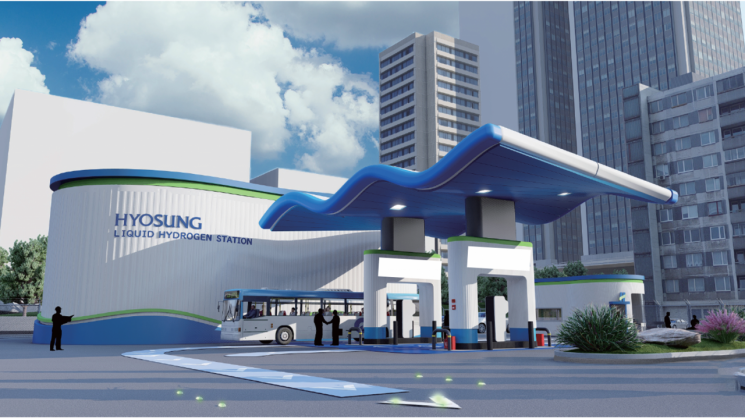
 Selected for the Ministry of Environment's Commercial Vehicle Liquid Hydrogen Refueling Station Construction Project (Bird's-eye View)
The amended High-Pressure Gas Safety Management Act Enforcement Rules (hereinafter referred to as the High-Pressure Act Enforcement Rules), which include provisions such as the relaxation of distance requirements for hydrogen charging stations to support the expansion of urban hydrogen charging stations, will be implemented in May next year. Hydrogen forklifts will also be allowed to charge at hydrogen charging stations. Technical standards for vehicle liquid hydrogen storage systems will be reviewed in the mid to long term.
On the 18th, the Ministry of Trade, Industry and Energy, led by Park Chan-gi, Director of the Hydrogen Economy Policy Division, visited the hydrogen charging station at Seosomun Government Complex in Seoul to inspect hydrogen safety management and listen to on-site feedback from Seoul city officials and related parties. The Seosomun Government Complex hydrogen charging station has been operating since 2022 as the first urban hydrogen charging station that relaxed the distance from protective facilities on the condition of installing additional safety devices through a regulatory sandbox.
After the site visit, the Ministry held a meeting on November 14 with the charging station and mobility industries to explain the amendments to the High-Pressure Act Enforcement Rules and major regulatory innovation cases this year, and to discuss difficulties and suggestions.
The main amendments to the High-Pressure Act Enforcement Rules include ▲relaxation of distance requirements for hydrogen charging stations, and ▲allowing hydrogen mobility such as forklifts to charge at hydrogen charging stations in addition to hydrogen vehicles. The amended enforcement rules allow the reduction of distance from protective facilities and business site boundaries when additional safety devices such as protective walls are installed. Also, hydrogen mobility powered by hydrogen fuel cells (forklifts, excavators, trams, etc.) other than hydrogen vehicles will be allowed to charge.
The amended High-Pressure Act Enforcement Rules will be applied from May 15, 2025.
In addition, the Ministry explained that it improved seven tasks including ▲relaxation of vibration performance evaluation standards for fuel cells used in forklifts and drones, and ▲relaxation of drop performance evaluation standards for drone fuel cells, and plans to review two other tasks later based on demonstration project results.
The Ministry stated that the establishment of standards for the development of vehicle liquid hydrogen storage systems will be reviewed as a mid to long-term task. Currently, there are no liquid hydrogen-related regulations in the Safety Regulations for Automotive Pressure Vessels, which govern automotive fuel pressure vessels, so the establishment of related regulations is necessary to develop vehicle liquid hydrogen storage systems and vehicles equipped with them.
An official from the Ministry said, "Since there are currently no domestic or international standards for liquid hydrogen storage system development, we plan to review this in the mid to long term by referring to demonstration results and international standards trends." The Ministry is conducting a project to develop advanced liquid hydrogen storage systems and demonstration evaluation technologies for hydrogen commercial vehicles from July 2024 to June 2027.
© The Asia Business Daily(www.asiae.co.kr). All rights reserved.
![Clutching a Stolen Dior Bag, Saying "I Hate Being Poor but Real"... The Grotesque Con of a "Human Knockoff" [Slate]](https://cwcontent.asiae.co.kr/asiaresize/183/2026021902243444107_1771435474.jpg)















