Ministry of Agriculture, Food and Rural Affairs Announces 'Agriculture and Rural Innovation Strategy'
Establishing a National Climate Change Response System
Implementing 'Cultivation Area Adjustment System' with a Goal to Reduce Rice Cultivation Area by 80,000ha Starting Next Year
The government will discover new cultivation sites covering 1,000 hectares and conduct pilot projects for production complex development to prevent a recurrence of the summer cabbage crisis. It has also decided to strategically foster new apple cultivation areas such as Gangwon.
The Ministry of Agriculture, Food and Rural Affairs announced the 'Agriculture and Rural Innovation Strategy' containing these details at the Economic Ministers' Meeting held on the 18th.
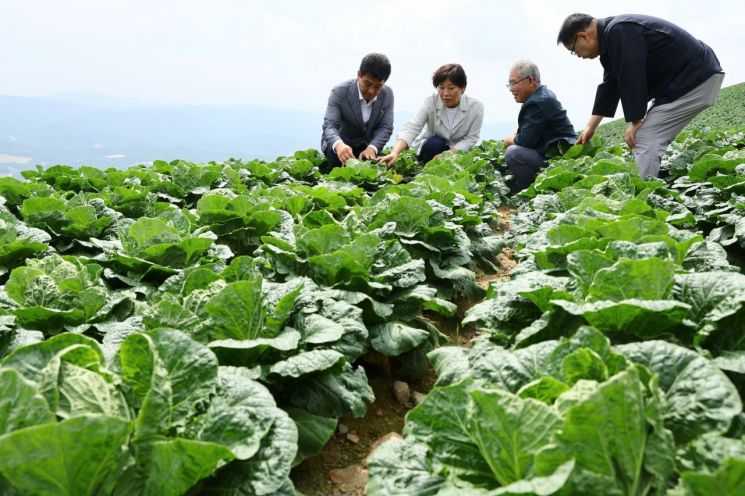 Song Miryeong, Minister of Agriculture, Food and Rural Affairs (second from the left), is inspecting the growth status of cabbage and the shipment trends at a highland cabbage field on August 8th this year.
First, the Ministry of Agriculture, Food and Rural Affairs will promote the establishment of a national climate change response system. For summer cabbage, it will discover new cultivation sites covering about 20% (1,000 hectares) of the average cultivation area and conduct pilot projects for production complex development. For apples, it will strategically foster new cultivation areas such as Gangwon and establish 60 specialized smart orchard complexes centered on new cultivation areas by 2030. To respond to frequently occurring disasters such as cold damage, heat waves, and insufficient sunlight, it will also expand preventive facilities to strengthen the production base. Additionally, through technological innovations such as digital precision breeding, it plans to develop varieties resilient to climate change and improve cultivation and breeding techniques.
To promote the growth and spread of smart agriculture, regulations on location and industry will be eased. The system will be improved to foster the data industry, and a growth ecosystem will be created through equipment standardization and the introduction of a national qualification system for smart agriculture managers. While designating 'Smart Agriculture Promotion Zones' that concentrate related companies and long-term leased smart farms, smart farm solutions will be distributed to 4,300 households (cumulative) by next year, focusing on major production areas.
To promote rural entrepreneurship and farming among youth and encourage the incorporation of agricultural management entities, specialized education courses will be reorganized. The business scope of agricultural corporations will be expanded to agribusiness-related projects, and agricultural corporations will be revitalized by easing the requirements for family farm incorporation (from 5 or more members to 3 or more) and improving the foreign labor employment system (introducing electronic visas for excellent and diligent seasonal workers, and flexibly applying minimum working days based on weekly working hours). To overcome the limitations of small-scale farming, the procedure for farmland use promotion projects will be simplified, and the spread of joint farming models will be promoted by considering switching capital gains tax to deferred taxation when farmland is contributed to corporations.
Measures to solve the recurring problem of rice overproduction are also included. Starting next year, the 'Cultivation Area Adjustment System' will be implemented with a goal to reduce rice cultivation area by 80,000 hectares. Reduction targets will be allocated to local governments, which will adjust all rice farmers accordingly, and government support such as preferential allocation of public stockpiled rice will be provided upon compliance with reduction. To create new demand such as rice processed foods, exports, and overseas aid, food companies converting government rice to private new rice will receive preferential policy funds, and pilot production complexes for processing rice (for processed rice and long-grain varieties) will be established. The traditional liquor tax reduction range will be expanded, support for exports of table rice and rice processed foods will be strengthened, and food aid, which is 110,000 tons this year, will be expanded to 160,000 tons next year.
The budget support method for local governments will be reorganized to focus support on local governments actively participating in agriculture and rural innovation. Local governments will select eligible projects within their budget range, and incentives such as additional project selection will be provided to excellent local governments through evaluation, thereby concentrating resources on agriculture and rural innovation. Governance, projects, investment, and government support systems will be restructured to strengthen local government autonomy and cooperation.
An official from the Ministry of Agriculture, Food and Rural Affairs said, "Despite changes in internal and external conditions such as rural population decline and stagnation of agricultural growth, agriculture and rural policies have maintained the framework suited to the 1990s liberalization era after going through the economic growth period of the 1970s and 1980s until now." He added, "The government will prepare for the future of agriculture and rural areas by revitalizing market functions, expanding private and regional autonomy, restructuring the industry, and promoting institutional improvements."
© The Asia Business Daily(www.asiae.co.kr). All rights reserved.
![Clutching a Stolen Dior Bag, Saying "I Hate Being Poor but Real"... The Grotesque Con of a "Human Knockoff" [Slate]](https://cwcontent.asiae.co.kr/asiaresize/183/2026021902243444107_1771435474.jpg)















