Announcement of the '3-Year Comprehensive Plan for Small Manufacturers' on the 18th
Focusing Policy Capabilities through Central-Local Cooperation System
The government will promote the growth of small manufacturers by establishing a region-led development system and focusing on the intensive cultivation of industrial clusters.
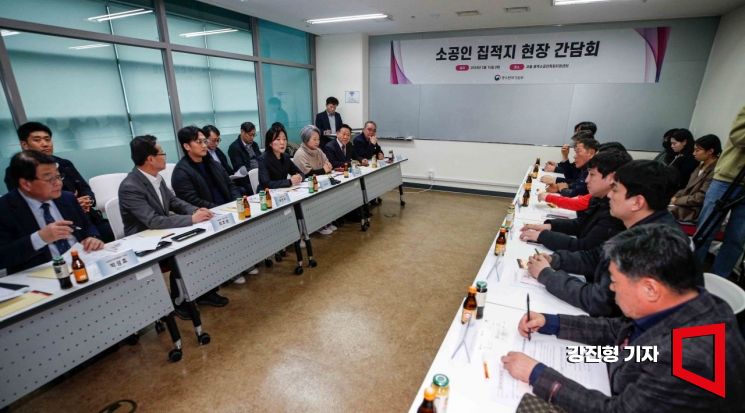 Minister Oh Young-joo of the Ministry of SMEs and Startups is sharing opinions with small business owners who attended the 'Small Business Cluster On-site Meeting' held on February 15 at the Seoul Metropolitan Small Business Specialized Support Center in Yeongdeungpo-gu, Seoul. Photo by Kang Jin-hyung aymsdream@
On the 18th, the Ministry of SMEs and Startups announced the "Three-Year Comprehensive Plan for Small Manufacturers" containing these details.
Small manufacturers are manufacturing businesses with fewer than 10 regular employees. As of 2022, there were 560,000 small manufacturing businesses creating 1.28 million jobs. This accounts for 88.9% of all manufacturing businesses and 25.7% of manufacturing jobs. By industry, they are widely distributed from core industries such as metal processing and machinery equipment to consumer goods industries such as food products and clothing/accessories.
The Ministry of SMEs and Startups plans to first establish a central-local cooperation system to promote region-led small manufacturer development projects and concentrate policy capabilities. By 2027, 10 dedicated small manufacturer management institutions will be selected in metropolitan local governments to carry out small manufacturer development projects reflecting regional characteristics, and a system will be established to enable linkage support and serve as hubs among small manufacturer support organizations within the region. For outstanding projects, from next year for three years, a certain scale of the Ministry’s small manufacturer support projects will be linked to support market development, smart manufacturing, and improvement of working environments.
To intensively cultivate small manufacturer clusters, 20 additional locations where small manufacturers gather will be discovered and designated. Production-based clusters established around manufacturing production hubs such as industrial complexes will be developed into regional production bases through industrial infrastructure support, including the establishment of small manufacturer complex support centers and industrial complex innovation support centers. Clusters that can be turned into tourism resources such as local specialties will be pilot-developed as experiential and themed tourist destinations in connection with regional tourism development projects. To prevent gentrification caused by the activation of commercial and living clusters close to urban centers, the Ministry will also consider establishing legal grounds within the Small Manufacturers Act, including the expansion of local government ordinances.
To alleviate the three major management burdens faced by small manufacturers?finance, workforce, and working environment?related ministries, local governments, and private companies will cooperate. The scale of accounts receivable factoring will be expanded to enable quick cash conversion of small manufacturers’ payment claims, and a new private contract performance guarantee product will be introduced to compensate for unpaid delivery payments in cooperation with the private sector. To resolve workforce shortages, skilled personnel will be trained through apprenticeship-style technical education institutions, and to create a safe working environment, related education and support for facilities and equipment will be expanded.
Support will also be provided for branding excellent small manufacturer products, developing domestic and overseas markets, and smart manufacturing technology. Excellent products with craftsmanship and rarity will be discovered and branded to nurture them as "Star Small Manufacturers," with support and management throughout all stages from strategy to sales. Additionally, various policies such as expanding online direct transactions and operating exclusive sales venues for small manufacturers will broaden their market channels. For companies participating in the small manufacturer smart manufacturing support project, a smart factory level diagnosis will be conducted, and a phased digital transformation support plan will be promoted by selecting outstanding small manufacturers and linking them to smart factory support projects.
Oh Young-joo, Minister of SMEs and Startups, stated, "According to the United Nations Industrial Development Organization (UNIDO), South Korea ranks 4th in manufacturing competitiveness worldwide, which is possible thanks to the efforts and roles of 560,000 small manufacturers who account for 88.9% of domestic manufacturing and have firmly supported the production base." He added, "We will carefully ensure that this three-year comprehensive plan for small manufacturers is well established and implemented on the ground, and we will continue to strengthen policy support so that small manufacturers can become core drivers of the manufacturing industry and regional economy as well as grow into small enterprises."
© The Asia Business Daily(www.asiae.co.kr). All rights reserved.
![Clutching a Stolen Dior Bag, Saying "I Hate Being Poor but Real"... The Grotesque Con of a "Human Knockoff" [Slate]](https://cwcontent.asiae.co.kr/asiaresize/183/2026021902243444107_1771435474.jpg)
















