November Retail Sales Growth 'Exceeds Expectations'
FOMC Begins... Focus on 2025 Dot Plot
Monetary Easing Likely to Slow Next Year
GDP on 19th, PCE Scheduled for 20th
The three major indices of the U.S. New York stock market were down in early trading on the 17th (local time). Investors are on alert as they digest the two-day regular meeting of the Federal Open Market Committee (FOMC) of the U.S. Federal Reserve (Fed) starting that day. With U.S. consumer spending showing resilience last month, the market expects that the Fed may reaffirm a cautious monetary easing policy the following day.
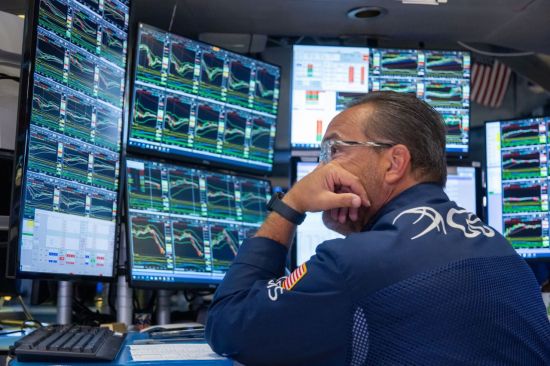
As of 12:11 p.m. in the New York stock market, the Dow Jones Industrial Average (Dow), which focuses on blue-chip stocks, was down 0.52% from the previous trading day at 43,491.78. If the Dow closes lower on this day, it will mark the first time since the 1970s that it has ended nine consecutive trading days in decline. The large-cap S&P 500 index was down 0.37% at 6,051.89, and the tech-heavy Nasdaq index was down 0.35% at 21,004.15.
By individual stocks, JPMorgan Chase was down 0.82%. Morgan Stanley was down 1.09%, and Bank of America (BoA) was down 1.32%. Semiconductor company Broadcom, which surpassed a market capitalization of $1 trillion for the first time last week, was down 4.43%. AI leader Nvidia was down 1.28%. Apple was up 0.8%, and Tesla was up 0.68%.
The U.S. retail sales data released that morning showed stronger-than-expected results. According to the U.S. Department of Commerce, November retail sales totaled $724.6 billion, up 0.7% from the previous month. This exceeded both the market forecast (0.6%) and October's figure (0.5%). The strong retail sales, a key pillar supporting two-thirds of the U.S. economy, repeatedly confirm that the U.S. economy continues to maintain solid growth, strengthening expectations that the Fed may slow the pace of rate cuts as previously indicated.
The market currently places a high probability on a 'small cut' (0.25 percentage point rate cut) this month. According to the Chicago Mercantile Exchange (CME) FedWatch, the federal funds futures market reflects a 95.4% chance that the Fed will cut rates by 0.25 percentage points at this month's FOMC meeting. The probability of a rate hold is 4.6%. The key issue is next year. If the U.S. economy remains more resilient than expected, even if the Fed cuts rates this month, it is likely to be a 'hawkish cut' (favoring monetary tightening) before the monetary easing halt in January next year. The market expects that the Fed's dot plot released the following day may reduce the number of rate cuts expected next year from the previous four times (100bp; 1bp = 0.01 percentage points) to fewer than three times.
Chris Larkin, Investment Managing Director at Morgan Stanley eTrade, said, "Stronger economic indicators like retail sales could support the argument that the Fed should stop cutting rates in January next year."
Tom Essay, President of Sevens Report, analyzed, "Whether the Fed's decision the next day is positive, negative, or neutral for stocks and bonds will likely depend on the FOMC's stance on rate cuts in 2025 rather than the actual rate cut."
Besides retail sales, key economic indicators that can confirm the U.S. economic situation will be released consecutively this week. On the 19th, the final figure for third-quarter Gross Domestic Product (GDP) growth will be announced, and on the 20th, the November Personal Consumption Expenditures (PCE) price index, the inflation gauge most closely watched by the Fed, will be released.
Government bond yields are declining. The U.S. 10-year Treasury yield, a global bond yield benchmark, was down 2 basis points from the previous trading day at 4.37%, and the 2-year Treasury yield was down less than 1 basis point at 4.24%.
© The Asia Business Daily(www.asiae.co.kr). All rights reserved.
![Clutching a Stolen Dior Bag, Saying "I Hate Being Poor but Real"... The Grotesque Con of a "Human Knockoff" [Slate]](https://cwcontent.asiae.co.kr/asiaresize/183/2026021902243444107_1771435474.jpg)















