The Constitutional Court has decided not to broadcast live the oral arguments in the impeachment trial of President Yoon Seok-yeol. However, in accordance with precedent, the Court will provide a recorded video afterward.

Lee Jin, the spokesperson for the Constitutional Court, responded during a briefing held on the morning of the 17th to the question, "How is the discussion going regarding the live broadcast of the oral arguments in President Yoon's impeachment trial? Will you actively gather opinions from President Yoon's side on this matter?" by saying, "(The impeachment trial) oral arguments will not be broadcast live."
However, the spokesperson added, "Whether the verdict will be broadcast live will be decided later and announced."
That afternoon, the Constitutional Court issued a separate notice to the press stating, "We inform you that there was no live broadcast of oral arguments during the impeachment trial of former President Park Geun-hye," and "At that time, a recorded video was provided after the oral arguments, and in the case of President Yoon Seok-yeol's impeachment trial, the same procedure will be followed by providing a recorded video after the oral arguments."
It has been confirmed that President Yoon has not yet received the National Assembly's resolution on the impeachment motion sent by the Constitutional Court.
The spokesperson said, "It is being delivered to the President," and added, "The Presidential Office has not confirmed receipt clearly."
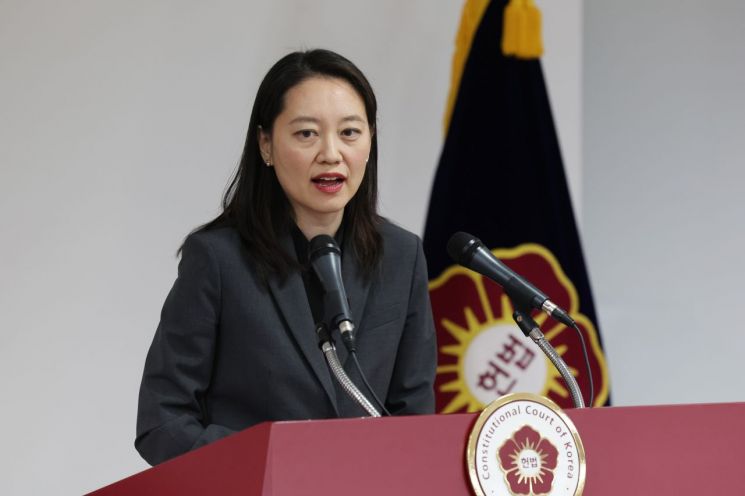 On the morning of the 17th, Lee Jin, the spokesperson of the Constitutional Court, is holding a briefing related to the impeachment trial of President Yoon Seok-yeol at the Constitutional Court annex in Jaedong, Jongno-gu, Seoul. Photo by Yonhap News.
The Constitutional Court reportedly sent a batch of documents the previous day, including the notification of receipt of the impeachment trial petition, requests for written responses and opinions, the decision to refer to preparatory procedures, notices of preparatory procedure dates, and summonses.
These documents were all delivered to the Chairman of the National Assembly's Judiciary Committee, the Speaker of the National Assembly, and the Minister of Justice, but delivery to President Yoon has not yet been completed.
When sending the National Assembly's impeachment resolution and related documents to President Yoon, the Constitutional Court requested that a written response be submitted within seven days from the date of receipt.
Since the Court attempted delivery on the 16th through three methods?personal delivery, same-day express mail, and electronic document system?if receipt had occurred on that day, the deadline for submitting the written response would be the 23rd. However, as delivery has been delayed, the deadline for submission is also being postponed.
Meanwhile, regarding the controversy over whether Acting President and Prime Minister Han Duck-soo can appoint the three vacant Constitutional Court justices, the spokesperson said, "I understand that there was a precedent where Acting President Hwang Kyo-ahn made appointments."
When asked, "If Acting President Han does not exercise the appointment authority, can the six sitting justices make a decision and deliver a verdict?" the spokesperson replied, "I understand that the bench is currently discussing this."
Kwon Seong-dong, the acting leader and floor leader of the People Power Party, said at a party strategy meeting held at the National Assembly that day, "The acting president can appoint Constitutional Court justices in the case of a presidential vacancy ('gweolwi'), but cannot do so during a presidential suspension ('jikmujeongji'). Until the impeachment motion is accepted by the Constitutional Court, the acting president's appointment of justices is impossible."
If the Constitutional Court accepts the impeachment petition and the president is dismissed, it is considered a presidential vacancy ('gweolwi'), allowing the acting president to exercise broad authority beyond maintaining the status quo, including appointing justices. However, mere suspension of presidential duties due to the National Assembly's impeachment motion is considered an 'accident' ('sago'), not a vacancy, so appointing new justices is beyond the acting president's authority. This is the logic presented.
It is argued that when former Prime Minister Hwang Kyo-ahn appointed Constitutional Court justices, former President Park had already been dismissed by the Court's impeachment decision, which differs from the current situation.
On the other hand, the Democratic Party holds the position that there is no problem with Acting President Han's appointment of justices. Since the three justices to be appointed are not presidential nominees but candidates originally elected by the National Assembly, the president's appointment is merely a formal procedure and falls within the scope of maintaining the status quo authority.
Meanwhile, during the briefing, questions were also raised about why the Constitutional Court did not disclose the fact that Justice Jeong Hyeong-sik was designated as the presiding justice for this case the previous day.
In response, the spokesperson said, "According to the decision and internal regulations, the principle of confidentiality is maintained, and for disclosure to be made as an exception, special circumstances must exist, but no such circumstances were found."
He added, "Being the presiding justice does not affect the schedule or content and mainly involves internal organization of the trial (content)."
The previous day, the Constitutional Court held the first justices' meeting related to this case and formed a task force (TF) of constitutional researchers led by the senior constitutional researcher as team leader. The spokesperson also reported that the TF held its first meeting.
© The Asia Business Daily(www.asiae.co.kr). All rights reserved.
![Clutching a Stolen Dior Bag, Saying "I Hate Being Poor but Real"... The Grotesque Con of a "Human Knockoff" [Slate]](https://cwcontent.asiae.co.kr/asiaresize/183/2026021902243444107_1771435474.jpg)
















