No Precedent Since 2023 Daehan Yuhwa
Expansion Halted Amid China and Gyeonggi Recession
COTC-Based Middle East Poses Even Greater Challenge
"Generic Price Competitiveness Inevitably Declines"
There has been no new ethylene capacity expansion, known as the "rice" of petrochemical products, this year. Domestic NCC (Naphtha Cracking Center) companies are improving efficiency through regular maintenance and increasing production scale, but there has been no change this year. This is interpreted as a focus on strengthening fundamentals as domestic companies shift toward high value-added products, while being outpaced by large-scale expansions in China and the Middle East.
According to the Korea Chemical Industry Association on the 18th, there has been no expansion of NCC capacity this year. This is the first time in six years since 2018 that there has been no new NCC expansion on an annual basis.
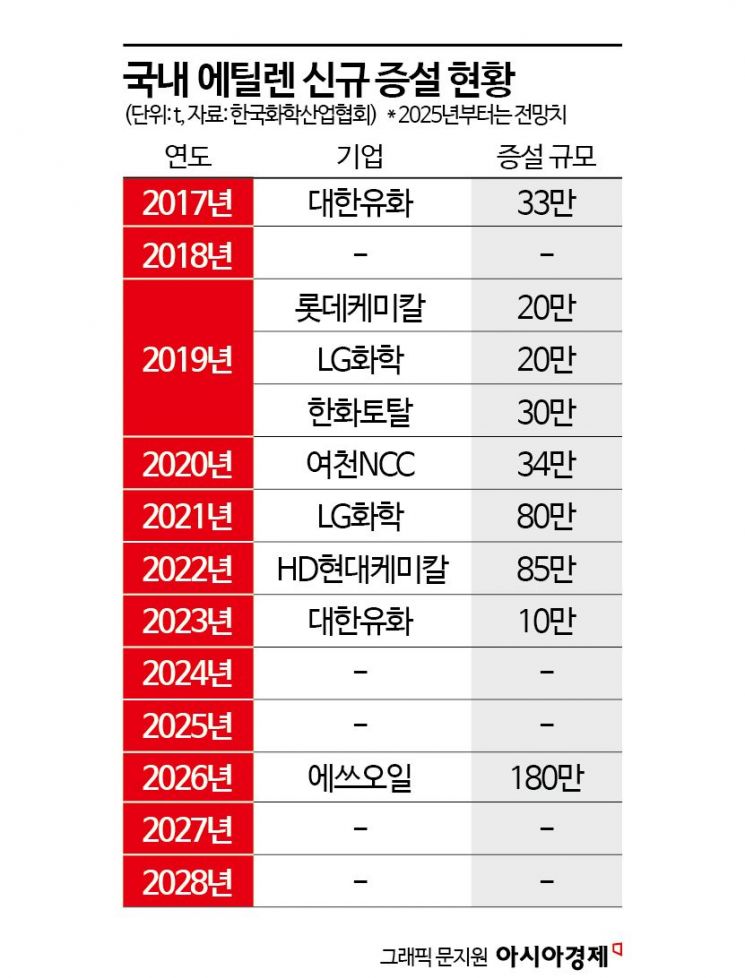
Domestic petrochemical companies pursue process efficiency through maintenance work. In this process, they increase production scale to realize economies of scale. Because of this, expansions have continued steadily every year. In 2019 alone, Lotte Chemical and LG Chem each increased ethylene capacity by 200,000 tons annually, and Hanwha Total increased by 300,000 tons. In 2020 and 2021, Yeochun NCC and LG Chem expanded by 340,000 tons and 800,000 tons respectively. In 2022, HD Hyundai Chemical established an HPC (Heavy-feed Petrochemical Complex) facility with a capacity of 850,000 tons. Last year, Daehan Petrochemical increased capacity by 100,000 tons.
The halt in new ethylene expansions by domestic companies is largely due to large-scale facility expansions in China and the Middle East. According to the association, the global ethylene expansion scale from 2026 to 2028 is expected to exceed an average of 12 million tons per year. This is more than double the expansion volumes of this year (6.13 million tons) and next year (6.65 million tons). China, which was the largest export market for domestic petrochemical companies, has been conducting large-scale expansions from 2020 to 2023 to increase self-sufficiency. Coupled with the ongoing economic downturn, excess supply that could not be absorbed domestically in China has leaked overseas, causing domestic companies to face the double blow of weak demand and declining price competitiveness. All domestic ethylene expansions from 2018 to last year were decided before 2020, influenced by China's aggressive expansion.
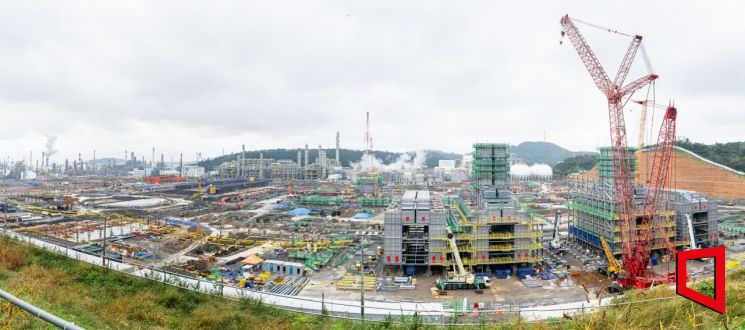 The construction site of the S-Oil Shahin Project, the largest investment in the history of the domestic petrochemical industry, with 9.258 trillion KRW invested. Photo by S-Oil
In particular, the Middle East's share of global ethylene expansions is expected to soar from 8% this year to 32% in 2028. The Middle East is poised to enter the petrochemical industry based on the ‘COTC (Crude Oil to Chemicals)’ technology, which produces petrochemical products such as ethylene directly from crude oil. This technology can reduce ethylene production costs by 40% compared to NCC. This is why it will inevitably become difficult even if domestic ethylene production scale is increased.
It is expected to be difficult to find new ethylene expansions domestically for the time being. From this year until 2028, the only company planning to expand ethylene production in Korea is S-OIL. Supported by Aramco, S-OIL plans to produce 1.8 million tons of ethylene annually starting in 2026 through the Shahin project. The Shahin project is also based on this COTC technology.
An industry insider explained, "Everyone agrees that if interest rates fall and the economy recovers, the global petrochemical industry cycle will eventually rise, but this does not apply exclusively to domestic companies," adding, "Ultimately, for commodity products, domestic companies cannot compete with the price competitiveness of China and the Middle East, so there is currently no reason to expand ethylene capacity." LG Chem and Lotte Chemical, which produce the most ethylene domestically, have commodity products accounting for 36% and 32% of their total petrochemical business, respectively. The insider added, "Focusing on specialties and strengthening fundamentals is the right direction for domestic companies."
© The Asia Business Daily(www.asiae.co.kr). All rights reserved.


















