Commuting Interval 6 Minutes 15 Seconds
Up to 5 Minutes from Bus Drop-off to GTX Platform
Outstanding Accessibility and Efficient Route Structure Draw Attention
Paju City Expands Connected Transportation Network Including 'GTX-Centered Bus Routes'
The private sector section of the Metropolitan Area Express Railway (GTX)-A line, spanning from Paju to Seoul Station, will hold an opening ceremony on the 27th and officially begin operation on the 28th. Paju City, which was almost a barren land for rail transportation, is set to experience a groundbreaking turning point in urban development with the dawn of the ‘GTX era’.
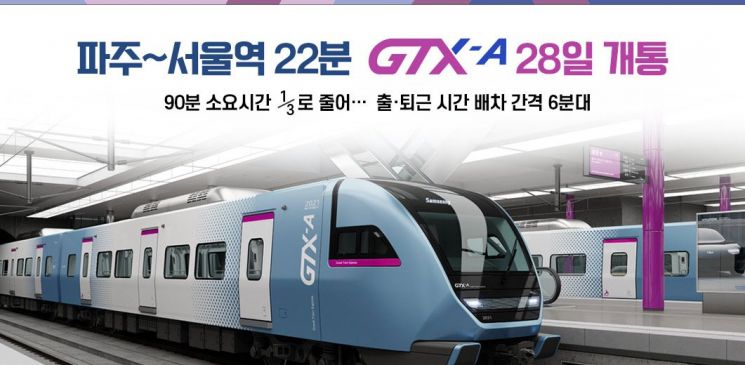 Paju City 'A Leap into the GTX Era of Transportation Revolution.' Photo by Ministry of Land, Infrastructure and Transport
The advent of the GTX era carries a significance beyond merely ‘improving transportation convenience.’ With high-speed travel drastically reducing travel time, the metropolitan cities and Seoul will effectively integrate into a single time-zone living area, triggering remarkable changes across the economy, culture, housing, and other regional aspects.
Paju City views the changes brought by GTX very positively. In his 2025 policy speech, Mayor Kim Kyung-il expressed his ambition, stating, “We will seize this once-in-a-lifetime opportunity called the ‘transportation revolution’ to fully open the golden age of Paju’s economy.” The opening of GTX is expected not only to elevate the quality of life for citizens but also to act as a catalyst that maximizes Paju’s urban capabilities as it moves toward becoming a self-sufficient city of one million residents.
◇ Regaining the 3 Hours Lost in Daily Commuting Battles
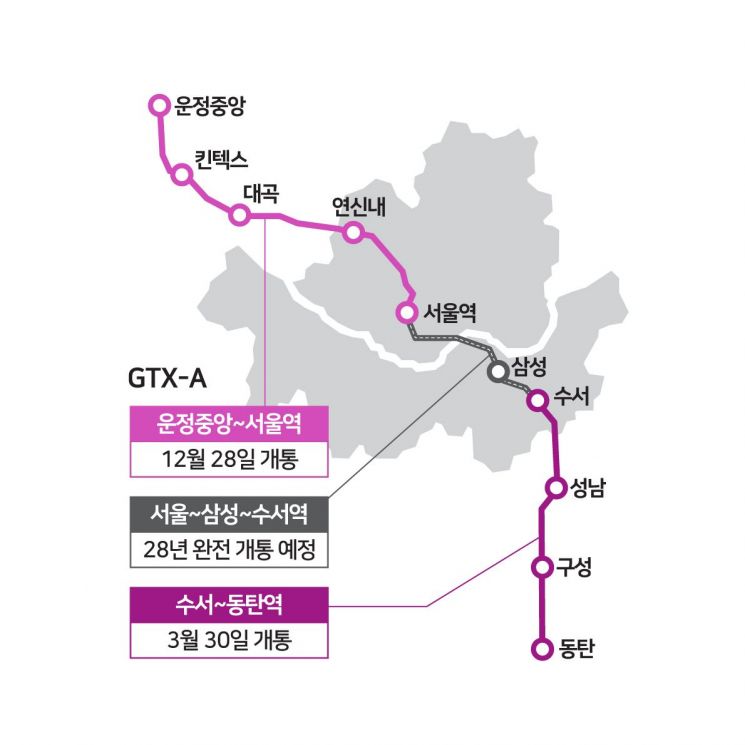
GTX tunnels are constructed at an average depth of 50 meters underground in the city center, with the route straightened to allow speeds more than twice as fast as existing subways?an average speed of over 100 km/h and a maximum speed of up to 180 km/h. Prioritizing connections to major points in Seoul within 30 minutes, the number of stops has been minimized to enhance operational efficiency.
When GTX service begins from Paju Unjeong Central Station to Seoul Station by the end of this year, travel time, which previously took over an hour by regular subway and about 90 minutes by express bus, is expected to be reduced to 22 minutes. From 2028, when the delayed Samsung Station opens as part of the integrated transfer center, access to the heart of Gangnam will be possible within 30 minutes, and traveling the entire 82.1 km route to the terminal station Dongtan is expected to take about 50 minutes. Although full operation of the entire route including Samsung Station requires waiting another four years until 2028, there are talks of discussing non-stop passage through the Samsung Station section starting in 2026 when the tunnel connecting Seoul Station, Samsung Station, and Suseo Station is completed.
The Suseo?Dongtan section shares tracks with the Suseo High-Speed Railway (SRT), resulting in a 17-minute interval between trains. However, the Unjeong Central Station?Seoul Station section uses dedicated tracks, and the number of trains deployed will be significantly increased, allowing the interval during peak commuting hours to be shortened to 6 minutes and 15 seconds?more than halving the current interval.
Fares are expected to be set at a level similar to the Suseo?Dongtan section. The fare structure consists of a base fare of 3,200 KRW plus 250 KRW for every 5 km beyond 10 km. Applying this to the Unjeong Central Station?Seoul Station section, the fare is expected to be around 4,450 KRW.
◇ ‘GTX-Centered Bus Routes’ and Introduction of Paju-Style Express City Buses (PBRT) in the Northern Area
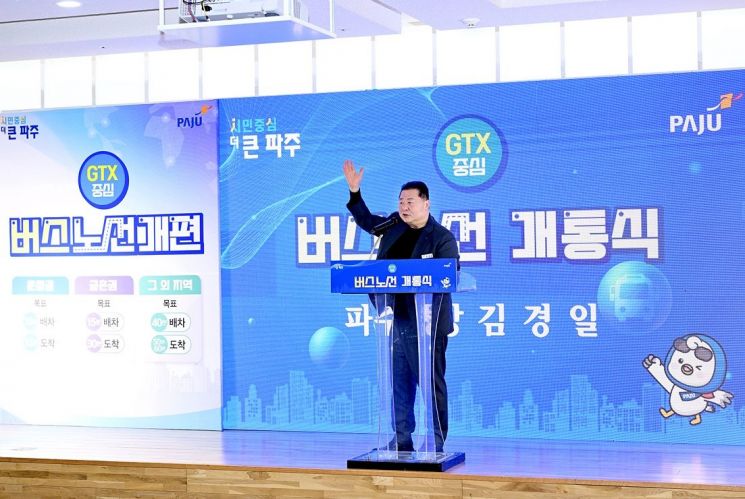
Despite the rosy outlook, there are still many challenges to address. To achieve a true transportation revolution with GTX, the expansion of fast and convenient connecting transportation networks is essential.
The city began a major bus route reorganization this spring to ensure that from each major hub within Paju, passengers can reach GTX Unjeong Central Station ‘with one bus ride, as quickly as possible.’ By the end of November, the city introduced the ‘GTX-centered bus routes,’ linking 12 routes with 83 buses to GTX Unjeong Central Station. The practical goals of this route reorganization are a 10-minute interval and arrival within 15 minutes in the Unjeong area, a 15-minute interval and arrival within 30 minutes in the Geumchon area, and a 40-minute interval and arrival within 50 minutes in areas such as Munsan and Jeokseong.
The ‘GTX-centered bus routes’ will begin full operation in line with the GTX opening date. Among the newly established routes, the 070A/B routes circulating Unjeong New Town started temporary operation as route 070 from December 1 until the GTX opening, excluding the Unjeong Central Station stop. Additionally, route 072 connecting the Geumchon area and route 80 serving Unjeong New Town and Daehwa Station also began temporary operation.
In February 2025, two routes connecting the Jeokseong and Munsan areas with the Beopwon and Gwangnan areas are scheduled to open. The city plans to introduce the ‘Paju-style Express City Bus (PBRT)’ system on these two routes for the first time. The Paju-style Express City Bus (PBRT) is a new concept transportation system designed to maximize travel speed and punctuality by minimizing stops, enabling rapid travel to destinations even from distant areas. The express city bus (PBRT) departing from Jeokseong will connect to GTX Unjeong Central Station via Papyung, Munsan, Wollong, and Geumchon, while the express city bus departing from Beopwon-eup will connect to GTX Unjeong Central Station via Yeonpung-ri and Gwangtan Samgeori.
◇ Excellent Accessibility and Efficient Flow Structure Allow Up to 5 Minutes from Bus Drop-off to Platform
The structure of GTX Unjeong Central Station is also focused on ‘fast and convenient use.’ The first thing that catches the eye is the connection between the station interior and the bus stops. There are bus boarding and alighting areas on the underground passage directly connecting both directions of Simhak-san-ro to the GTX station, allowing passengers to enter the station concourse without delay after getting off the bus.
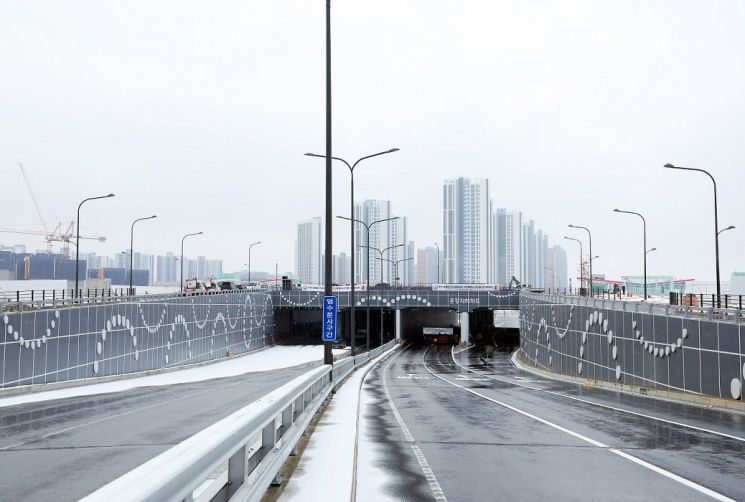
The bus boarding and alighting areas will operate 12 platforms in total, with six platforms each for the directions toward Gyoha and Unjeong, and toward Unjeong, Geumchon, Jori, Tanhyeon, Beopwon, and Jeokseong. Passengers arriving at Unjeong Central Station by GTX can easily and quickly transfer to buses heading in various city directions.
The travel time from getting off the bus, passing through the concourse, to reaching the platform with the GTX tracks takes only about 4 to 5 minutes. Once entering the concourse on the first basement floor, passengers immediately encounter the central escalator. Once on the escalator, they can descend directly to the third basement floor where the ticket office and gates are located. After passing through the gates, there are eight high-speed elevators with a speed of 150 meters per minute within seconds’ distance, allowing passengers to reach the GTX platform within one minute. Even considering waiting times during peak commuting hours, it takes no more than 1 minute 30 seconds to 2 minutes.
◇ Temporary Parking Lot Secured to Accommodate 1,009 Vehicles Simultaneously
Great care has been taken to secure parking facilities to enhance transfer convenience for private car users. The plan for the transfer center, which also serves as the GTX station, includes 942 parking spaces spanning from the first basement floor to the third basement floor. However, since construction is expected to be completed in the second half of 2026, a temporary parking lot will operate for about two years after the GTX opening.
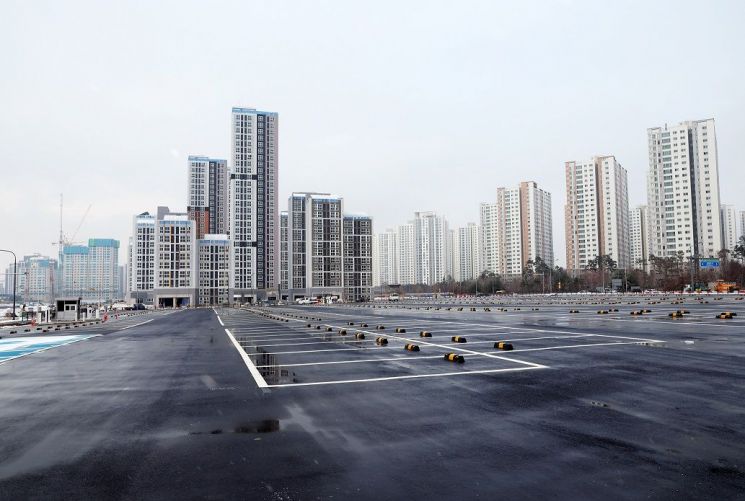
The temporary parking lot has been constructed on the sites where cultural facilities and office complex facilities will be built after the transfer center is completed, with a capacity to accommodate 1,009 vehicles simultaneously. It will open in time for the GTX opening, be free of charge for one month until January, and switch to paid parking from February. Parking fees are 600 KRW for the first 30 minutes, 250 KRW for every 10 minutes thereafter, and a maximum daily fee of 9,000 KRW. Special discounts apply to GTX transfer users, reducing the fee to 500 KRW for the first 30 minutes, 70 KRW for every 10 minutes thereafter, and a maximum daily fee of 3,000 KRW, minimizing parking cost burdens.
Measures have also been prepared to minimize traffic congestion around the station. To this end, since April this year, the city has signed a business agreement with the Korea Land and Housing Corporation (LH) and conducted traffic simulation analyses of the traffic impact zone around the station. Based on this, various user-centered traffic measures have been established, including improvements to road geometry, expansion of traffic safety facilities, installation of traffic information devices, and reorganization of transfer parking lot flow systems.
◇ Cultural Park and Cheongryongducheon Riverside Park to be Created in the Station’s Upper Space
The city has also put great effort into strengthening urban capabilities centered on GTX, including forming a dedicated team to establish a development plan for the station area around Unjeong Central Station.
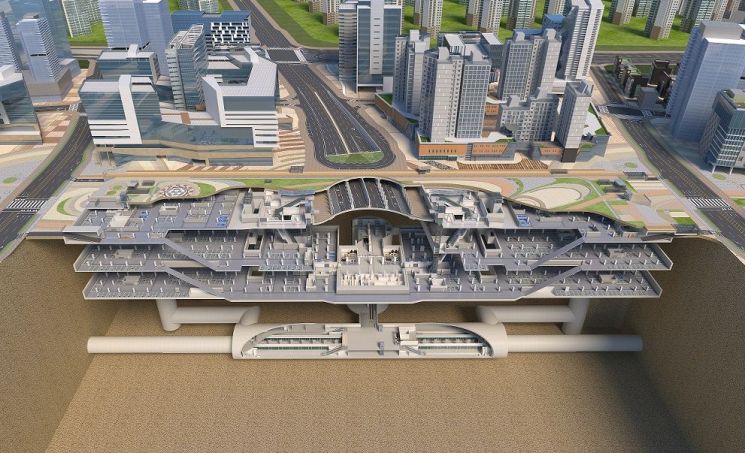
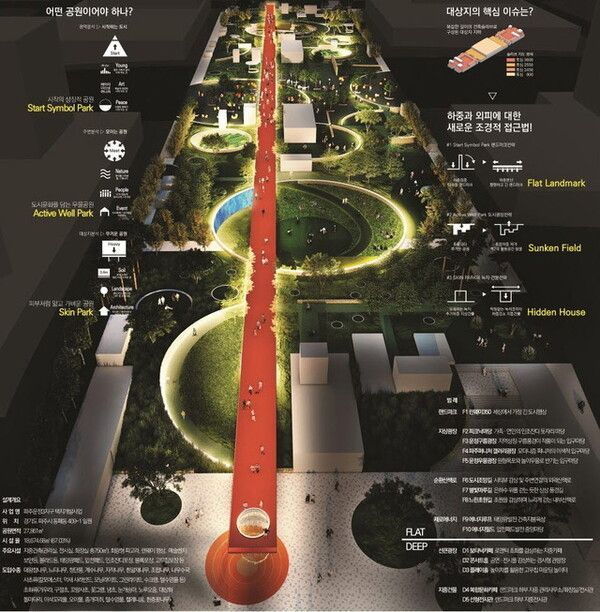 Perspective view of the cultural park to be created above Unjeong Jungang Station. Provided by Paju City
The city aims to develop the approximately 360,000 square meter upper space of Unjeong Central Station into a regional economic and cultural hub by actively attracting large-scale commercial facilities such as department stores and hotels, as well as leading companies in new industries that can revitalize the local economy and create jobs.
In particular, the special planning zone for the GTX station area will feature a cultural park in the upper space of the station to serve as a resting place for citizens, designed to be easily connected with nearby commercial and office facilities, creating a regional landmark where public and private sectors harmonize. The Korea Land and Housing Corporation, the project implementer for Paju Unjeong 3 District, has actively accepted Paju City’s ‘landmark park concept’ and started detailed design based on the work selected through a design competition held by the end of August. Additionally, the city is reviewing specific implementation plans such as expanding parking facilities to develop the Cheongryongducheon Riverside Park, created 400 meters northwest of the station in September, into a key landmark of the GTX era.
◇ “GTX is the Catalyst for ‘Closer Paju, Leap to One Million Paju’”
The most fundamental aspect of a desirable city to live in is convenient transportation. Based on the year-end GTX-A opening, Paju City is changing the paradigm of Paju transportation by opening a 20-minute era from Paju to Seoul and concentrating administrative efforts on building a railway network for Paju’s leap to a self-sufficient city of one million residents, following the confirmed West Sea Line extension project to Paju.
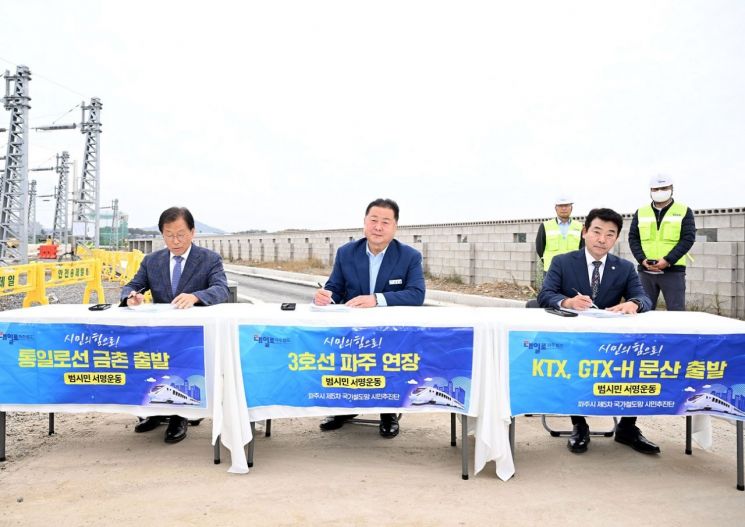 Signing Ceremony for the Inclusion in the 5th National Railroad Network Construction Plan (November 11). Provided by Paju City
Paju City has set as an immediate goal to have the 3rd subway line extension, the establishment of the Tongil-ro Line, the KTX Munsan extension, and the GTX-H line proposed by Gyeonggi Province this year included in the ‘5th National Railway Network Construction Plan.’
Mayor Kim Kyung-il said, “GTX is not the completion but the beginning of the transportation revolution. We will create future value for Paju through the GTX opening and lay the foundation for a city of one million residents. Using this as a catalyst for Paju’s leap as the central city of northern Gyeonggi, we will open various routes to Paju by having the 3rd subway line extension, Tongil-ro Line, KTX Munsan extension, and Metropolitan Area Express Railway (GTX)-H line included in the 5th National Railway Network Construction Plan, thereby further expanding Paju City.”
© The Asia Business Daily(www.asiae.co.kr). All rights reserved.
![Clutching a Stolen Dior Bag, Saying "I Hate Being Poor but Real"... The Grotesque Con of a "Human Knockoff" [Slate]](https://cwcontent.asiae.co.kr/asiaresize/183/2026021902243444107_1771435474.jpg)

















