A nano-technology-based cleaning system has been developed to resolve odor complaints arising from livestock manure organic fertilizer manufacturing facilities.
The Korea Institute of Civil Engineering and Building Technology (hereinafter referred to as KICT) announced on the 17th that Dr. Jeong Won-sik's research team at the Environmental Research Headquarters has succeeded in developing a cleaning system that can efficiently reduce fine dust and ammonia emitted from fertilizer manufacturing facilities.
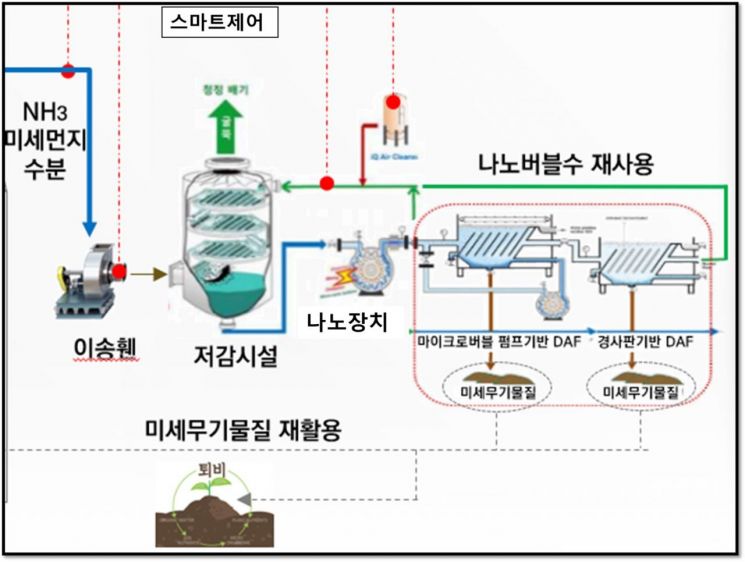
The technology developed by the research team applies a nano-emulsion device and flotation separation to the existing cleaning system, enhancing the efficiency of fine dust and odor collection, while extending the usage period of the cleaning wastewater, thereby reducing chemical costs simultaneously.
This technology complements the shortcomings of existing technologies, effectively removing fine dust and ammonia, and presents a standardized treatment facility that meets legal standards.
Existing technologies have an ammonia removal rate of 30?60%, with a cleaning water replacement cycle within 7 days. In contrast, the cleaning system developed by the research team achieves an ammonia removal rate of over 90%, and the cleaning water replacement cycle is extended to more than 45 days, offering advantages in both economy and efficiency.
The installation cost is approximately 40 million KRW higher than that of existing scrubbers. However, considering that it reduces 60% (50 million KRW) of the cost in cleaning wastewater treatment and 30% (50 million KRW) in chemical costs, resulting in an annual maintenance cost saving of 100 million KRW, KICT explains that the cost savings offset the installation cost. Above all, the most significant achievement of this research is that the technology developed by the research team can effectively resolve odor complaints.
Previously, the research team conducted pilot tests with a capacity of 20 CMM (Cubic meter/min, processing capacity of 20 cubic meters per minute) in Byeokje, Goyang-si, Gyeonggi Province, and Hongseong-gun, Chungnam Province. Currently, they are conducting a 100 CMM-scale demonstration test at the Moga Nonghyup composting site in Icheon-si, Gyeonggi Province, and are promoting standardization applicable to composting facilities according to scale and concentration.
Currently, about 1,500 livestock manure organic fertilizer manufacturing facilities operate domestically. These facilities frequently generate odor complaints caused by fine dust and ammonia. According to data from the Environmental Statistics Portal, odor complaints increased from 14,816 cases in 2014 to 40,854 cases in 2019. Among these, about 12,000 cases (30%) were odor complaints arising from the livestock sector.
To address this, the Ministry of Environment revised the Enforcement Rules of the Atmospheric Environment Conservation Act in May 2019, requiring matured organic fertilizer manufacturing facilities to be reported as air pollutant emission facilities and setting the ammonia emission standard to 30 ppm or less.
However, the chemical washing systems widely used in most composting facilities and manufacturing plants currently show low treatment efficiency and have limitations such as high costs for cleaning wastewater treatment and chemicals.
Park Seon-gyu, President of KICT, said, “The nano-technology-based cleaning system developed by the research team can be applied not only in the livestock sector but also in various industrial fields such as scrubbers at sewage treatment plants and scrubbers installed in general factories.” He added, “We hope this technology will contribute to resolving fine dust and odor complaints and solving social environmental problems.”
© The Asia Business Daily(www.asiae.co.kr). All rights reserved.
![Clutching a Stolen Dior Bag, Saying "I Hate Being Poor but Real"... The Grotesque Con of a "Human Knockoff" [Slate]](https://cwcontent.asiae.co.kr/asiaresize/183/2026021902243444107_1771435474.jpg)















