Experts Urge "Enhancements Suitable for the City of Protest Posters"
Councilor Park Pil-soon Calls for "Diverse Discussions Including Plan B Measures"
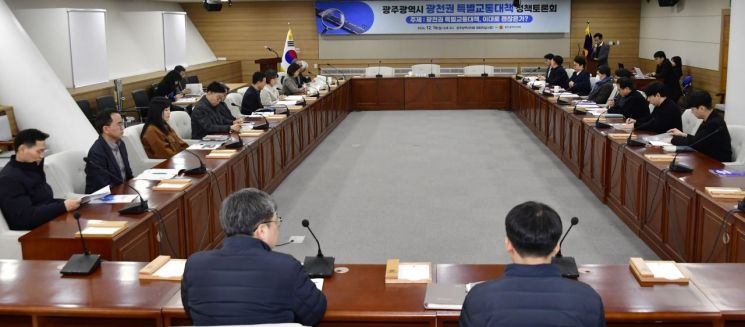 On the 16th, Park Pil-soon, a member of the Gwangju City Council, held a policy debate titled "Is the Special Transportation Measure for the Gwangcheon Area Okay as It Is?" in the city council's main conference room, with experts including Min Man-ki, co-representative of the Green Transportation Movement, and Park Yong-nam, director of the Sustainable City Research Center, in attendance. Photo by Gwangju City Council
Concerns about feasibility and calls for reconsideration aligned with the poster city development have emerged regarding Gwangju City's ambitious 'Gwangcheon Area Special Transportation Measures.'
On the 16th, Park Pil-soon, a member of the Gwangju City Council (Democratic Party of Korea·Gwangsan-gu 3), held a policy debate titled 'Is the Gwangcheon Area Special Transportation Measures Okay as It Is?' at the city council's main conference room.
Discussants expressed opinions that the Gwangcheon Area Special Transportation Measures require supplementation and reconsideration in a form suitable for a poster city.
Min Manki, co-representative of the Green Transportation Movement, stated, “The Gwangcheon Area Special Transportation Measures show a typical pattern of past development eras,” adding, “It is difficult to succeed by first establishing facility development plans and then preparing other measures accordingly.” He continued, “While gathering customers from all over Gwangju might be good for business, it is the worst from a transportation perspective,” and said, “Without demand management measures for traffic volume as a premise, success is difficult.”
Park Yong-nam, director of the Sustainable City Research Center, said, “The city expects traffic volume to more than double after development, but it is hard to agree with such an estimate amid a declining population,” and questioned, “I am not sure if it is reasonable to push for high-cost transportation facilities like subways when the population is decreasing.” He added, “It also seems practically impossible to complete preliminary feasibility studies and Ministry of Economy and Finance budget negotiations and finalize the project plan by the opening of the complex shopping mall (2027?2028),” and explained, “Currently, it is difficult to secure funding for the second phase of the Urban Railway Line 2, and public contributions have not been clearly confirmed, making it hard to predict whether the project can proceed.”
Park also expressed concern, saying, “The estimated project cost of 692.5 billion KRW for the Gwangcheon-Sangmu Line, estimated at 89 billion KRW per kilometer, is judged to be excessively underestimated,” and added, “I worry that mistakes will be repeated like with Urban Railway Line 2.”
Oh Seong-hoon, senior research fellow at the Architecture and Space Research Institute, said, “The current measures mainly focus on major plans such as routes and the introduction of transportation modes,” and added, “For a poster city, methods to elevate the quality of public transportation, bicycles, and walking to the level of automobiles should be presented.”
There was also a claim that urgent measures are needed for regional transportation policies such as the Sangmu-Gwangcheon Line. Professor Choi Dong-ho of Gwangju University argued, “Gwangju Urban Railway Line 2 is located too widely for the city’s scale, so a connecting line in the middle is necessary,” and claimed, “The Gwangcheon-Sangmu Line, which connects Champions Field, the terminal, shopping malls, and metropolitan rail, is a line needed in the long term.”
Opinions were also voiced that a citizen communication process acceptable to residents is necessary. Eom Ji-yeon, director of EOD Design Institute, emphasized, “If a road diet is implemented, it is necessary to consider how to utilize the secured space,” and stressed, “Especially, social experiments that are considered and executed together with citizens should be conducted.”
Park Pil-soon, who hosted the debate, stated, “The Gwangcheon Area Special Transportation Measures, with an expected project cost of 1 trillion KRW, will undoubtedly be a very important project determining Gwangju’s future,” and said, “Since various concerns and improvements were raised through the debate, the council will continue in-depth discussions from multiple perspectives, including securing the budget and a Plan B in case of failure, as well as explaining and asking citizens about the Gwangcheon Area poster city plan.”
© The Asia Business Daily(www.asiae.co.kr). All rights reserved.
![Clutching a Stolen Dior Bag, Saying "I Hate Being Poor but Real"... The Grotesque Con of a "Human Knockoff" [Slate]](https://cwcontent.asiae.co.kr/asiaresize/183/2026021902243444107_1771435474.jpg)















