Trump Stingy in Supporting Eco-Friendly Policies
Battery Tariffs Imposed After Administration Transition
BlueOvalSK Approved for $9.6 Billion Loan
Samsung SDI Also Expedites ATVM Procedures
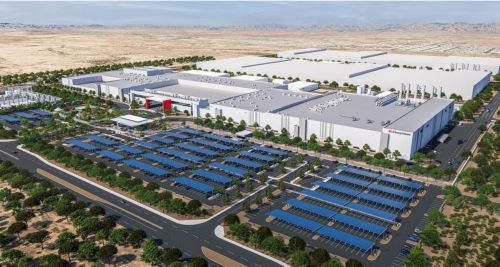
South Korean battery companies such as SK On and Samsung SDI are accelerating their efforts to secure loan approvals from the U.S. Department of Energy (DOE). This is interpreted as an attempt to create the most favorable investment conditions ahead of the inauguration of the Donald Trump administration in January next year, which is expected to be stingy in providing funds for eco-friendly policies such as electric vehicles and batteries. It has been reported that the Trump administration's transition team also plans to impose tariffs on battery materials.
On the 16th (local time), the U.S. DOE announced that it had given final approval for a $9.63 billion (approximately 13.8 trillion KRW) policy loan to BlueOvalSK, a battery production joint venture between SK On and Ford. The interest rate is known to be at the level of the U.S. 10-year Treasury bond yield. This financial support was provided under the DOE's Advanced Technology Vehicles Manufacturing (ATVM) program.
BlueOvalSK had received conditional approval for the ATVM policy loan in June last year. After undergoing eligibility evaluations in various fields such as technology, market influence, finance, and legal matters, the contract was finalized. BlueOvalSK is constructing three factories in the U.S., including Kentucky plants 1 and 2 and a Tennessee plant, and is preparing for sequential commercial operation (SOP) starting next year.
Samsung SDI is also expediting the ATVM approval process. The company recently announced that its board of directors had resolved to guarantee debt for $3.8 billion (approximately 5.459 trillion KRW), which is 51% of the ATVM loan for its affiliate, StarPlus Energy (a battery joint venture with Stellantis). StarPlus Energy is expected to secure a total loan agreement of $7.5 billion (approximately 10.7745 trillion KRW), and Samsung SDI plans to provide its 51% stake in StarPlus Energy as collateral. This loan is intended for factory construction and operational costs.
Samsung SDI, together with North American automaker Stellantis, is building two battery factories with a total capacity of 67 GWh in Kokomo, Indiana. The investment amount for the two factories exceeds $6.6 billion (approximately 9.4815 trillion KRW). The industry particularly expects that additional investment will be necessary due to increased construction costs in the U.S., which explains why the loan amount has increased beyond the initially planned investment.
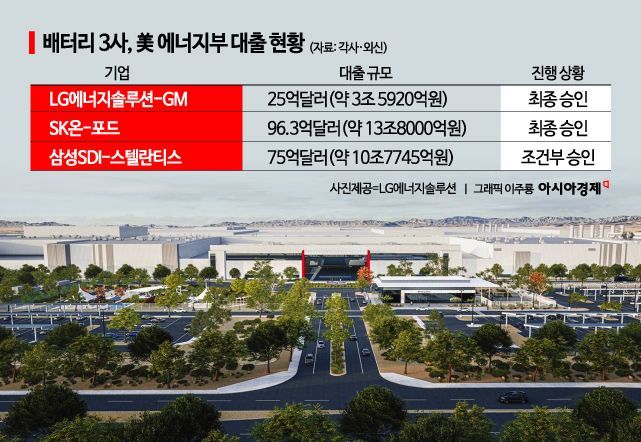
The DOE's ATVM loan program provides funding for automobile and parts manufacturing businesses. It was established under the Energy Independence and Security Act of 2007. Along with the U.S. Inflation Reduction Act (IRA), it serves as an incentive to attract the automotive industry domestically. By supporting construction and operational costs at a low interest rate equivalent to the 10-year U.S. Treasury bond yield (4.3%), it plays a vital role in easing liquidity for battery companies that must bear construction and facility investment costs amounting to trillions of won in a short period. Previously, LG Energy Solution and General Motors (GM)'s joint venture Ultium Cells secured a $2.5 billion (approximately 3.592 trillion KRW) ATVM loan in 2022.
The reason domestic battery companies are rushing the loan procedures is interpreted as an effort to complete the final approval process before the second term of the Trump administration begins. President-elect Trump has repeatedly announced plans to reduce or halt support for electric vehicle and battery policies. According to foreign media on the 16th (local time), the Trump transition team has drafted documents to reduce support for electric vehicles and charging stations and to strengthen measures blocking Chinese-made cars, parts, and battery materials. The documents also include plans to abolish subsidies (consumer tax credits) of up to $7,500 based on the U.S. Inflation Reduction Act (IRA).
Because of this, there is a strong atmosphere to finalize government-level support before the new administration takes office. An industry insider said, "The Biden administration is also known to be proactive in approving loans to ensure policy continuity in the electric vehicle and battery sectors," adding, "It seems necessary to quickly finalize approvals and start loan disbursements to create an irreversible situation."
There are also expectations that securing loans and accelerating business operations will provide an opportunity to strengthen the position of Korean batteries in the U.S. after the Trump administration takes office. An industry official said, "Strengthening the North American supply chain is positive for Korean batteries," and added, "There is a possibility that new opportunities will arise for the Korean battery industry during the Trump administration period."
© The Asia Business Daily(www.asiae.co.kr). All rights reserved.


















