Growth Rate of Private Korean Language Education Expenses 11.1%
Recently, there has been an increase in the number of parents in the Daechi-dong academy district sending their preschool children to reading and writing academies. Experts say that reading and writing education at the early childhood stage can help improve literacy to some extent, but excessive early education can have adverse effects.
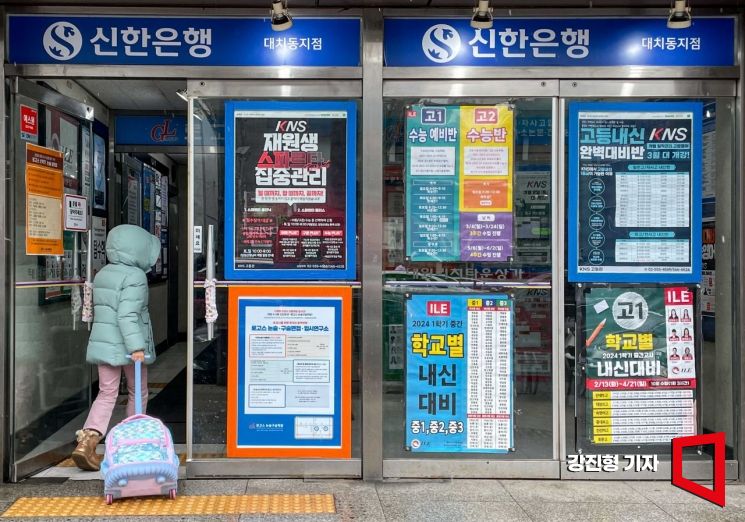 A child is pulling a suitcase into the academy district in Daechi-dong, Gangnam-gu, Seoul. Photo by Jinhyung Kang aymsdream@
According to industry sources on the 17th, reading and writing classes for preschool children are being newly established in academy districts such as Daechi-dong in Gangnam-gu, Seoul, and Banpo-dong in Seocho-gu, Seoul. Previously, classes were mainly focused on subjects for elementary, middle, and high school students, but as inquiries from parents about preschool classes increased, separate '6-7-year-old classes' were created. In the case of a newly established children's reading class at a writing academy in Banpo-dong, Seocho-gu, Seoul, all four classes?comprising Monday-Wednesday and Tuesday-Thursday sessions with a capacity of 10 students each?were fully booked within six months of opening, and they are currently accepting waiting lists.
Kim (49), the director of a writing academy operating for over 10 years in Banpo-dong, Seocho-gu, Seoul, said, "In the past, many parents thought it was only worth paying for writing academies when their children reached lower elementary grades, but recently, many parents have come for consultations with their young children, believing they should send them to reading and writing academies early on. The 6-7-year-old class we currently operate was filled quickly, and we are accepting waiting lists. There are many inquiries from parents requesting additional classes, so we are discussing this with our instructors."
For academies that previously operated writing classes for preschool children, the waiting lists have grown so long that registration requires waiting over two years. A writing academy in Daechi-dong, Gangnam-gu, Seoul, is currently recruiting students for admission in January 2026 for its preschool writing class. Kwon (40), who is raising a 7-year-old child in Dongjak-gu, Seoul, said, "I looked into sending my child to a reading and writing academy because other parents said reading habits should be formed early. I didn’t realize registration was this competitive; at famous academies in Gangnam, it’s joked that you have to put your child on the waiting list even before they are born to get in."
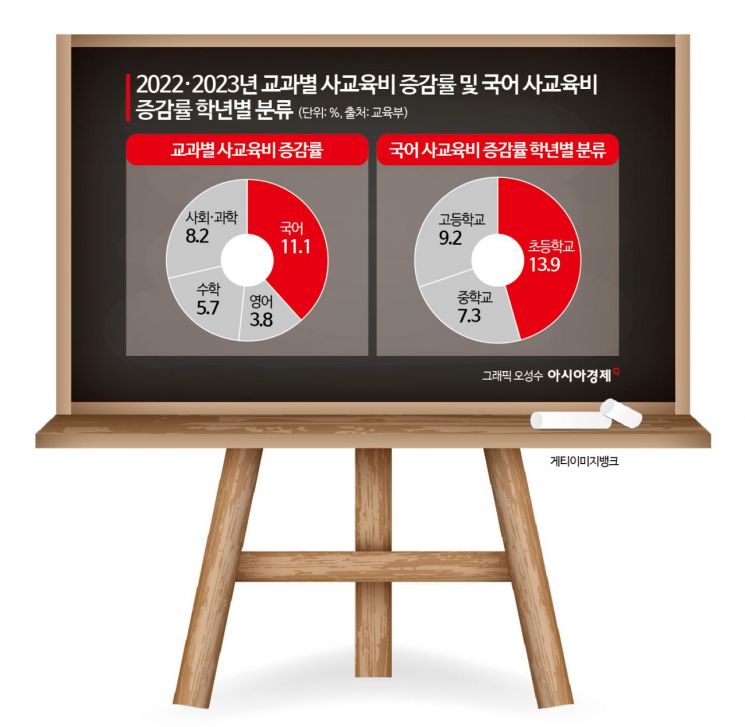
According to the '2023 Survey on Private Education Expenses for Elementary, Middle, and High School Students' published by the Ministry of Education, the total private education expenses spent this year amounted to 27.1 trillion won, a 4.5% increase compared to the previous year (26 trillion won). The average monthly private education expense per person was 434,000 won, up 5.8% from the previous year (410,000 won). Among all subjects, the increase was most pronounced in Korean language (11.1%), followed by social studies and science (8.2%), mathematics (5.6%), and English (3.8%). The growth rate of private education expenses for Korean language by school level was most notable in elementary school (13.9%).
Experts advise that while reading and writing education for young children can help improve literacy to some extent, excessive early education may only increase their burden. Seo Hyuk, a professor in the Department of Korean Language Education at Ewha Womans University, explained, "Oral language development precedes written language development, and the process of reading books and expressing feelings can accelerate children's oral language development. Research also shows that during early childhood, engaging in many conversations and learning vocabulary improves reading and writing skills after entering school. However, logically writing down one’s thoughts in writing, which is required in writing education, is generally possible only from middle school onwards. Instead of forcing writing education at the preschool stage, learning to read books and verbally express one’s thoughts would be more effective."
© The Asia Business Daily(www.asiae.co.kr). All rights reserved.
![Clutching a Stolen Dior Bag, Saying "I Hate Being Poor but Real"... The Grotesque Con of a "Human Knockoff" [Slate]](https://cwcontent.asiae.co.kr/asiaresize/183/2026021902243444107_1771435474.jpg)

















