Six Bills Including the Grain Management Act to Be Discussed at Tomorrow's Cabinet Meeting
Government's Position Is "Rejection"... Opposition Party to Protest If Held
Prime Minister Han Duck-soo, acting president, has entered the final stage of deliberation over exercising the right to request reconsideration (veto power) on six bills, including the Grain Management Act, which were passed solely by the opposition party. According to the government's existing stance, exercising the veto would be a natural step, but it is expected to provoke strong opposition from the opposition party.
According to the Prime Minister's Office on the 16th, the government has not yet finalized whether to submit these bills, which it has opposed so far, to the Cabinet meeting or to exercise the veto power. A senior government official said, "The weight is naturally leaning toward exercising the veto," adding, "These are bills the government has clearly opposed, and changing the stance now would look like flip-flopping depending on the political situation."
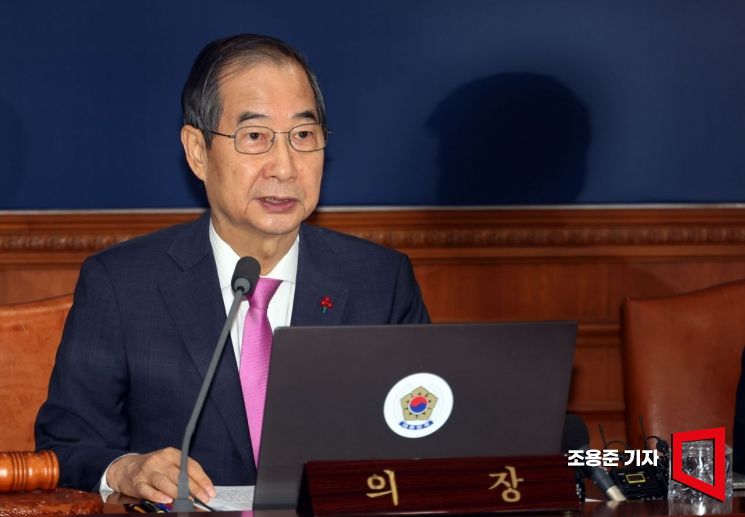 Prime Minister Han Duck-soo is speaking at the first Cabinet meeting held on the 10th at the Government Seoul Office in Jongno-gu, Seoul, following the failure of the impeachment vote against President Yoon Suk-yeol due to a lack of quorum caused by the collective absence of People Power Party lawmakers. Photo by Jo Yong-jun
The problematic bills include the Grain Management Act, the Act on Distribution and Price Stabilization of Agricultural and Fishery Products, the Agricultural and Fishery Disaster Countermeasures Act, and the Agricultural and Fishery Disaster Insurance Act?collectively known as the 'Four Agricultural Acts' amendments?as well as amendments to the National Assembly Act and the National Assembly Witness Examination Act.
The Ministry of Agriculture, Food and Rural Affairs and the Ministry of Economy and Finance have already recommended to President Yoon Suk-yeol that the veto power be exercised on these bills, and Kwon Seong-dong, floor leader of the People Power Party, also requested President Yoon to exercise the veto on the 13th.
These bills were forcibly passed by the opposition party in the National Assembly plenary session on the 28th of last month and were sent to the government on the 6th. The deadline for exercising the veto is the 21st. If the reconsideration request is not submitted, deliberated, and resolved at the regular Cabinet meeting scheduled for the 17th, a separate extraordinary Cabinet meeting must be convened to exercise the veto.
Although exercising the veto is likely, Acting President Han Duck-soo is expected to continue deliberating until the last moment. Exercising the veto would likely make cooperation with the opposition party difficult. In a political situation where the ruling party holds fewer seats than the opposition, it would be challenging to manage the impeachment situation stably without the opposition's cooperation.
Moreover, Acting President Han is currently a suspect in the investigation related to the emergency martial law incident. While the Democratic Party of Korea has expressed willingness to cooperate in managing state affairs by dropping the 'Prime Minister impeachment' card, it cannot be ruled out that they might change their stance if Acting President Han exercises the veto. The pressure is expected to intensify.
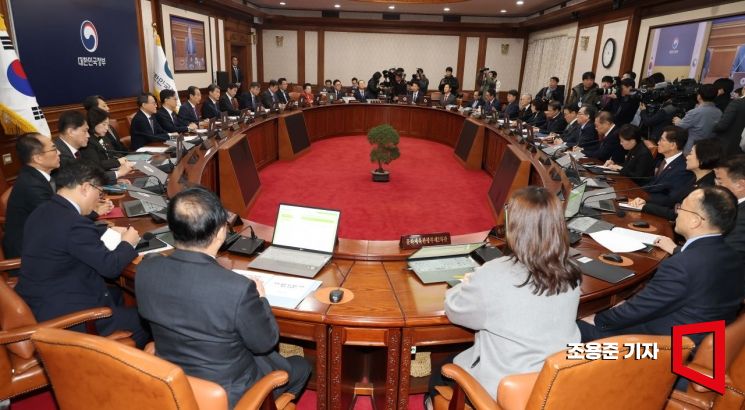 Prime Minister Han Duck-soo is speaking at the first Cabinet meeting held on the 10th at the Government Seoul Office in Jongno-gu, Seoul, following President Yoon Suk-yeol's statement entrusting party and government with state administration. Photo by Jo Yong-jun
So far, the exercise of veto power has proceeded through a procedure where the Cabinet meeting presided over by the Prime Minister resolves the reconsideration request, and then the president approves it. However, with President Yoon's duties suspended, Acting President Han will preside over the reconsideration request resolution meeting as Prime Minister and also approve it in his capacity as acting president.
There is precedent for an acting president exercising veto power on bills. During the Roh Moo-hyun administration, Acting President Ko Gun exercised veto power on special laws regarding compensation for the Geochang civilian massacre and amendments to the pardon law, citing concerns over the national budget burden and potential unconstitutionality. At that time, Acting President Han was involved as the Director of the Office for Government Policy Coordination.
Meanwhile, Acting President Han began receiving presidential office work reports by sector starting today. He listened to reports from Park Chun-seop, Senior Secretary for Economic Affairs, and Shin Jung-beom, Secretary for Economic and Financial Affairs. Bang Ki-jeon, Director of the Office for Government Policy Coordination, also attended. He plans to receive sequential work reports from other senior secretaries' offices this week, including those for social affairs, science and technology, and low birthrate issues.
© The Asia Business Daily(www.asiae.co.kr). All rights reserved.
![Clutching a Stolen Dior Bag, Saying "I Hate Being Poor but Real"... The Grotesque Con of a "Human Knockoff" [Slate]](https://cwcontent.asiae.co.kr/asiaresize/183/2026021902243444107_1771435474.jpg)
















