Korea Labor Institute 'Impact of Impeachment Crisis on Employment' Report
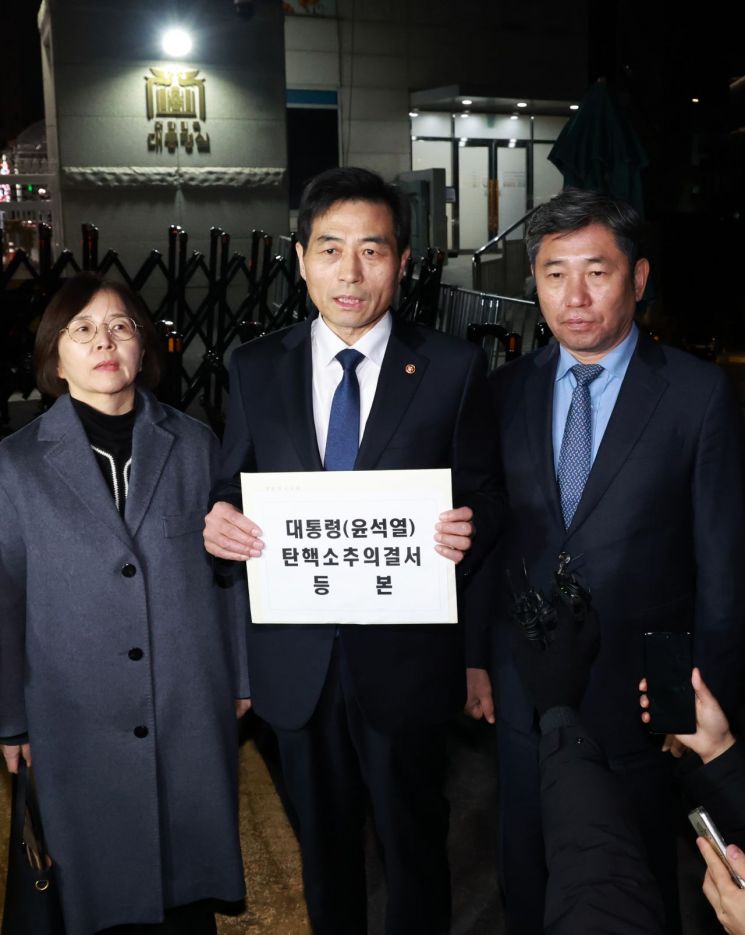
Assemblywoman Kim Hyun-jung "Year-end and New Year Economic Downturn Requires More Attention to Self-Employed and Employment-Insecure Groups"
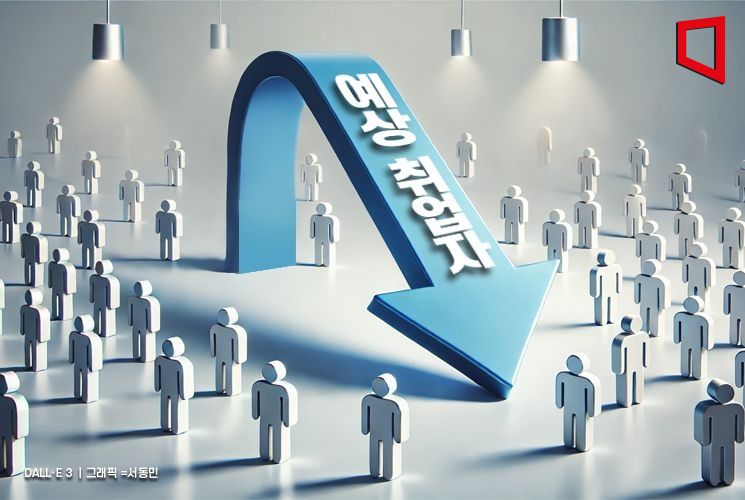
There is a projection from a government-funded research institute that if external credibility deteriorates due to the unprecedented 12·3 emergency martial law situation and the impeachment political turmoil, the increase in the number of employed people next year could fall below 100,000.
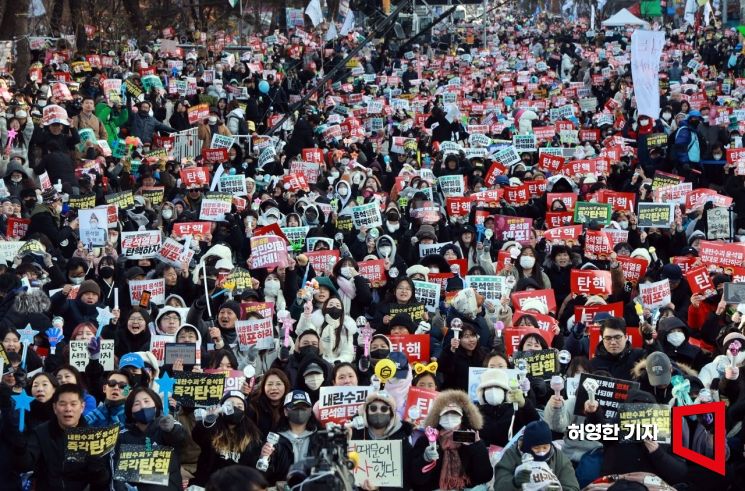 Participants are shouting slogans at a rally calling for impeachment held on the 14th in front of the National Assembly in Yeouido, Seoul, where the second impeachment vote against President Yoon Seok-yeol is scheduled. Photo by Heo Young-han
In a response submitted on the 16th by the Korea Labor Institute to Assemblyman Kim Hyun-jung of the National Assembly's Political Affairs Committee titled "The Impact of the Impeachment Political Turmoil on Employment," concerns were raised that if industrial downturns in sectors such as steel, petrochemicals, and secondary batteries lead to restructuring and external credibility also plummets, next year's employment growth would not only struggle to reach 100,000 but could also be accompanied by a deterioration in employment quality.
The fact that the increase in the number of employed people falls below 100,000 means that the prolonged impeachment political turmoil could cause significant damage not only to the financial markets but also to the real economy. This figure is more than 17% lower than the Korea Labor Institute's previous estimate before the impeachment turmoil, which projected that the number of employed people in 2025 would reach 28.72 million, an increase of 120,000 from the previous year. It is also more than 45% lower than the 182,000 increase in employed people announced by the Korea Development Institute last September. This means that next year's employment growth would drop to about 30% of last year's 327,000, which was driven by increased employment among the elderly.
The Labor Institute pointed out, "Since companies have already set their business plans for the next year, if the impeachment turmoil prolongs, it will inevitably cause serious disruptions to corporate management," adding, "If there are issues related to large-scale investment attraction, it could negatively affect employment."
There was also a warning that President Yoon Seok-yeol's impeachment turmoil could have a worse impact than the impeachment of former President Park Geun-hye, potentially causing employment problems comparable to those during the 1980 martial law period. The Labor Institute expressed concern, stating, "If the perception spreads that the sustainability of policy direction is lacking, the ripple effects on the labor market could be shockingly worse than those during the 2016 impeachment turmoil," and "Self-employed businesses may face increased difficulties at the end of this year and early next year."
In particular, it explained, "This impeachment turmoil is likely to be temporally more similar to the 1980 martial law period than to the Park Geun-hye state affairs manipulation scandal that lasted from October 2016 to May of the following year," adding, "Along with economic downturn and political instability, the increase in employed people during the 1980 martial law period decreased by about 110,000 compared to the previous year, mainly among daily workers with lower employment security."
Politics was also cited as the biggest variable for the future labor market. The Labor Institute forecasted, "If the political process becomes clear and signals spread that government policies are operating systematically, the impact on employment will be limited." It emphasized, "To minimize the negative impact of the impeachment turmoil on employment, politics must not further increase overall economic uncertainty," and "Policy efforts for economic stabilization and revitalization centered on the National Assembly are necessary, and this point should be kept in mind during the upcoming presidential election process."
Assemblyman Kim Hyun-jung stated, "Since South Korea's growth rate is expected to slow down due to the strengthening of U.S. protectionism and instability in the Chinese economy, negatively affecting employment, it is necessary to clearly demonstrate the political process and prove that government policies are operating according to the system," adding, "With the global economic downturn and impeachment turmoil overlapping, difficulties are arising mainly in face-to-face service sectors at the end of the year and early next year, so more attention should be paid to revitalizing the self-employed business sector and to vulnerable groups with employment insecurity."
© The Asia Business Daily(www.asiae.co.kr). All rights reserved.
![Clutching a Stolen Dior Bag, Saying "I Hate Being Poor but Real"... The Grotesque Con of a "Human Knockoff" [Slate]](https://cwcontent.asiae.co.kr/asiaresize/183/2026021902243444107_1771435474.jpg)


















