Focus on Stabilizing Business Economic Indicators
December Sentiment Economy Worsens Mainly in Manufacturing Sector
With the onset of the impeachment crisis, the clocks of our companies are also ticking rapidly. Companies are diligently monitoring rapidly changing market trends and economic indicators according to the political situation and are seeking future response strategies.
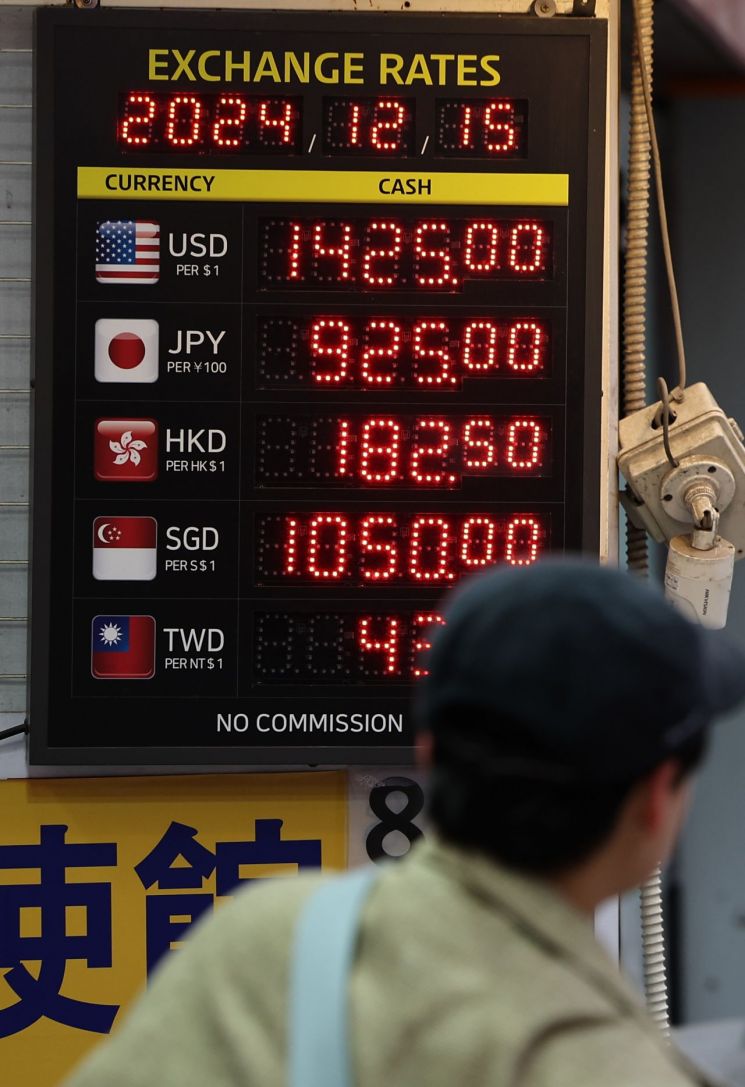 A currency exchange booth in Myeongdong, Jung-gu, Seoul. As the National Assembly passed the impeachment motion against the president, factors such as consumer recession and exchange rates are casting a dark shadow over the domestic economy. Photo by Yonhap News
According to the business community on the 16th, major Korean conglomerates reportedly discussed the impact of the impeachment during their scheduled weekly meetings. Not only the top management but also teams and other units held meetings to explore response measures. In particular, these meetings were considered the last substantial discussions of the year as companies planned their business directions for the next year. It is believed that from next week, most manufacturing companies will switch to year-end rest mode, which would slow down responses to current issues.
Business insiders are showing high interest in measures to stabilize economic indicators. Especially, companies pointed to the high exchange rate as the biggest issue. While the business community acknowledges that the approval of the impeachment motion against President Yoon Seok-yeol has removed uncertainty and avoided the worst-case scenario, complaints persist that the high exchange rate still prevents them from feeling secure. As of the morning of the day, the won-dollar exchange rate stood at 1,433.20 won per dollar. A high exchange rate makes it difficult for companies importing raw materials from overseas to generate profits.
Because of this, there are significant concerns that the manufacturing sector will suffer major damage among various industries. According to the ‘November Business Survey Results’ announced by the Bank of Korea on the 27th of last month, the Corporate Business Survey Index (CBSI) worsened significantly, centered on manufacturing. The CBSI is an indicator that reflects the degree to which companies directly feel the economic situation. The manufacturing CBSI was recorded at 90.6, down 2.0 points from the previous month, marking the lowest level in 1 year and 1 month since October last year (90.5). The decline was also the largest since August (-2.9 points). Many companies expected the economic conditions in December to worsen, especially in manufacturing. The December manufacturing CBSI was forecasted to drop 1.6 points from this month’s outlook to 88.9.
This is also expected to reduce domestic investment incentives. Major manufacturing companies that have made tens of trillions of won in investments in the United States, such as in semiconductors and automobiles, are reportedly considering whether to provide additional support overseas rather than domestically. When the new U.S. administration takes office in January next year, information sharing and responses regarding subsidy reductions and tariff increases will be necessary, but there are concerns that government-level diplomatic support and negotiation power may weaken. A business community official said, "At present, we cannot expect government support," adding, "Companies must find self-help measures on their own."
© The Asia Business Daily(www.asiae.co.kr). All rights reserved.
![Clutching a Stolen Dior Bag, Saying "I Hate Being Poor but Real"... The Grotesque Con of a "Human Knockoff" [Slate]](https://cwcontent.asiae.co.kr/asiaresize/183/2026021902243444107_1771435474.jpg)















