Political Turmoil in Korea on the 11th
Emergency Martial Law Suddenly Declared and Later Lifted by the National Assembly
Impeachment Passed After Great Struggles in the Political Sphere
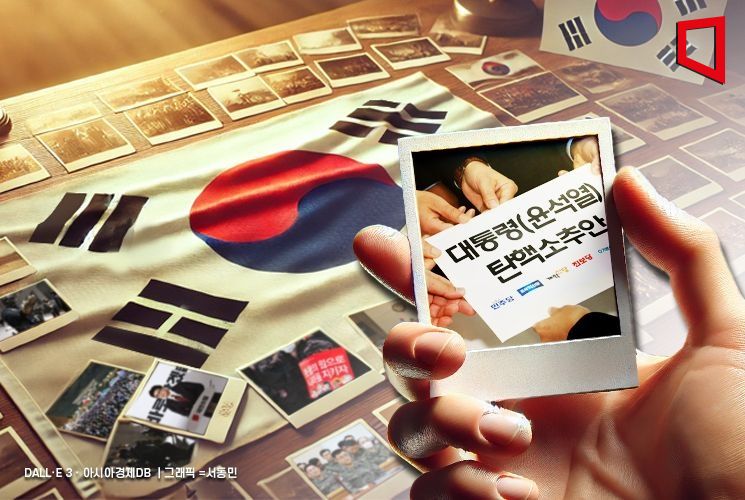
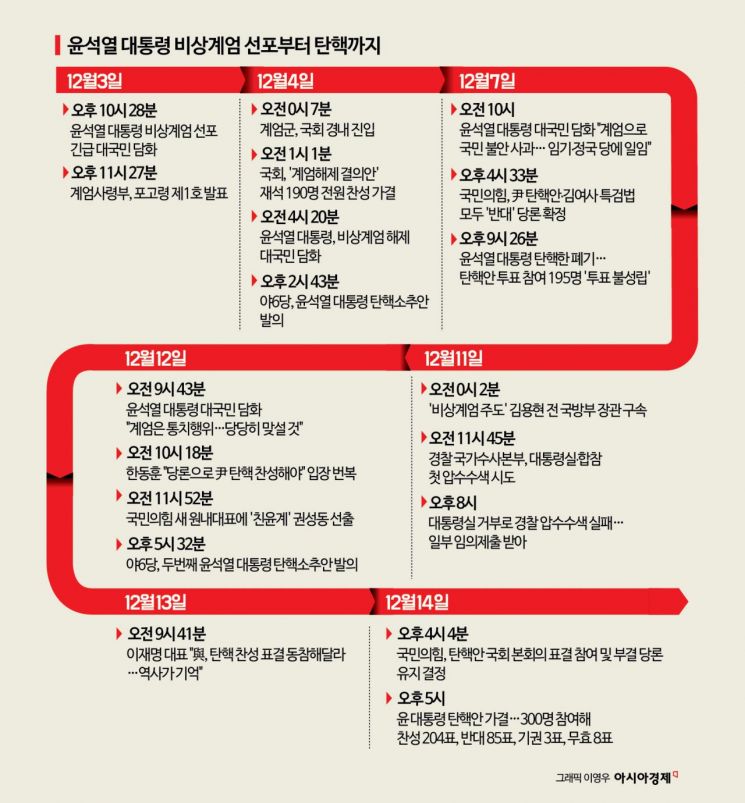
President Yoon Suk-yeol was impeached by the National Assembly and suspended from office. President Yoon, who had boldly declared martial law late at night on the 3rd, politically 'collapsed' in just 11 days. Now, President Yoon stands at a crossroads, awaiting the Constitutional Court's review to determine whether he will return to office or be dismissed. We look back on the past 11 days that shook Korean society.
Yoon's Shock of Declaring Martial Law Late at Night
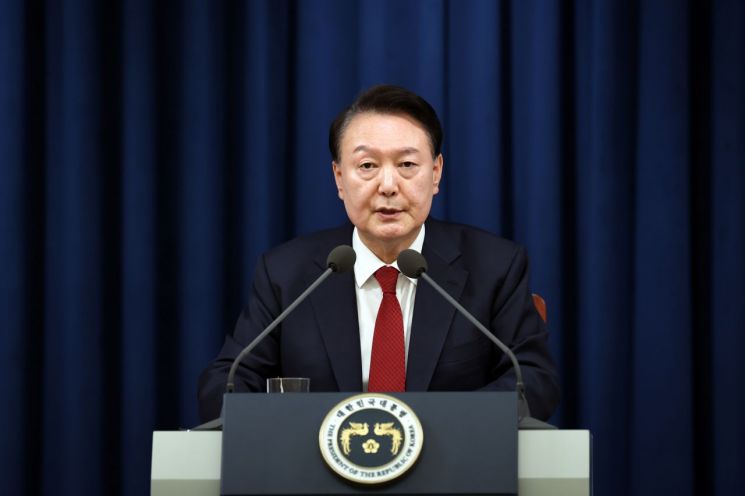
The 'martial law incident' suddenly began late at night on the 3rd. Around 10:23 p.m. that day, President Yoon issued an emergency statement from the Yongsan Presidential Office and declared martial law. He stated, "I declare martial law to protect the free Republic of Korea from the threat of North Korean communist forces, to eradicate the shameless pro-North anti-state forces who plunder our people's freedom and happiness, and to uphold the free constitutional order." The announcement came without the knowledge of most aides at the Yongsan Presidential Office and ruling party lawmakers, causing great shock. Presidential aides were either off work or working late in the office when they heard the president's late-night statement. Reporters were also not informed in advance and were not allowed into the briefing room where the presidential address was held.
Subsequent confirmations revealed that the Cabinet meeting preceding the martial law declaration lasted only five minutes from 10:17 p.m. However, this Cabinet meeting had no signatures, and there was no notification to the National Assembly about the martial law declaration. Further investigation showed that President Yoon had called a small number of Cabinet members to Yongsan around 8 to 9 p.m. to convey his intentions, and when Prime Minister Han Duck-soo and others raised concerns, he reluctantly held a Cabinet meeting. However, the meeting was essentially a notification by President Yoon, and even the attendees did not realize when it ended. There was no official record of the meeting.
After declaring martial law, President Yoon bypassed the Chairman of the Joint Chiefs of Staff and appointed Army Chief of Staff Park An-soo, a graduate of the Korea Military Academy, as the martial law commander. Around 11:30 p.m., the martial law command issued a proclamation.
The proclamation included bans on political activities such as those by the National Assembly, control over the press and publications, and prohibitions on strikes and assemblies. Considering that the Constitution grants the National Assembly the right to demand the lifting of martial law, the decision to ban activities of the National Assembly and others was unconstitutional.
Martial Law Troops Blockade the National Assembly... Lawmakers Climb Over Walls
Once martial law was declared, the entire country went into emergency mode. Both ruling and opposition parties issued 'lawmaker summons' to the National Assembly, and the military formed a martial law command and was ordered to deploy troops to the National Assembly and other locations. Immediately after the martial law announcement, Lee Jae-myung, leader of the Democratic Party, and Han Dong-hoon, leader of the People Power Party, declared opposition to the martial law declaration and vowed to block it.
With police surrounding the National Assembly, partial access for lawmakers was allowed, but complete lockdowns also occurred. The ruling and opposition parties then showed two different trends. The People Power Party appeared confused. Leader Han ordered lawmakers to gather at the National Assembly, but Floor Leader Choo Kyung-ho directed members to assemble at the party headquarters. Meanwhile, the opposition, upon hearing the martial law news, entered the National Assembly with the help of citizens who climbed over walls. Speaker Woo Won-shik and others also climbed over walls.
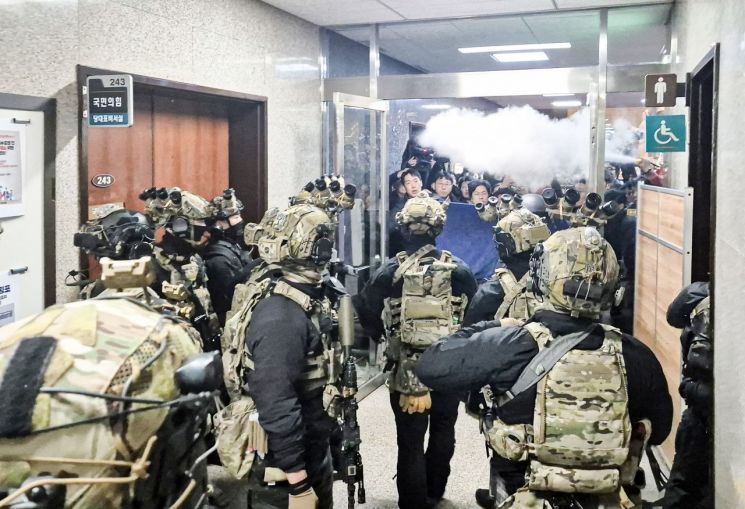
Around midnight, armed martial law troops entered the National Assembly grounds. Among them were some of South Korea's elite units, including the 707 Special Mission Group, the 1st Airborne Special Forces Brigade, and the Capital Defense Command Military Police Special Mission Unit. The 3rd Airborne Special Forces Brigade under the Special Warfare Command and investigators from the Counterintelligence Command went to the National Election Commission and other locations. According to investigations and testimonies of participants, during this period, President Yoon attempted to locate key politicians, journalists, civil society figures, and legal professionals. There are indications that arrests and detentions were attempted under martial law. During this process, President Yoon ordered the arrest of key politicians and the detention of lawmakers gathered in the plenary session to demand the lifting of martial law.
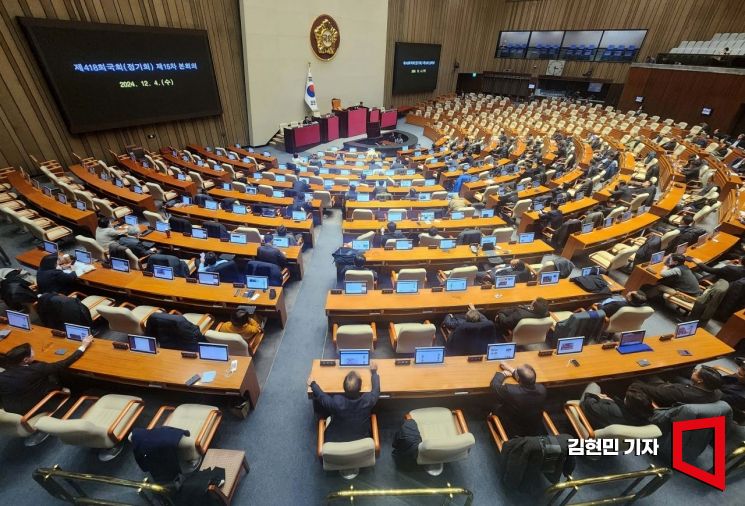 In the early morning of the 4th, opposition party lawmakers stayed overnight in the plenary hall after a resolution demanding the lifting of martial law was passed at the National Assembly. President Yoon Seok-yeol declared martial law in an emergency statement on the night of the 3rd. Photo by Kim Hyun-min
The area inside and outside the National Assembly resembled a battlefield at this time. Outside the National Assembly, citizens blocked the military and police, while inside, lawmakers' aides and party officials physically resisted the military's entry into the plenary hall.
Despite military and police interference, 190 lawmakers eventually gathered in the plenary hall, and at 1:02 a.m., the National Assembly passed a resolution to lift martial law. In addition to 172 opposition lawmakers, 18 People Power Party lawmakers attended. The unanimous passage of the resolution to lift martial law reversed the atmosphere. Once the constitutionally mandated lifting procedure was carried out, the military began to withdraw.
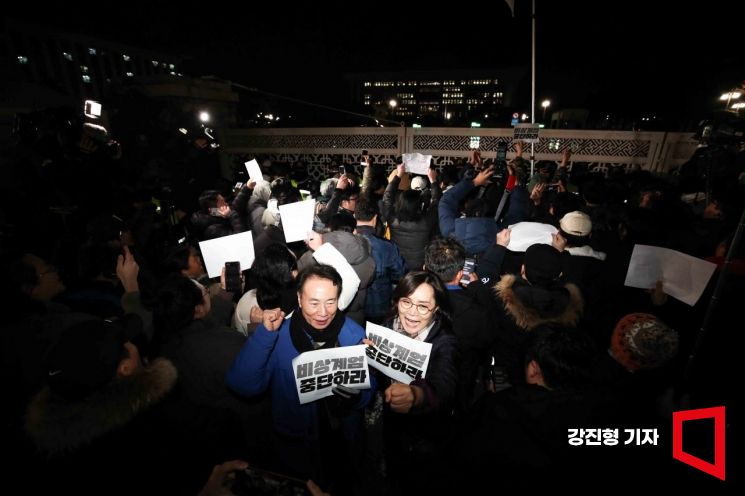 As President Yoon Suk-yeol declared martial law, citizens in front of the National Assembly in Yeouido, Seoul, cheered upon hearing the news of the resolution to lift martial law being passed on the 4th. Photo by Kang Jin-hyung
After Martial Law Ends, It's the National Assembly's Time
As the legitimacy of martial law disappeared and public opinion worsened, President Yoon finally declared the lifting of martial law through an emergency statement around 4:30 a.m. It was about six hours after President Yoon declared martial law and about three and a half hours after the National Assembly passed the resolution demanding its lifting. In his statement, President Yoon said without apology, "The National Assembly just demanded the lifting of martial law, so the military has withdrawn," and "Martial law will be lifted immediately through a Cabinet meeting." In fact, the Prime Minister's Office announced around 5 a.m. that "the Cabinet meeting at 4:30 a.m. resolved to lift martial law."
Immediately after President Yoon lifted martial law, calls for impeachment surged. Until then, the opposition had focused more on a special investigation law for First Lady Kim Keon-hee than on impeaching President Yoon, but with the grounds for impeachment arising from martial law, the weight shifted toward presidential impeachment. The opposition labeled the martial law as 'rebellion.' There were reactions that the grounds for President Yoon's impeachment had finally been fulfilled.
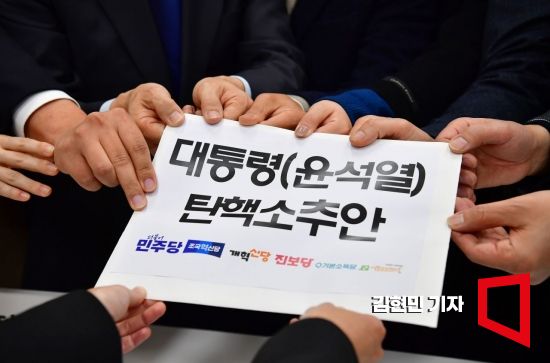 On the 4th, Lee Ju-young of the Reform New Party, Cheon Ha-ram, floor leader, Shin Jang-sik of the Innovation Party for Justice, Yoon Jong-oh, floor leader of the Progressive Party, Yong Hye-in, leader of the Basic Income Party, Han Chang-min, leader of the Social Democratic Party, and Kim Yong-min of the Democratic Party of Korea submitted the impeachment motion against President Yoon Seok-yeol, jointly proposed by six opposition parties, to the National Assembly's Legislative Affairs Office. Photo by Kim Hyun-min
On the afternoon of the 4th, the opposition filed an impeachment motion. President Yoon then began consultations with the government and ruling party. The ruling party decided to reject the impeachment motion as party policy through a late-night party meeting. At 12:48 a.m. on the 5th, the impeachment motion against President Yoon was reported to the National Assembly. The ruling party, including Leader Han, who had played a key role in lifting martial law, demanded President Yoon's withdrawal from the party but aimed to block impeachment. On the 5th, the Democratic Party filed charges of rebellion against eight individuals, including President Yoon, Defense Minister Kim Yong-hyun, Army Chief of Staff Park An-soo, and Minister of the Interior Lee Sang-min, with the National Investigation Headquarters.
On the 6th, President Yoon and Leader Han met at the presidential residence to seek solutions. After discussions, the People Power Party reaffirmed its policy to reject the impeachment motion against President Yoon. The party holds 108 seats, enough to block impeachment. The approval requirement for the impeachment motion is two-thirds of the total National Assembly members (at least 200 votes). The opposition holds 192 seats, so the key was whether eight or more ruling party lawmakers would defect. Therefore, the pro-Han (pro-Han Dong-hoon) faction within the ruling party, which had conflicts with President Yoon, was seen as a casting vote. Leader Han initially said, "I will try to prevent the passage of the impeachment motion," but suddenly changed his stance to "I believe a swift suspension of duties is necessary."
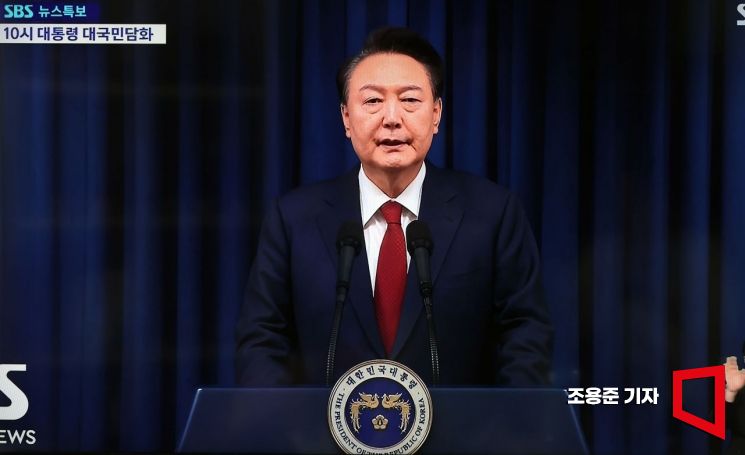 President Yoon Suk-yeol is delivering a live nationwide address at 10 a.m. on the 7th, ahead of the impeachment vote related to the declaration of martial law. President Yoon apologized to the public for the martial law situation and stated that he would entrust his term and political stability measures to the party. (TV footage) Photo by Jo Yong-jun
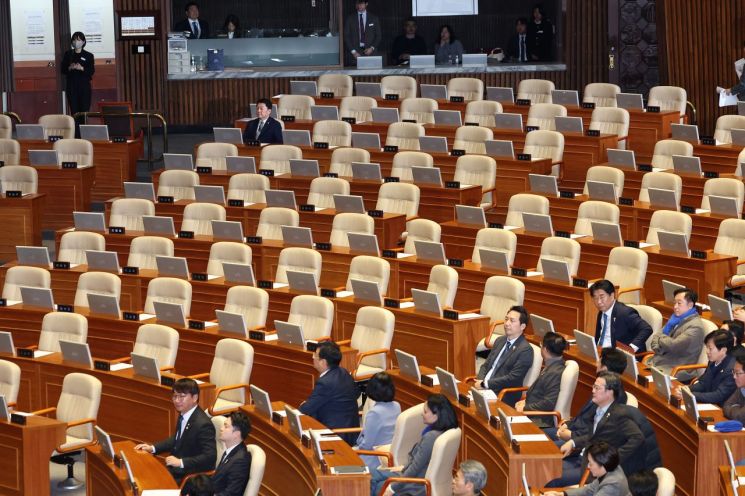
As the situation worsened, President Yoon issued his third national address at 10 a.m. on the 7th, apologizing for the martial law incident. At that time, President Yoon said, "I will entrust the party with stabilizing the political situation, including my term," suggesting he might accept stepping back from the front line. In response, Leader Han reverted to opposing impeachment, and the People Power Party decided through a party meeting to reject both the impeachment motion against President Yoon and the special investigation law for the First Lady ahead of the vote. The National Assembly voted on the impeachment motion against President Yoon that afternoon, but the vote failed due to a lack of quorum caused by the absence of People Power Party lawmakers. Only 195 lawmakers attended, falling short of the 200 required. Among the People Power Party, only lawmakers Ahn Cheol-soo, Kim Ye-ji, and Kim Sang-wook participated in the vote. Speaker Woo Won-shik apologized to the public immediately after the vote's failure, saying, "On behalf of the National Assembly, I apologize to the people."
Impeachment Fails, Chaos Returns
Right after the first impeachment motion was rejected on the 8th, both ruling and opposition parties proposed their own recovery plans. The People Power Party suggested a 'orderly early resignation' of President Yoon as a political solution. In particular, Leader Han and Prime Minister Han held meetings to seek political stabilization. However, the opposition labeled this stabilization plan, which lacked legal grounds, as a 'collusion.'
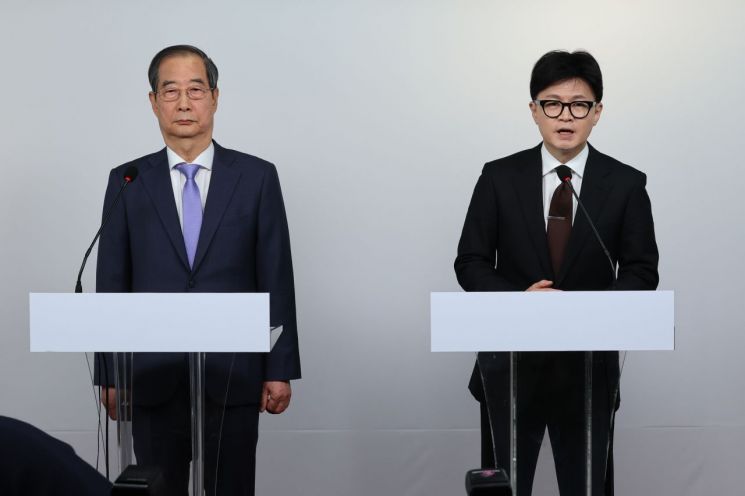 Prime Minister Han Duck-soo and People Power Party leader Han Dong-hoon are announcing a joint statement containing measures to manage state affairs on the morning of the 8th at the People Power Party headquarters in Yeouido, Seoul. Photo by Yonhap News
Public sentiment worsened further. After the weekend, the financial markets also shook. On the 9th, as the impeachment failed and political turmoil ensued, the financial markets and others were severely impacted. President Yoon lost leadership to steer the government, but the resulting vacuum was not filled. While the People Power Party grappled with solutions, the opposition and investigative authorities worked to uncover the truth behind the martial law incident.
On the 10th, the budget bill, one of the reasons cited for martial law, was passed. Despite negotiations between the government and both parties amid the chaotic political situation, differences could not be reconciled, and a reduced budget bill, with cuts made by the opposition to the government's proposal, was passed. The opposition soon mentioned the possibility of a supplementary budget. That day, the entire country was stirred by news that Air Force One, the president's exclusive aircraft, had taken off. Although it was merely a test flight for performance checks, the military and presidential office had to explain due to the sensitive public reaction.
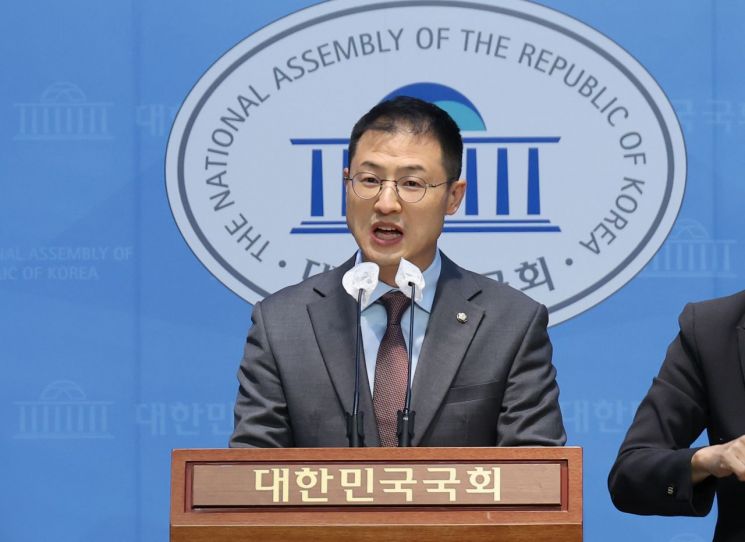 Reporter = Kim Sang-wook, a member of the People Power Party, is holding a press conference at the National Assembly Communication Office on the 10th, urging the president to apologize and resign immediately. Photo by Yonhap News
Protests surged against People Power Party lawmakers who collectively boycotted the vote, and lawmaker Kim Jae-seop even received threats when a box cutter was found in front of his home. The ruling party clung to the 'orderly early resignation' plan, but as time passed, defections within the party gradually increased. Lawmaker Kim Sang-wook, who had voted against impeachment in the first vote, promised on the 14th to vote in favor in the plenary session. Funeral wreaths were delivered to People Power Party lawmakers' constituency offices, and protests demanding impeachment continued. Meanwhile, testimonies from key military personnel involved in the martial law incident poured out. On the 10th, Army Special Warfare Commander Kwak Jong-geun appeared before the National Defense Committee and said, "The president called me directly on a burner phone," and "He said the quorum for the vote was not yet met, so break down the door quickly and drag out those inside."

Kim Yong-hyun, former Defense Minister, who was known to have led the martial law incident alongside President Yoon, was arrested on the early morning of the 11th after an arrest warrant was issued for 'engaging in important tasks of rebellion.' It was also revealed that Kim attempted suicide inside the Seoul Eastern Detention Center just before the warrant was issued. Investigations by prosecutors and police intensified. The National Police Agency's Special Investigation Unit for Martial Law conducted the first search of the Yongsan Presidential Office on the afternoon of the 11th. The charges against President Yoon reportedly include rebellion and mutiny under the Military Criminal Act. However, the search failed due to refusal by the presidential office. The police attempted to search four locations within the presidential office: the Cabinet meeting room, the Security Office, the 101 Guard Unit, and the control command room in the Joint Chiefs of Staff basement, but after nearly eight hours of standoff, they withdrew after receiving some voluntary submissions of materials.
Yoon "I Will Resist"... Adding Fuel to the Fire of Public Sentiment
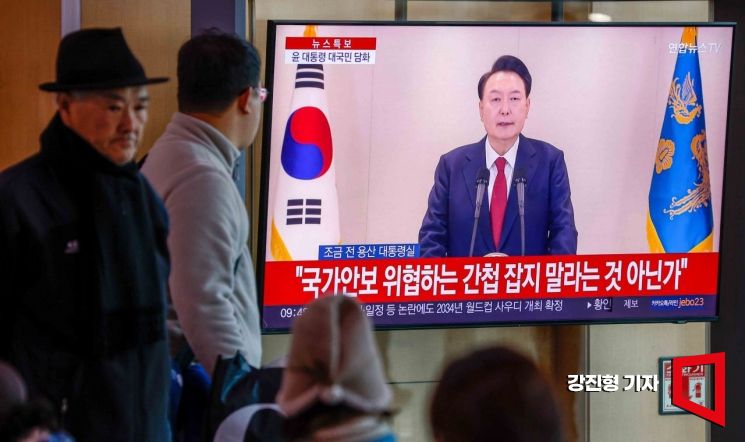 On the 12th, citizens at the Seoul Station waiting room are watching the urgent statement announcement regarding President Yoon Seok-yeol's declaration of martial law. Photo by Kang Jin-hyung
Leader Han, who had opposed the first impeachment vote and advocated for 'orderly early resignation,' eventually reversed his stance. On the morning of the 12th, he announced at the National Assembly, "I have confirmed that the president has no intention of early resignation," and said, "This breaks the public promise to entrust the party with issues including the term." He added, "We must stop further chaos. Now, there is only one effective way," and urged, "At the next (impeachment) vote, our party lawmakers must attend the session and vote according to their conscience and beliefs."
President Yoon immediately issued his fourth national address, reversing his earlier willingness to step back and stating, "Whether impeached or investigated, I will face it confidently." This implied that the martial law declaration was justified, shocking public opinion and the political world again. At that time, President Yoon claimed that the Democratic Party's push for impeachment was "an attempt to avoid the imminent guilty verdict of the opposition leader by impeaching the president and holding an early presidential election." His statement echoed the Constitutional Court's arguments, asserting that the martial law declaration was a 'warning' against the opposition's unilateral control of the National Assembly and was conducted within the constitutional framework, thus not constituting rebellion.
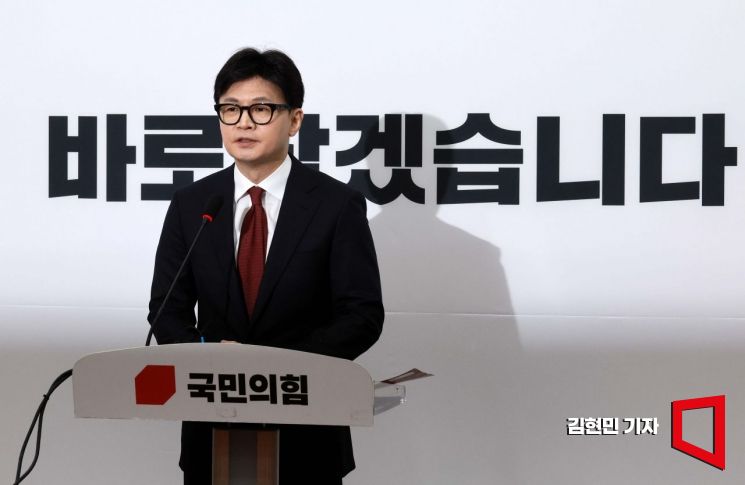 Handonghun, the leader of the People Power Party, is holding an emergency press conference at the National Assembly on the 12th regarding the impeachment of President Yoon Seok-yeol. Photo by Kim Hyun-min
Thereafter, the ruling party descended into extreme division. Leader Han advocated for supporting the impeachment motion as party policy at a party meeting to elect the floor leader. Meanwhile, the pro-Yoon (pro-Yoon Suk-yeol) faction condemned Leader Han. Pro-Yoon lawmaker Kwon Seong-dong was elected floor leader. On the same day, impeachment motions against the Minister of Justice and the Commissioner General of the National Police Agency passed the plenary session. At least 11 ruling party lawmakers voted in favor of the police chief's impeachment.
At 5:28 p.m. that day, the six opposition parties submitted a second impeachment motion against President Yoon to the National Assembly. The opposition narrowed the grounds for impeachment to rebellion to expedite the Constitutional Court's judgment, reflecting situations revealed during the fact-finding process.
And then, on the 14th.
The National Assembly held a plenary session at 4 p.m. to present the second impeachment motion against President Yoon. The vote took place in a solemn atmosphere, unlike the usual shouting or laughter.
The People Power Party, unlike the first time, agreed to 'participate but reject' and entered the plenary hall. After about 20 minutes of speech by Democratic Party Floor Leader Park Chan-dae, the vote proceeded in a solemn atmosphere.
 On the 14th, the impeachment motion against the President (Yoon Seok-yeol) was presented at the 4th plenary session of the 419th National Assembly (extraordinary session) held at the National Assembly. Photo by Kim Hyun-min
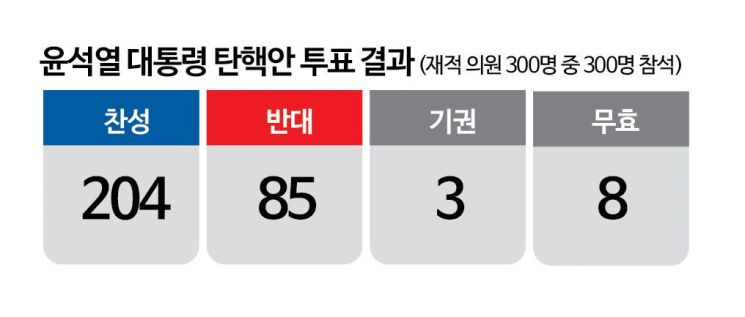
When the counting began, the only sounds breaking the silence in the plenary hall were the whispering of the vote counters and the 'drip-drip' of the counting machines. After several rounds of counting, the vote result held by Speaker Woo Won-shik showed '204 in favor, 85 against, 3 abstentions, and 8 invalid votes.' Speaker Woo declared the impeachment motion passed, saying, "The earnestness, courage, and dedication to democracy shown by the people led to this decision." At least 12 ruling party lawmakers participated in the impeachment vote.
Afterward, the official and certified copies of the impeachment resolution, approved by Speaker Woo, were sent to the Constitutional Court and the presidential office. Upon receipt of the certified copy by the presidential office, President Yoon's duties were suspended. President Yoon's dismissal or reinstatement will be decided through the Constitutional Court's impeachment trial.
© The Asia Business Daily(www.asiae.co.kr). All rights reserved.
![Clutching a Stolen Dior Bag, Saying "I Hate Being Poor but Real"... The Grotesque Con of a "Human Knockoff" [Slate]](https://cwcontent.asiae.co.kr/asiaresize/183/2026021902243444107_1771435474.jpg)

















