Deputy Prime Minister Choi Sang-mok Signals Risk Mitigation After Impeachment Vote
F4 Meetings Run Consecutively for Market Stability Efforts
Advancing Year-End Economic Policy Direction and Fully Committed to Managing External Credibility
Authorities' Leaders Strengthen Global Communication Through Overseas Interviews and Meetings
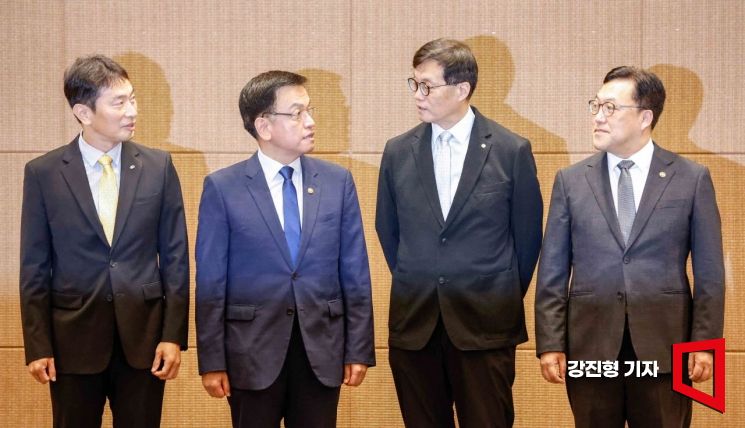 Lee Bok-hyun, Governor of the Financial Supervisory Service, Choi Sang-mok, Deputy Prime Minister for Economy and Minister of Economy and Finance, Lee Chang-yong, Governor of the Bank of Korea, and Kim Byung-hwan, Chairman of the Financial Services Commission (from left), are attending the "Macroeconomic Financial Meeting" held on the 19th at the Seoul Regional Public Procurement Service Annex in Seocho-gu, Seoul, exchanging opinions. Photo by Kang Jin-hyung aymsdream@
From the martial law situation to the presidential impeachment phase, economic leaders have continued strong efforts to stabilize the market amid political upheaval. During the two weeks of ongoing turmoil, economic and financial authorities have devoted themselves fully, even sacrificing weekends, to restoring domestic and international confidence. Although the political risk has been partially alleviated with the National Assembly’s approval of the impeachment motion against President Yoon Seok-yeol over the weekend, economic leaders plan to remain vigilant for the time being.
Since the impeachment motion was passed on the 14th, the financial market has shown signs of calming down. On the morning of the 16th, the won-dollar exchange rate opened at 1,431 won, down 2.0 won from the previous trading day, and the KOSPI recovered to the 2,500 level. Foreign exchange and financial authorities have also quickly communicated this market stabilization trend externally. At the 'ASEAN (Association of Southeast Asian Nations) +3 Economic Cooperation and Financial Stability Forum' held that morning, Choi Sang-mok, Deputy Prime Minister and Minister of Economy and Finance, stated in his opening remarks, “We are well aware of the international community’s concerns about Korea’s political situation, but Korea’s economic system is solid and the emergency response system is operating stably,” emphasizing, “Political uncertainty was resolved last weekend in terms of the recovery process.” Although the forum had been scheduled months ago, the timing coincided to provide an opportunity to deliver a message of market stability.
An official from the Ministry of Economy and Finance explained, “Deputy Prime Minister Choi is sending a message daily that despite internal and external uncertainties, authorities are making every effort to stabilize the market and that volatility is gradually decreasing,” adding, “At this critical time, repeated and consistent messaging is important to prevent political instability from leading to economic sentiment contraction.”
Before the forum, Deputy Prime Minister Choi also met with Lee Kou-ching, Director of the ASEAN+3 Macroeconomic Research Office (AMRO), and stressed economic stability by saying, “The Ministry of Economy and Finance will take the lead and do its utmost to manage the economy as stably as possible,” and “The National Assembly and government will cooperate regardless of party lines.” He focused on consistently conveying the message that the economy is being managed stably to prevent this situation from negatively affecting external credibility. At the emergency macroeconomic and financial issues meeting (F4) held that day, Deputy Prime Minister Choi also noted, “The government bond yields are maintaining a stable level, and the foreign exchange market is showing signs of reduced volatility.”
The announcement of next year’s economic policy direction has also been moved forward to be released within this year. On the afternoon of the 15th, when the impeachment was decided, Deputy Prime Minister Choi chaired an emergency meeting of economic-related ministers and decided to release the 2025 economic policy direction within this month, covering four major policy directions: maintaining external credibility, responding to trade uncertainties, improving industrial structure, and stabilizing people’s livelihoods. Originally, the economic policy direction was expected to be postponed to next year due to the martial law aftermath delaying the announcement schedule. However, as political turmoil intensified and variables increased more than ever, it appears that the decision was made to establish a policy core for swift follow-up measures.
The market stabilization efforts by economic leaders, including Deputy Prime Minister Choi, have been at an unprecedented level. The F4 meetings have been held almost daily for two weeks since the martial law situation, except for two Saturdays, closely monitoring market trends. The Financial Supervisory Service (FSS) has also taken strong measures, holding financial situation review meetings every two days instead of the usual once a month.
Communication with the global financial sector has also been strengthened. Lee Chang-yong, Governor of the Bank of Korea, gave three direct interviews to foreign media after the martial law situation, emphasizing that “economic issues operate independently from political situations” and “considering Korea’s solid market fundamentals and mature democratic system, separation of politics and economy is possible.”
Kim Byung-hwan, Chairman of the Financial Services Commission, and Lee Bok-hyun, Governor of the Financial Supervisory Service, held meetings with representatives of major global credit rating agencies such as S&P and Moody’s, and met with the British and Japanese ambassadors to Korea to explain the stability of the Korean financial market and the progress of value-up policies, focusing on enhancing external credibility. A meeting with the Japanese Financial Services Agency minister is also scheduled, indicating that exchanges with the global financial sector are expected to expand further.
In the market, the prevailing view is that gradual stabilization will follow as some uncertainties have been resolved. Major securities firms assess that political risks have been partially alleviated by the approval of the impeachment motion. Kim Byung-yeon, a researcher at NH Investment & Securities, forecasted, “The Korean financial market will focus on the possibility of increased government spending following the new government’s launch in the second half of next year, political resilience, and capital market stabilization,” adding, “The stock market is expected to show an upward trend reflecting expectations for domestic demand stimulus.”
However, since it is not yet time to lower vigilance, authorities’ market stabilization drive is expected to continue. Given that domestic and international variables still exist due to recent political situations and the launch of the new U.S. administration, comprehensive monitoring of the financial and foreign exchange markets centered on the F4 meetings will be maintained. On the 16th, Chairman Kim also held an expanded executive meeting including department heads to review market conditions and ordered continuous communication with domestic and foreign financial firms and investors. The ripple effects of external variables such as the U.S. Federal Reserve’s monetary policy direction and risks originating from China are also being closely watched. An official from the authorities stated, “If the approval of the impeachment motion is interpreted externally as a resolution of uncertainty and normalization of the economy, it is positive,” but emphasized, “Since volatility remains, the perspectives of overseas investors must be carefully monitored.”
© The Asia Business Daily(www.asiae.co.kr). All rights reserved.

















