To address future food supply issues, technology development that integrates plants, agriculture, electronic engineering, and bioengineering is being promoted.
The Electronics and Telecommunications Research Institute (ETRI) announced on the 16th that it will hold the "1st Plant-Electronic Engineering Convergence Symposium" on the 17th at the Hoam Faculty House of Seoul National University to solve future food supply problems.
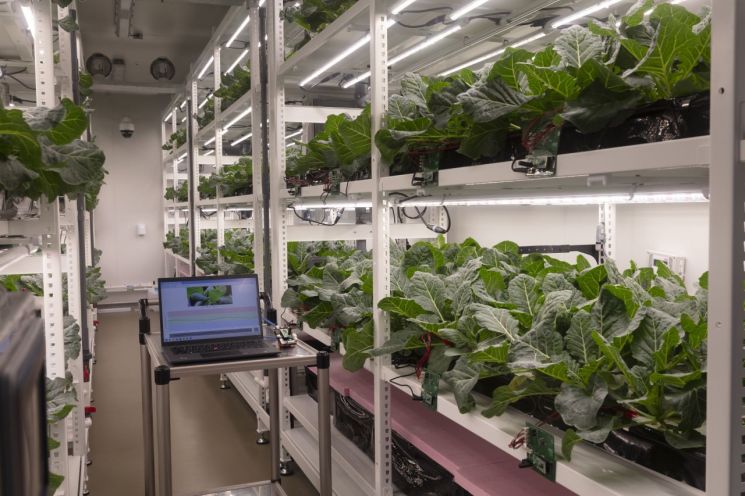 Indoor farm scene applying the plantronics-based unmanned automatic plant health monitoring system developed by the joint research team of ETRI and Seoul National University. Photo by ETRI
The symposium will reveal for the first time research achievements such as plant-integrated electrode technology, plant in-body technology, and plant haptics technology developed domestically.
Previously, ETRI and Seoul National University conducted joint research to find solutions to future food supply problems, producing world-class research outcomes through the convergence of plant/agriculture and bio/electronic engineering.
First, the plant-integrated electrode technology plays a crucial role in electrically assessing plant health and forming electrodes essential for promoting growth through electrical stimulation to stabilize plants.
The research team also developed plant in-body technology that applies various frequency voltages within plants and analyzes the resulting microcurrents to monitor and respond to the plant's stress levels in real time.
Additionally, plant haptics technology electrically endows tactile functions to plants, which lack touch, enabling them to respond to external factors such as wind, snow, and pests.
The severity of climate change and environmental pollution leads to instability in the supply and demand of agricultural and marine products, affecting humanity's food supply issues. In this context, agriculture and food production technologies, along with artificial intelligence, semiconductors, bio, and quantum technologies, are gaining attention as new industrial fields responsible for humanity's future.
The symposium will be filled with discussions among domestic experts in plant science, agriculture, electronic engineering, and bioengineering on maximizing the practical application and impact of related technologies such as plant-integrated electrode technology. In particular, experts attending the symposium will explore sustainable plant management and ecosystem innovation strategies using the Plantronics approach.
This discussion provides an opportunity for plant and agriculture experts from government, research institutes, universities, and companies to be introduced to a new approach in electronic and bioengineering, and for electronic and bioengineering experts to be presented with new application targets in plants and agriculture, fostering mutual exchange and cooperation.
Furthermore, the symposium will feature presentations and expert discussions on topics such as the application of human electronic engineering to plants, plant electronic engineering, next-generation plant diagnostics, and plant-mimicking material engineering.
ETRI and Seoul National University expect this event to be a practical first step toward solving future food supply issues for Korea and humanity.
Senior Researcher Kim Jae-jun of ETRI stated, "Considering the increasingly severe climate crisis, developing new agricultural technologies is not an option but a necessity," adding, "The symposium will be an opportunity to confirm the importance and potential of convergence research to solve future food supply problems."
Meanwhile, the symposium is based on the project "Development of a Plantronics-based Direct Plant Health Monitoring System for Ultra-environmental Plant Cultivation and Full-cycle Management," a new-concept preliminary research project jointly conducted by ETRI and Seoul National University.
© The Asia Business Daily(www.asiae.co.kr). All rights reserved.

















