Creating an 'Edge City' Beyond a Bedroom Town with Advanced Industry and Self-Sufficiency
Developing Penta Station Area as a Complex Transfer Center and Cultural-Industrial Convergence Hub
Lee Dong-hwan, Mayor of Goyang, "Fostering Urban Competitiveness Centered on Advanced Industry"
Goyang Special City, Gyeonggi Province (Mayor Lee Dong-hwan) plans to develop an advanced knowledge industry complex with self-sustaining functions in the Daegok Station area and nurture it as a hub for transportation, culture, and industry where five railway lines intersect.
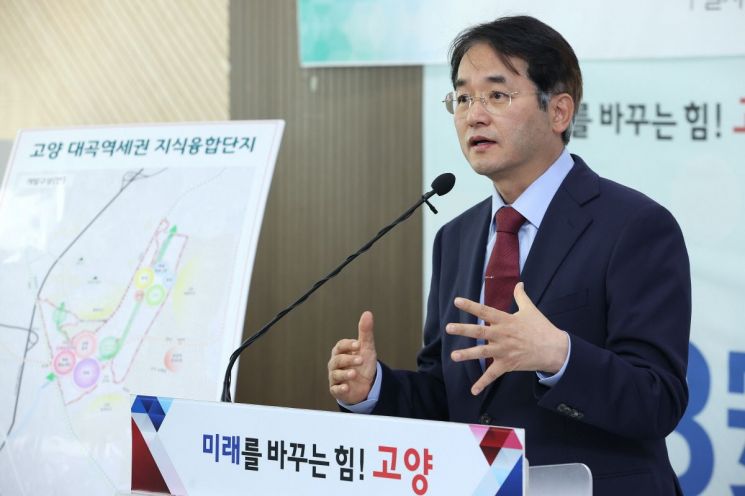
Mayor Lee Dong-hwan of Goyang Special City stated, “Despite multiple regulations, Goyang City is optimally located near the capital Seoul and Incheon International Airport, making it ideal for securing domestic and international talent and fostering advanced industries. We aim to create a competitive city centered on advanced industries like the Silicon Valley in the U.S., moving beyond a mere bedroom community serving residential functions.”
Goyang Special City plans to develop the ‘Daegok Station Knowledge Convergence Complex,’ announced last November, as an independent edge city with self-sustaining capabilities.
An edge city refers to a city that is independent and self-sustaining without being subordinate to the old downtown area. The concept was popularized in 1991 by American journalist Joel Garreau. Its main elements include sufficient office space (jobs), retail (serving as a center for commerce and leisure), more jobs than residences, formation of living zones, and non-urban areas.
A representative example is the cities in the Silicon Valley area near San Francisco, USA. Silicon Valley was originally a suburb of San Francisco without manufacturing or industrial complexes, but advanced technology companies settled and grew there, leading to explosive job growth and natural expansion of housing, public facilities, and cultural facilities.
Companies and jobs played a central role in urban growth, with world-renowned companies located in cities such as Palo Alto (HP), Mountain View (Facebook), Cupertino (Apple), Sunnyvale (LinkedIn), San Jose (eBay, Adobe), and Santa Clara (Intel).
In Korea, the example of Pangyo is cited. Bundang New Town was a satellite city supporting residential demand in Gangnam, Seoul, but by developing Pangyo with independent self-sustaining functions, major venture companies including IT firms from Gangnam’s Teheran Valley relocated there, growing it into a uniquely prestigious business district in the metropolitan area.
Goyang City faces a challenging environment for attracting large-scale industrial facilities and major corporations due to overlapping regulations such as the metropolitan area overpopulation control zone, greenbelt, and military facility protection zone. However, it plans to create a city balanced with jobs and housing centered on advanced industry promotion policies such as Ilsan Techno Valley, Broadcasting and Video Valley, and designation as an economic free zone.
Goyang Special City plans to develop Daegok Station as a key transportation hub with a three-dimensional metropolitan transportation complex transfer system and establish it as a complex hub area where culture and industry converge.
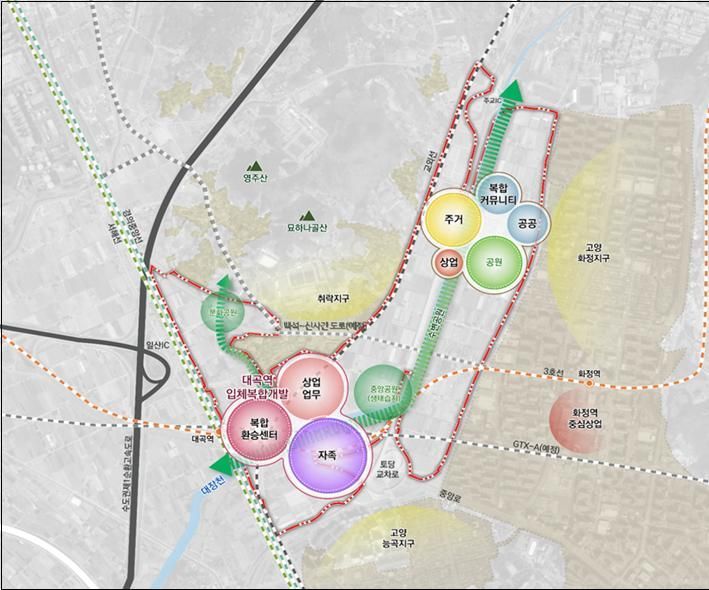
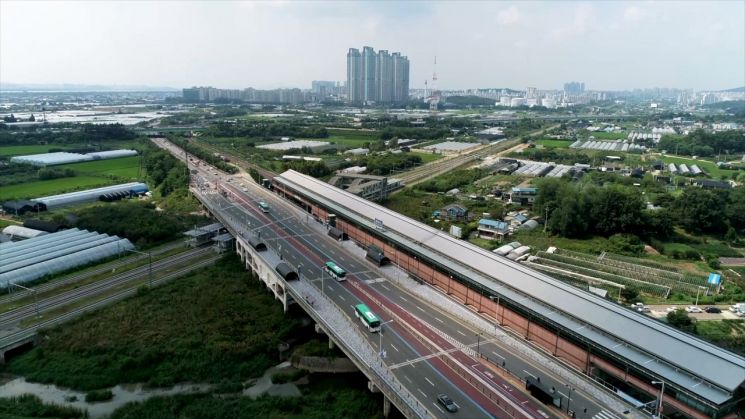
Daegok Station is attracting attention as a penta-station area where five railway lines intersect: the Metropolitan Area Express Railway (GTX)-A line, Subway Line 3 (Ilsan Line), Gyeongui-Jungang Line, Seohae Line, and the Gyeo-ui Line. It is a transportation hub with excellent accessibility to major downtown areas in Seoul and easy and fast access in all four directions: east, west, south, and north.
Goyang Special City plans to utilize Daegok Station’s transportation convenience and growth potential to create a metropolitan transportation complex transfer center and promote three-dimensional complex development. While the presence of multiple railway lines increases accessibility and railway users, there may be a shortage of usable land, so a reasonable complex development plan must be established considering this.
The Paris Rive Gauche project in France is cited as an example of utilizing narrow urban space three-dimensionally. It is an experimental urban redevelopment project connecting the banks of the Seine River by creating an artificial ground. Buildings were constructed above ground to create commercial, residential, and cultural spaces, and the underground was designed for railway lines. The Rive Gauche district developed high-rise buildings housing many companies, public facilities such as the Mitterrand National Library, Paris 7 University, a general hospital, and green spaces.
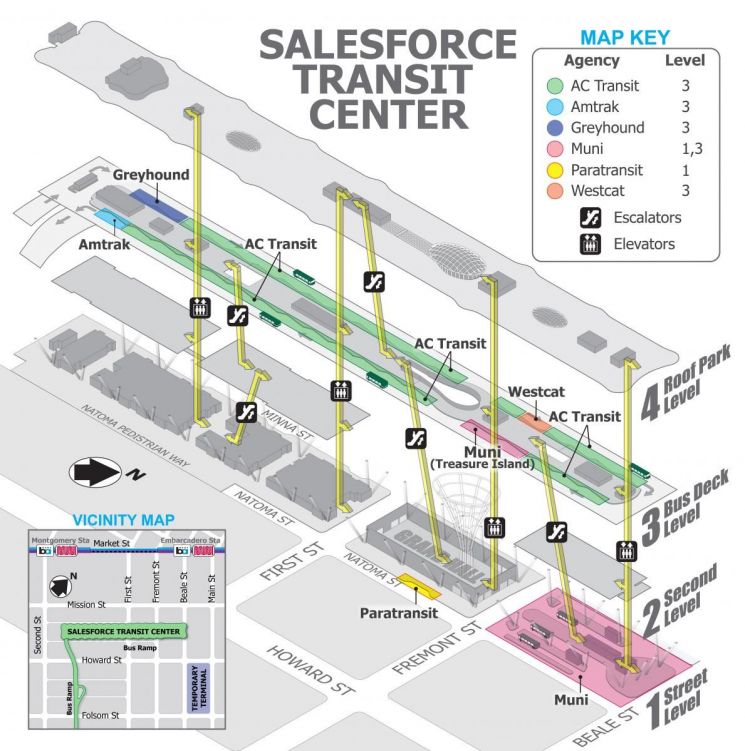
Also, looking at the Salesforce Transit Center in San Francisco, USA, it serves as a hub station connecting major cities’ public transportation. The multi-story building includes a rooftop park and the West Grand Central Station, a state-of-the-art bus and railway station accommodating 11 transportation systems. It is designed to centralize San Francisco’s transportation network to transport more than 100,000 passengers daily.
Goyang Special City plans to develop the Daegok Station complex transfer center to connect various transportation systems and establish it as a complex hub area where culture and industry converge.
Mayor Lee Dong-hwan of Goyang Special City said, “We must take the opportunity to transform the city’s structure, which lacks self-sufficiency, by developing the Daegok Station Knowledge Convergence Complex as a self-sustaining specialized city. It is necessary to establish it as a central hub for transportation and industry through the construction of a metropolitan complex transfer center.”
© The Asia Business Daily(www.asiae.co.kr). All rights reserved.
![Clutching a Stolen Dior Bag, Saying "I Hate Being Poor but Real"... The Grotesque Con of a "Human Knockoff" [Slate]](https://cwcontent.asiae.co.kr/asiaresize/183/2026021902243444107_1771435474.jpg)

















