Traditional Bureaucrat with Over 50 Years of Public Service Experience with Faint Political Color
Summarizes Domestic and International Situations in a Day... Must Garner Opposition Cooperation
Challenges Include 'Political Stabilization,' Personnel Authority, and Veto Power Decisions
In the impeachment political crisis triggered by the emergency martial law situation, Han Duck-soo, a 'traditional bureaucrat' and Prime Minister, has taken on the role of acting president. Given the intense confrontation between the ruling and opposition parties, maintaining balance is expected to be the most challenging task.
On the 16th, Acting President Han Duck-soo plans to receive reports on livelihood issues from various ministries at the Government Seoul Office. On the evening of the 14th, when the impeachment motion against President Yoon Seok-yeol passed the National Assembly, he immediately held a Cabinet meeting after transitioning to the acting president system to assess urgent tasks. He promptly promised to manage state affairs through a public address and subsequently convened the National Security Council (NSC) urgently to review the security situation. He also moved swiftly by communicating with National Assembly Speaker Woo Won-shik and Lee Jae-myung, leader of the Democratic Party of Korea.
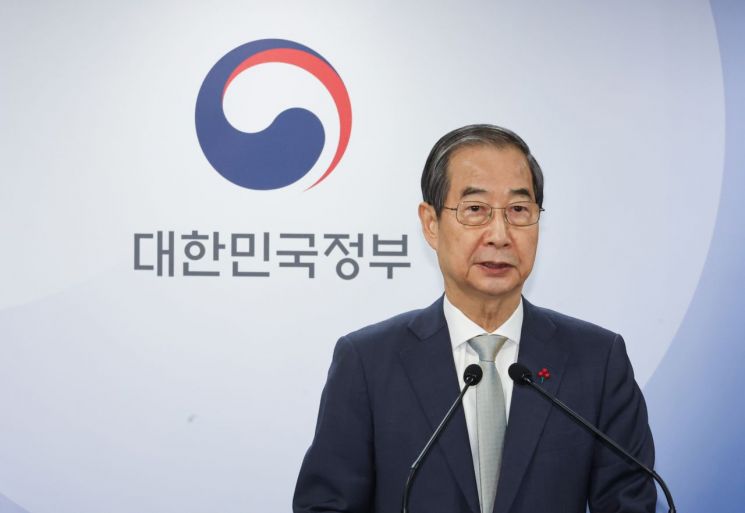 Acting President Han Duck-soo is delivering a national address at the Government Seoul Office in Jongno-gu, Seoul, on the 14th. Photo by Yonhap News
Externally, he confirmed the mutual commitment to the Korea-US alliance with US President Joe Biden via phone and urged General Paul LaCamera, Commander of US Forces Korea, to maintain joint defense readiness. All this was accomplished within a single day.
Holding the helm of a sinking ship, Acting President Han is an 'elite bureaucrat' with extensive experience in economic, diplomatic, and trade fields. He is serving his second term as prime minister following the Participatory Government, and combined, he is the longest-serving prime minister since democratization. His lack of strong political affiliation in a minority government is an advantage. With over 50 years of public service experience, his background is considered well-suited to repair the damage to South Korea's diplomatic status and credibility.
He has already managed an impeachment crisis as the Minister for Government Policy Coordination during the Participatory Government. However, the current situation differs from when a 'managerial prime minister' was needed. He must exercise personnel authority over Constitutional Court justices presiding over the impeachment trial, as well as the Ministers of National Defense and the Ministry of the Interior and Safety. He also faces the decision of whether to veto laws such as the Grain Management Act, which was passed solely by the opposition party. It is uncertain how the opposition will react if the ruling party's veto demands are met.
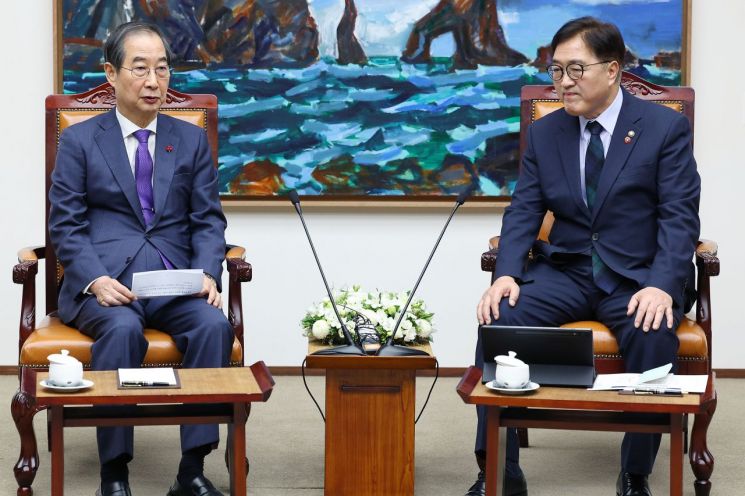 Acting President Han Duck-soo is paying a courtesy call on National Assembly Speaker Woo Won-shik in the Speaker's office on the 15th. Photo by the Presidential Office Press Photographers Group
Originally, the opposition party, which had even predicted a 'prime minister impeachment,' decided to accept the acting president system for the sake of political stability. Instead, Lee Jae-myung, leader of the Democratic Party, proposed forming a 'political stability consultative body' involving both the National Assembly and the government. The government quickly expressed willingness to accept this, but the People Power Party rejected it, asserting "We are the ruling party."
It remains to be seen whether National Assembly Speaker Woo Won-shik, who swiftly ended the emergency martial law situation, will act as a facilitator. After meeting Acting President Han at the National Assembly the previous day, Speaker Woo reached a consensus on cooperation between the government and the National Assembly to manage the political situation. He also reportedly plans to communicate directly with the People Power Party to form the consultative body.
The key will be whether Acting President Han can demonstrate the art of balance amid the confrontation between the ruling and opposition parties. He stated, "I believe that swift resolution and stable governance are my final duties in a long public service career, and I will devote all my efforts. I will base all standards on the Constitution, laws, and the nation's future, and cooperate closely with the National Assembly."
© The Asia Business Daily(www.asiae.co.kr). All rights reserved.
![Clutching a Stolen Dior Bag, Saying "I Hate Being Poor but Real"... The Grotesque Con of a "Human Knockoff" [Slate]](https://cwcontent.asiae.co.kr/asiaresize/183/2026021902243444107_1771435474.jpg)
















