Blocked Due to Backlash from Pro-Military Faction
The ruling party in Thailand's push to enact the 'Coup Prevention Act' has been stalled due to backlash from pro-military factions.
According to local media including the Bangkok Post on the 15th, Phra Thai Party lawmaker Prayut Siripanich announced that he would withdraw the amendment to the Ministry of Defense Administrative Act, which he proposed earlier this month, amid ongoing controversy.
Since the bill was proposed, pro-military groups have strongly opposed it, arguing that "if the bill passes, there will be political interference in military affairs."
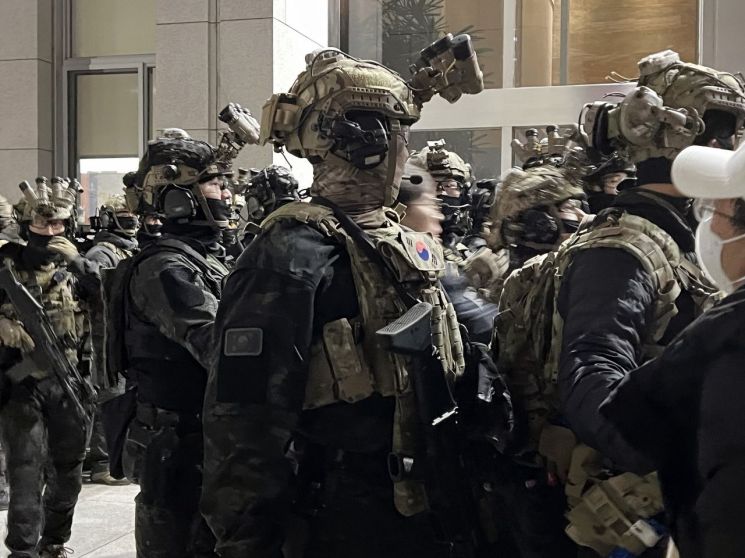 In the early morning of the 4th, armed martial law troops attempted to enter the National Assembly building in Yeouido, Seoul. Photo by Yonhap News
Not only the opposition Palang Pracharath Party (PPRP) but also coalition government parties such as Ruam Thai Sang Chart Party (RTSC) and Phumjaithai Party expressed opposition, leading to conflict. Even within the Phra Thai Party, some lawmakers raised concerns, and there were criticisms that it is difficult to prevent coups through legislation.
As the controversy escalated, Phra Thai Party leader Prime Minister Paetongtarn Chinnawath said, "Opinions on the bill are divided, and all parties involved must listen to every voice." Deputy Prime Minister and Minister of Defense Phumtham Wechayachai also attempted to ease tensions by stating, "There is no intention to seize control of the military, and the government maintains a good relationship with the military."
Ultimately, reflecting opposition both inside and outside the party, lawmaker Prayut decided to withdraw the bill. However, he stated that to ensure national stability, military power must be limited, and he plans to revise and reintroduce the bill in the future.
Prayut’s bill granted the prime minister the authority to immediately suspend military officers attempting to seize power by force. It prohibited the use of the military to control administrative power and stipulated that officers have the right not to obey illegal orders from superiors. The appointment of generals was to be proposed by a personnel committee composed of the Minister of Defense and the Chiefs of Staff, and approved by the cabinet.
Amid the Coup Prevention Act controversy, the Korean martial law incident was also mentioned in Thai political circles and media.
Lawmaker Prayut said, "Granting the prime minister the authority to suspend military personnel who act beyond constitutional responsibilities is to prevent coups," adding, "It is similar to the recent use of authority by the Korean National Assembly to lift martial law declared by the president."
The Bangkok Post editorial stated, "The Korean incident highlights the need for Thailand to establish mechanisms to respond to martial law or coups," and argued that efforts to enact the Coup Prevention Act should continue.
© The Asia Business Daily(www.asiae.co.kr). All rights reserved.
![Clutching a Stolen Dior Bag, Saying "I Hate Being Poor but Real"... The Grotesque Con of a "Human Knockoff" [Slate]](https://cwcontent.asiae.co.kr/asiaresize/183/2026021902243444107_1771435474.jpg)















