'Seminar on US Trump Administration and Digital Policy'
Abolition of Net Neutrality... Active Investment in Spectrum and Infrastructure
Focus on Deregulation and Technological Advancement over AI Safety
It is anticipated that if the Trump administration takes office next year, net neutrality regulations in the United States will be abolished, and frequency policies to prepare for the 6th generation (6G) mobile communication era will be actively promoted. Additionally, regulations and interventions with somewhat political characteristics are expected to be strengthened regarding online platforms and big tech companies.
The Korea University Technology Law Policy Center and the law firm Kwangjang held a seminar on the 12th, presenting and discussing the topic "Prospects and Challenges of Korean Digital Policy Following the Inauguration of the Trump Administration."
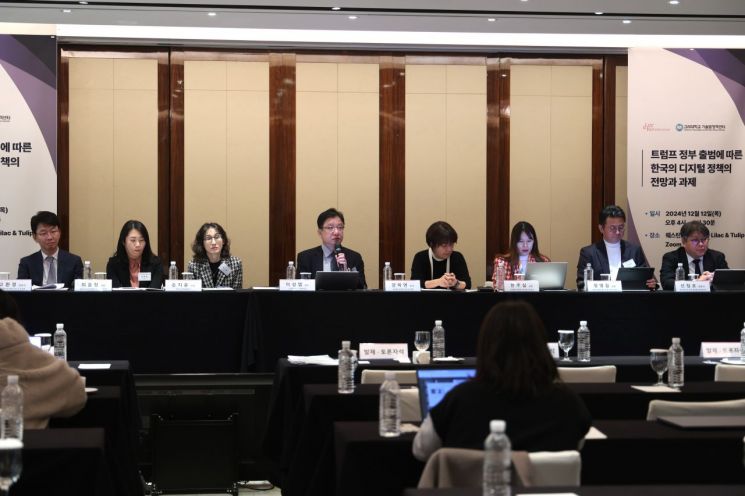 (From left) Lawyer Ko Hwangyeong, Choi Yoonjeong, Director of the Personal Information Commission, Son Jiyoon, Director at Naver, Professor Lee Seongyeop of Korea University, Dr. Kang Hayun, Han Jusil, Director at the Ministry of Trade, Industry and Energy, Jeong Younggil, Director at the Ministry of Science and ICT, and Lawyer Seon Jeongho are discussing at a seminar. Provided by Law Firm Gwangjang.
Abolition of Net Neutrality... Increased Burden on OTT
Dr. Cho Dae-geun, a senior advisor at the law firm Kwangjang, predicted that net neutrality regulations in the U.S. will effectively be phased out. He explained, "The Trump administration abolished net neutrality regulations during its first term, and Brendan Carr, recently nominated as chairman of the FCC (Federal Communications Commission), is also a prominent figure opposing net neutrality regulations."
Net neutrality regulation means treating all internet traffic equally and fairly for everyone. It prohibits intentionally slowing down or blocking internet speeds for specific websites and forbids unfair treatment of any content providers. While telecommunications operators oppose it, platform companies support this regulation.
Recently, since OTT video streaming services such as YouTube and Netflix account for the majority of network traffic, momentum for abolishing net neutrality has increased. Brendan Carr argued in a column that "it is time to fundamentally reconsider the funding method for ultra-high-speed networks" and insisted that "big tech should be required to pay their fair share."
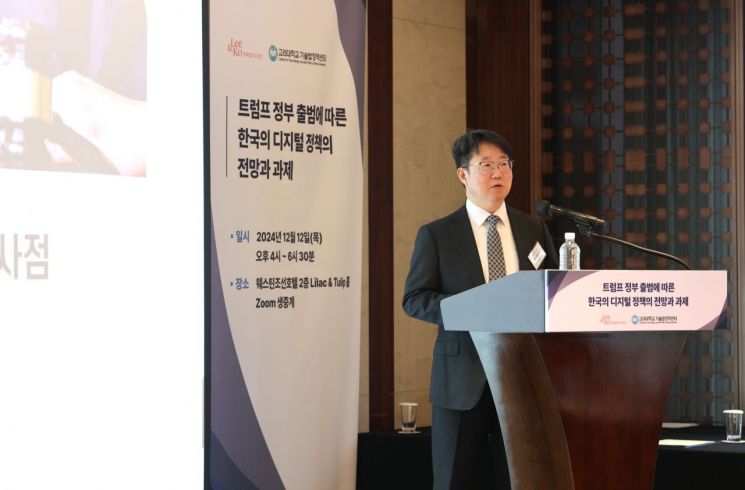 Dr. Cho Dae-geun is presenting on "The Impact and Implications of ISP and Platform Policies Following the Inauguration of the Trump Administration" at a seminar. Provided by Law Firm Gwangjang
6G Frequency and Standards Competition... Rise of Starlink
There is also a prediction that the U.S. will promote active frequency policies and investments to prepare for the 6G era, and that low Earth orbit satellite services will become more active.
First, the "Spectrum Pipeline Act," which secures frequency resources for next-generation networks, is expected to pass in the 119th Congress next year under Republican leadership. This act mandates the FCC to reallocate or auction at least 2,500 MHz of frequency bands between 1.3 GHz and 13.2 GHz. Specifically, it requires completing auctions of more than 600 MHz within three years of enactment and completing auctions of the remaining allocated bands within six years.
The U.S. is currently implementing the BEAD program, a $42.5 billion initiative to improve infrastructure such as broadband internet. It is expected that low Earth orbit satellites like Starlink, led by Elon Musk, will benefit from the BEAD program.
Dr. Cho said, "There is also a podcast remark from President-elect Trump stating that 'using low Earth orbit satellites is better than spending millions of dollars to lay fiber optic cables across the U.S.'" and added, "Low Earth orbit satellite services may emerge as a solution to bridge the digital divide in the U.S."
He continued, "Even in Korea, where communication networks are excellent, it is time to consider the use of low Earth orbit satellite services as a complementary measure for universal service in the mid to long term," and suggested, "Competition over 6G frequency bands and technical standards between Korea and the U.S. may intensify, so preparations are necessary."
In response, Jung Young-gil, Director of the Telecommunications Policy Planning Division at the Ministry of Science and ICT, said, "Since low Earth orbit satellites provide services on a different level than geostationary satellites, we are closely monitoring their potential impact on the domestic market," and added, "The low Earth orbit satellite project passed a preliminary feasibility study this year, and expanding the domestic industrial base will be an important task going forward."
Platform Immunity Clause Likely to be Revised
The United States regulates online platform companies through Section 230 of the Communications Act, which exempts them from legal responsibility for third-party content. This includes the platforms' authority to autonomously manage and delete harmful or illegal content. President-elect Trump has argued that big tech unfairly censors or suppresses conservative voices on social media by exploiting Section 230 and has advocated for strong regulations on this matter.
Dr. Cho predicted, "In the future, the FCC is likely to announce an executive order that strengthens the conditions online platform operators must meet to be exempt under Section 230 and narrows the scope of immunity."
Some states such as Florida and Texas have introduced regulations on social media operators through state laws, but President-elect Trump has claimed he will address this issue at the federal level by including it in a "Digital Bill of Rights."
However, the second Trump administration is expected to adopt a more flexible and lenient stance on big tech mergers and acquisitions compared to the Biden administration, and regulatory easing is likely in new technology fields such as artificial intelligence (AI).
Dr. Cho said, "Throughout Trump's term, legal and institutional disputes over the authority and responsibility of online platform operators regarding content will continue," and added, "These trends in the U.S. are expected to spark discussions in the domestic market as well."
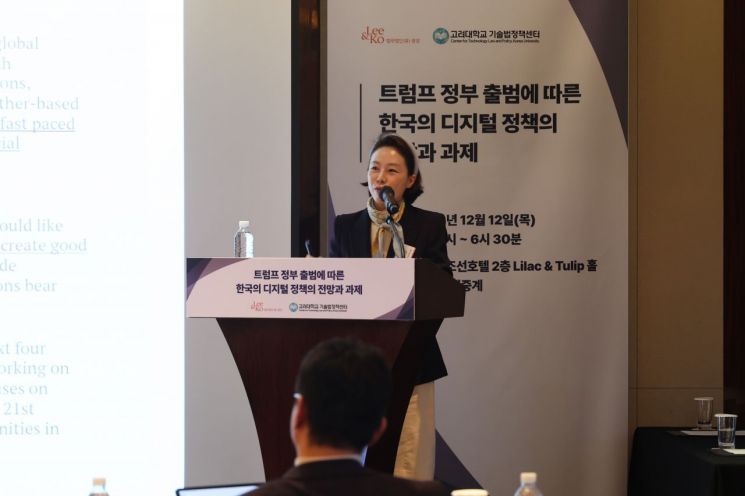 Professor Lee Ju-hyung of Seoul National University of Science and Technology Law School is presenting on "The Impact and Challenges of Data and AI Policies Following the Inauguration of the Trump Administration." Provided by Law Firm Gwangjang
Abolition of AI Executive Order... Focus on Technological Advancement over Safety
If the Trump administration takes office, President Biden's "AI Executive Order," which emphasized safe and transparent AI development, is likely to be abolished, and the role of the AI Safety Institute is expected to be reduced.
Professor Lee Ju-hyung of the Seoul National University of Science and Technology Law School said, "The AI Safety Institute will likely focus on technological advancement instead of safety, ethics, and regulation," and added, "It seems they will prefer minimal regulation within the scope that does not hinder AI technological innovation."
However, it is expected that the Trump administration will align with the Biden administration in principle regarding strengthening cybersecurity using AI, enhancing defense capabilities, and applying pressure on China. Professor Lee noted, "Export controls related to AI, such as semiconductors, will be strengthened," and emphasized, "Attention should also be paid to changes in policies regarding cross-border data movement."
Government: "Practical Trade Negotiations" and "Improvement of Personal Information Policies"
In response to these U.S. AI policy trends, the Korean government is also responding swiftly. Han Ju-sil, Director of the Free Trade Agreement Services and Investment Division at the Ministry of Trade, Industry and Energy, said, "The Trump administration will focus on deregulation and technological innovation, concentrating on advancing its own AI technology," and added, "Trade negotiations will be conducted in a practical manner that genuinely helps companies."
In the U.S., voices are emerging to ease Korea's regulatory barriers related to cross-border data transfers. The more abundant data secured across borders, the more advantageous it is for AI technological advancement.
Choi Yoon-jung, International Cooperation Officer at the Personal Information Protection Commission, said, "We are developing institutional improvement plans to streamline and rationalize the data cross-border transfer mechanism," and added, "We are also reviewing so-called 'Personal Information Policy 2.0 for the AI Era' to proactively respond to the changing AI environment."
© The Asia Business Daily(www.asiae.co.kr). All rights reserved.
![Clutching a Stolen Dior Bag, Saying "I Hate Being Poor but Real"... The Grotesque Con of a "Human Knockoff" [Slate]](https://cwcontent.asiae.co.kr/asiaresize/183/2026021902243444107_1771435474.jpg)

















