Trump's Second Administration May Raise Tariffs on China
CATL and Other Chinese Battery Firms Could Enter US Market
Korean Companies Must Accelerate Planned Investments to Secure Market
Respond to China's Low-Cost Offensive with New Technologies like Fast Charging, Solid-State, and Dry Electrodes
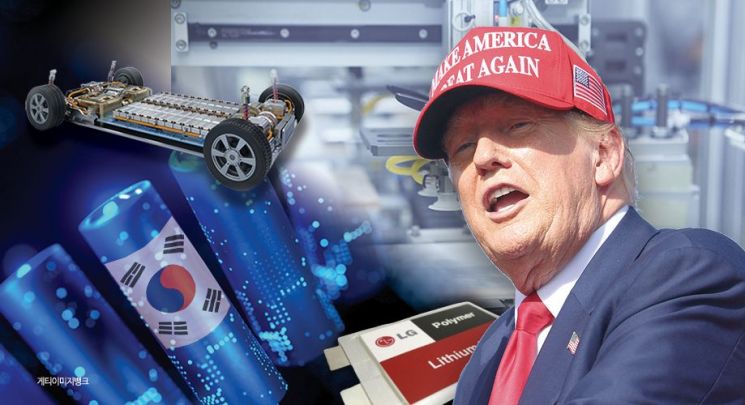
"We need to enter the American fence." "We must raise entry barriers before Chinese companies come in."
At the 3rd Analyst Day event hosted by SNE Research on the 12th at Novotel Ambassador Seoul Gangnam Hotel, held under the theme "Overcoming the Chasm (temporary growth stagnation)," speakers emphasized that domestic battery companies should hasten their investments in the U.S. to raise barriers amid the second term of the Donald Trump administration.
Seho Kim, Senior Research Fellow at LG Business Research Institute, expressed concerns in his keynote presentation that "if the Trump second-term administration relaxes Corporate Average Fuel Economy (CAFE) or Zero Emission Vehicle (ZEV) regulations, it could significantly impact the electric vehicle and battery markets," but also stated, "there is a need to expedite planned investments to strengthen the domestic fence within the U.S."
CAFE is a system regulating the average fuel efficiency of vehicles produced by a company in a year; relaxing it would increase the production of internal combustion engine vehicles. The zero-emission vehicle regulation mandates that a certain percentage of new car releases must be electric vehicles, hydrogen fuel cell vehicles, or other carbon emission-free vehicles, a policy adopted by states like California.
With expectations that environmental policies will retreat under the Trump administration's second term, uncertainty is increasing for domestic battery companies already stuck in the chasm. One notable issue is the imposition of high tariffs on Chinese products.
If the Trump administration modifies or abolishes parts of the Inflation Reduction Act (IRA), which has so far favored domestic battery companies, and shifts to tariff policies against China, Chinese companies like CATL might bypass tariffs and directly enter the U.S. market. Under the IRA, electric vehicles equipped with Chinese minerals or components were ineligible for subsidies. In fact, almost all Chinese companies were classified as Foreign Entities of Concern (FEOC), making U.S. entry difficult.
However, if subsidy regulations are abolished, the FEOC clause would also disappear, opening the door for Chinese companies to enter the U.S. market. Meanwhile, Trump has announced plans to impose a high tariff of 60% on Chinese products. To avoid this, Chinese battery companies may pursue entry into the U.S. In 2023, CATL attempted to establish a joint venture with Ford in the U.S., but the plan was put on hold due to opposition from the U.S. Congress. However, there are expectations that Trump will not block CATL's entry into the U.S.
Experts diagnose that K-battery companies need to preemptively invest to secure market dominance in preparation for Chinese battery companies entering the U.S. Younggeol Park, Head of Division (Executive Director) at Samjong KPMG, said, "Large corporations are rapidly advancing their planned investments in the U.S. to raise entry barriers against China," adding, "there are also many alliances and mergers among domestic small and medium-sized enterprises, as well as attempts by Chinese companies to acquire Korean firms," describing the current market atmosphere.
Recently, LG Energy Solution decided to acquire a factory under construction in Michigan, which was a joint venture with General Motors (GM). It is known that LG Energy Solution plans to convert this factory into a dedicated line for Toyota.
SNE Research emphasized that accelerating the development of next-generation battery technologies is essential to winning the increasingly intense competition with China.
Dooyeon Lee, Vice President of SNE Research, identified next-generation battery technologies such as porous current collectors, fast-charging technologies, battery fire prevention technologies, composite copper foil films, solid-state and semi-solid-state batteries, bipolar batteries, lithium metal batteries, anode-free batteries, lithium-sulfur batteries, 46-series cylindrical batteries, and dry electrode technologies. Taegeun Kim, Director at SNE Research, also stressed, "It is difficult to compete with Chinese companies on price," and emphasized, "we must develop competitive technologies in next-generation materials such as dry electrodes, silicon anode materials, and CNT conductive materials compared to China."
The autonomous vehicle market, expected to see deregulation under the Trump second-term administration, is anticipated to serve as a new opportunity for electric vehicle expansion. Senior Research Fellow Seho Kim said, "Autonomous vehicles and electric vehicles have the potential to grow together," adding, "if the new U.S. government relaxes autonomous driving regulations, it will positively impact the expansion of electric vehicles."
Elon Musk, CEO of Tesla, has recently accelerated autonomous driving services by unveiling the robo-taxi 'Cybercab' and releasing FSD version 13. There are also expectations that Sean Duffy, a House Representative nominated by Trump for Secretary of Transportation, will work to ease autonomous driving regulations. Vice President Dooyeon Lee predicted, "The era of urban air mobility (UAM) and autonomous electric vehicles is coming soon."
© The Asia Business Daily(www.asiae.co.kr). All rights reserved.
![Clutching a Stolen Dior Bag, Saying "I Hate Being Poor but Real"... The Grotesque Con of a "Human Knockoff" [Slate]](https://cwcontent.asiae.co.kr/asiaresize/183/2026021902243444107_1771435474.jpg)











