Emergency Martial Law Declared on Night of 3rd... Staff Unaware
Lifted After 6 Hours... Yoon Impeachment Public Opinion Surges
Yoon Denies Charges in National Address, "Will Resist"
Impeachment Passed on 14th, 11 Days Later... 'Suspension from Duty'
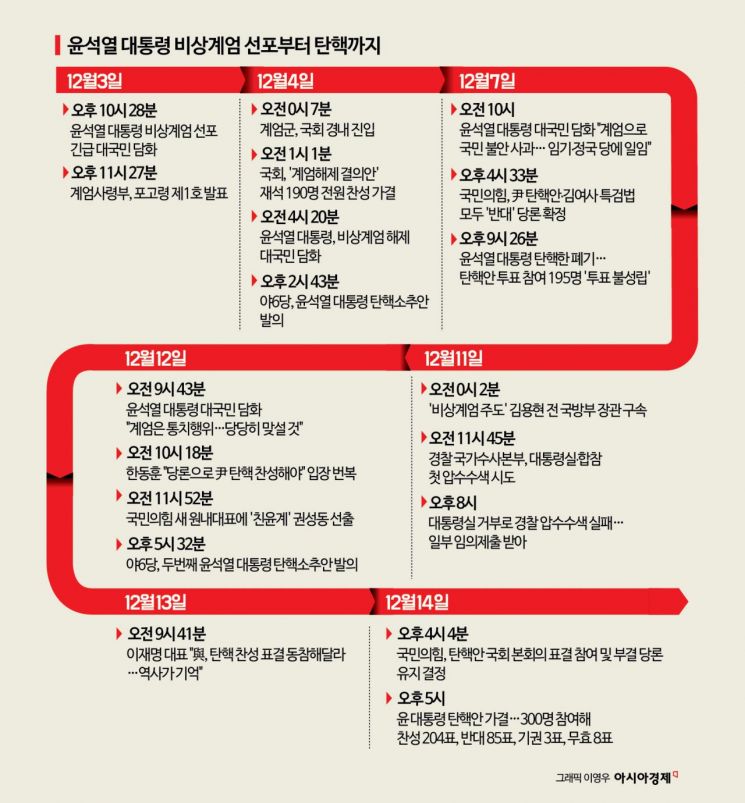
The impeachment motion against President Yoon Suk-yeol was passed in the National Assembly plenary session on the 14th. The situation, which began with the sudden declaration of martial law on the night of the 3rd, ultimately led to the approval of the third presidential impeachment motion in the history of the constitutional government. We look back on the past 11 days that shook Korean society, from the declaration of martial law to the passage of the impeachment motion.
Yoon, Shock from Midnight Martial Law Declaration
The 'martial law incident' suddenly began late at night on the 3rd. Around 10:23 p.m. that day, President Yoon issued an emergency statement at the Yongsan Presidential Office and declared martial law. It was a shock because it was announced without the knowledge of most of the Yongsan Presidential Office aides and ruling party lawmakers. The presidential aides either had left for the day or were working late in the office when they heard the president's midnight statement. Reporters covering the president were also not informed in advance and were not allowed into the briefing room where the presidential address was held.
That night, President Yoon stated in the emergency address, "I hereby declare martial law to eradicate the shameless pro-North anti-state forces who threaten the free Republic of Korea from the North Korean communist forces and rob our people's freedom and happiness, and to protect the free constitutional order." He added, "Through this martial law, I will rebuild and protect the free Republic of Korea that is falling into ruin."
According to later confirmations, the Cabinet meeting before the martial law declaration lasted only five minutes from 10:17 p.m. President Yoon had called a small number of Cabinet members to Yongsan around 8 to 9 p.m. to convey his intentions, and when Prime Minister Han Duck-soo and others raised concerns, he reluctantly held the Cabinet meeting. However, the meeting was essentially a notification by President Yoon, and even the attendees did not realize when it ended. There were no minutes or signatures from attendees, and the National Assembly was not notified.
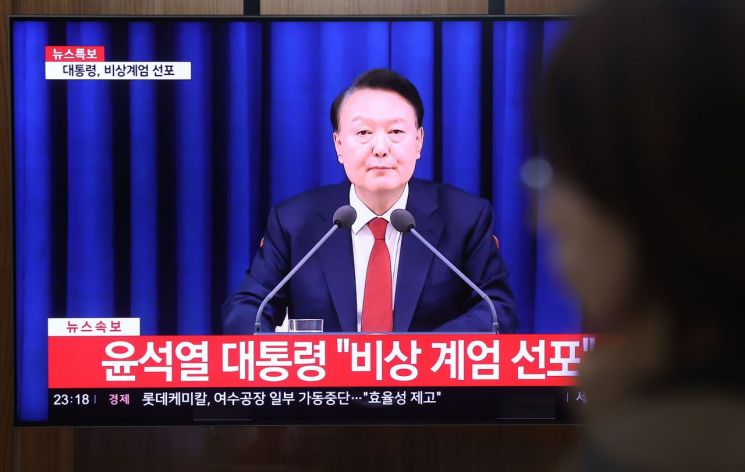 News related to President Yoon Suk-yeol's declaration of martial law on the 3rd is emerging at Seoul Station. Yonhap News Agency
Afterwards, President Yoon appointed Army Chief of Staff Park An-su, a graduate of the Korea Military Academy, as the martial law commander, and around 11:30 p.m., the martial law command issued a proclamation. The proclamation included bans on political activities such as the National Assembly, control of the press and publications, and prohibitions on strikes and assemblies.
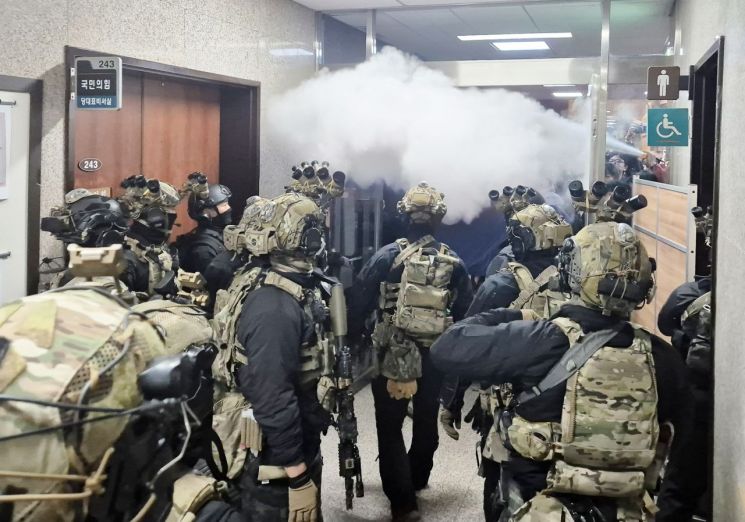 President Yoon Suk-yeol declared martial law on the evening of the 3rd, and on the night of the 4th, martial law troops are entering the main building of the National Assembly in Seoul. Yonhap News
Martial Law Troops Block National Assembly... Lawmakers Climb Over Walls
With the declaration of martial law, the entire country went into emergency. Both ruling and opposition parties issued 'lawmaker summons' to the National Assembly, and the military was deployed to the National Assembly and other locations. The ruling and opposition parties then showed two different trends. The People Power Party appeared confused. Leader Han instructed lawmakers to gather at the National Assembly, but Floor Leader Choo Kyung-ho ordered members to assemble at the party headquarters and other locations. Meanwhile, the opposition parties, upon hearing the martial law news, entered the National Assembly with the help of citizens who rushed to the scene, climbing over walls and using other means.
Armed martial law troops entered the National Assembly grounds around midnight. These included the 707 Special Mission Unit, the 1st Airborne Special Forces Brigade, and the Military Police Special Mission Unit of the Capital Defense Command, some of South Korea's elite units. The 3rd Airborne Special Forces Brigade under the Special Warfare Command and counterintelligence investigators went to the Central Election Commission and other locations. During this process, President Yoon ordered the arrest of key politicians and the detention of lawmakers gathered in the plenary session to demand the lifting of martial law.
However, the atmosphere reversed when the National Assembly convened a plenary session at 1:02 a.m. on the 4th and passed a resolution demanding the lifting of martial law with unanimous approval from all 190 members present. In addition to 172 opposition lawmakers, 18 People Power Party lawmakers attended. After the resolution passed, the military began to withdraw.
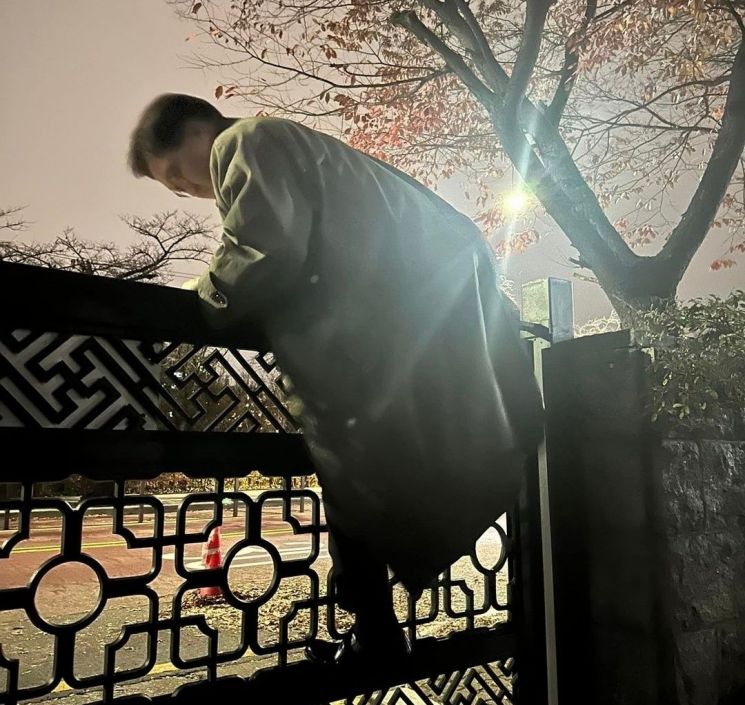 Speaker Woo Won-sik climbing over the National Assembly fence after the declaration of martial law. Speaker Woo's Instagram
As the legitimacy of martial law disappeared and public opinion worsened, President Yoon finally declared the lifting of martial law through an emergency address around 4:30 a.m.
It was about six hours after President Yoon declared martial law and about three and a half hours after the National Assembly passed the resolution demanding its lifting.
In the address, President Yoon said without an apology, "The National Assembly just demanded the lifting of martial law, so the military has withdrawn," and "Martial law will be lifted immediately through a Cabinet meeting."
 The representatives of the six opposition parties submitted the impeachment motion against President Yoon Seok-yeol at the National Assembly's Legislative Affairs Office on the 12th. Photo by Kim Hyun-min
"Unconstitutional Martial Law"... Yoon's Impeachment Gains Momentum
Immediately after President Yoon lifted martial law, the impeachment momentum surged.
Until then, the opposition had focused more on a special investigation law for First Lady Kim Keon-hee than on impeaching President Yoon, but with the martial law incident providing grounds for impeachment, the weight shifted toward presidential impeachment.
On the 4th at around 2:43 p.m., 190 lawmakers from six opposition parties?the Democratic Party, the People's Innovation Party, the Reform New Party, the Progressive Party, the Basic Income Party, and the Social Democratic Party?as well as independent lawmaker Kim Jong-min, filed an impeachment motion against President Yoon, which was reported to the National Assembly plenary session in the early hours of the 5th.
The approval requirement for the impeachment motion is two-thirds (200 members) of the total National Assembly members. The opposition had 192 members, so the key was whether there would be at least eight defections from the People Power Party. Because of this, the pro-Han faction (pro-Han Dong-hoon) within the ruling party, which had conflicts with President Yoon, was seen as a casting vote.
Leader Han changed his stance several times over two days, influencing the political impeachment trend. Initially, Han said, "I will try to prevent the passage of the impeachment motion," but suddenly the day before, he indicated support for impeachment by saying, "I judge that an early suspension of duties is necessary."
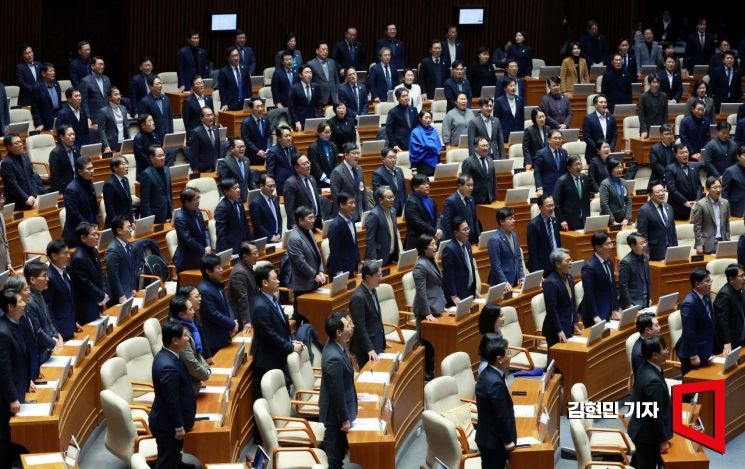 On the 7th, during the plenary session of the National Assembly, opposition party members are calling out the names of People Power Party lawmakers who left the chamber to abstain from voting on the impeachment motion against President Yoon Seok-yeol. Photo by Kim Hyun-min
Yoon's Third Address... First Impeachment Vote 'Invalid'
As the situation worsened, President Yoon apologized for the martial law incident in his third national address at 10 a.m. on the 7th. He said, "I will entrust the future political stability measures, including my term, to our party," and "Our party and government will take joint responsibility for future state affairs."
At 5 p.m. that day, the impeachment motion vote procedure began, but People Power Party lawmakers attending the re-vote on the Kim Keon-hee special investigation law all left the chamber. Only lawmakers Ahn Cheol-soo, Kim Ye-ji, and Kim Sang-wook participated in the vote. The impeachment motion against President Yoon was rejected due to insufficient quorum at 9:34 p.m. with 195 lawmakers present, falling short of the required 200. Speaker Woo Won-shik apologized to the public immediately after the vote was invalidated, saying, "On behalf of the National Assembly, I apologize to the people."
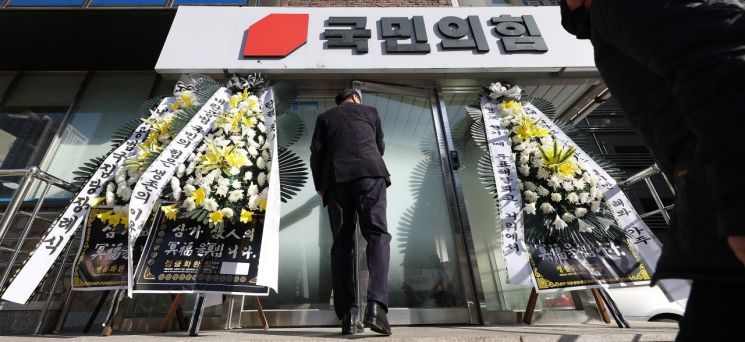 On the 10th, condolence wreaths condemning the People Power Party sent by citizens were installed in front of the People Power Party Daegu City Party Office in Suseong-gu, Daegu. Photo by Yonhap News
Impeachment Rejection Worsens Public Sentiment... Military Testimonies Emerge
After the impeachment motion was rejected in the National Assembly, public sentiment worsened further.
Protests against People Power Party lawmakers who collectively boycotted the vote surged, and lawmaker Kim Jae-seop was threatened when a box cutter was found in front of his home. Funeral wreaths were delivered to the constituency offices of People Power Party lawmakers, and protests demanding impeachment continued.
Meanwhile, testimonies from key military officials involved in the martial law incident poured in.
Army Special Warfare Command Commander Kwak Jong-geun appeared before the National Assembly Defense Committee on the 10th and said, "The president called me directly on a burner phone," and "He said the quorum for the vote was not yet met, and ordered to break down the door quickly and drag out the people inside."
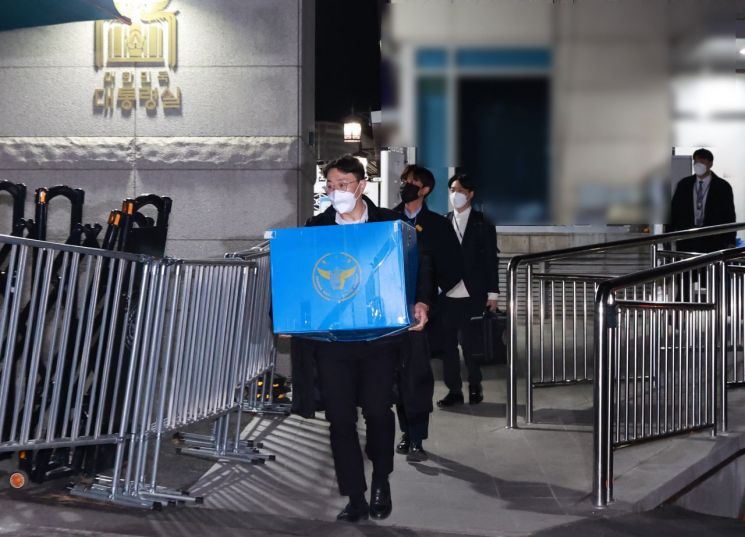 Police officers from the National Police Agency's Criminal Investigation Headquarters (CIH), who carried out a search and seizure at the Presidential Office to investigate the 'December 3 Emergency Martial Law Incident,' are seen leaving the Civil Complaints Office of the Presidential Office in Yongsan, Seoul, on the evening of the 11th, carrying boxes of seized items and forensic equipment. Photo by Yonhap News
Defense Minister Arrested... Presidential Office Raided
Kim Yong-hyun, Minister of National Defense, who was known to have led the martial law incident alongside President Yoon, was arrested in the early hours of the 11th after an arrest warrant was issued on charges of 'engaging in important duties related to rebellion.' It was also revealed that Kim attempted suicide inside the Seoul Eastern Detention Center just before the warrant was issued.
Investigations by prosecutors and police also intensified.
The Special Investigation Unit on Martial Law under the National Police Agency's National Investigation Headquarters conducted the first raid on the Yongsan Presidential Office on the afternoon of the 11th. The charges against President Yoon reportedly include rebellion and mutiny under the Military Criminal Act.
However, the raid failed due to refusal by the presidential office. The police attempted to search four locations within the presidential office: the Cabinet meeting room, the security office, the 101st Guard Unit, and the command and control room in the Joint Chiefs of Staff basement. After nearly eight hours of standoff, they withdrew after receiving some voluntary submissions of materials.
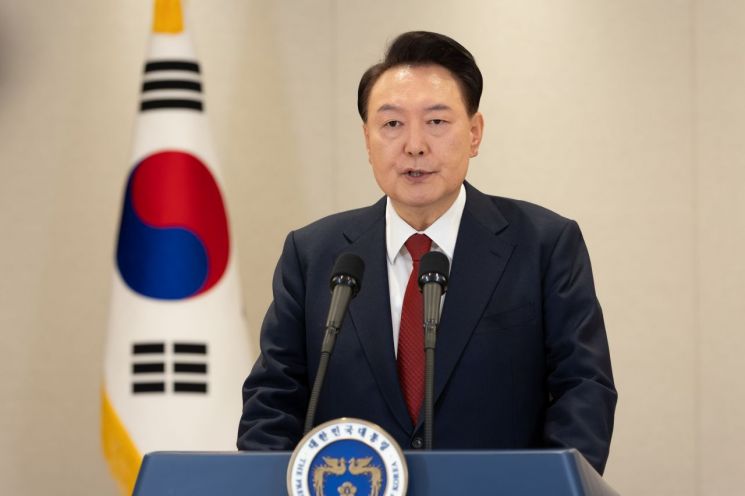 President Yoon Suk-yeol is delivering a national address at the Yongsan Presidential Office on the 12th. Photo by Yonhap News
Yoon "Will Resist"... Adding Fuel to the Fire of Public Discontent
Han Dong-hoon, leader of the People Power Party, who had opposed the first impeachment vote, eventually changed his stance.
On the morning of the 12th, Han announced at the National Assembly, "I have confirmed that the president has no intention of stepping down early," and "This breaks his public promise to entrust issues such as his term to the party."
He added, "Further chaos must be prevented. Now, there is only one effective way," and "At the next (impeachment) vote, our party lawmakers must attend the session and vote according to their conscience and beliefs."
President Yoon immediately responded with his fourth national address. He reversed his earlier stance on stepping back and said, "Whether impeached or investigated, I will face it boldly." This implied that the martial law declaration was justified, once again shocking public opinion and the political sphere.
At the time, President Yoon claimed that the Democratic Party's push for impeachment was "an attempt to avoid the imminent guilty verdict of the opposition party leader by impeaching the president and holding an early presidential election."
President Yoon's statement resembled the Constitutional Court's oral argument summary. He said the martial law declaration was a 'warning' against the unilateral operation of the National Assembly by the major opposition party and was conducted within the constitutional framework, thus not meeting the criteria for treason.
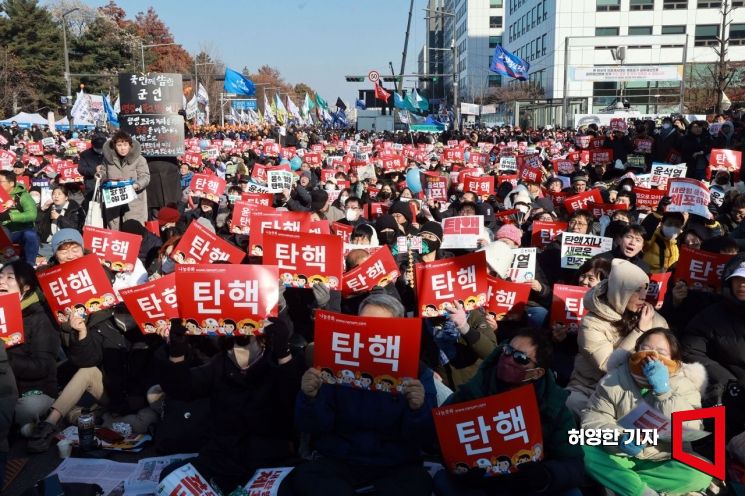 Participants are shouting slogans at a rally urging impeachment held on the 14th in front of the National Assembly in Yeouido, Seoul, ahead of the second impeachment vote against President Yoon Seok-yeol. Photo by Heo Young-han
Second Impeachment Motion Vote... Eventually Passed
At around 5:28 p.m. on the same day, the six opposition parties submitted a second impeachment motion against President Yoon to the National Assembly. On the same day, impeachment motions against Minister of Justice Park Seong-jae and National Police Agency Commissioner Cho Ji-ho, who were suspected of involvement in the martial law incident, also passed the National Assembly plenary session.
Lee Jae-myung, leader of the Democratic Party, urged People Power Party lawmakers to join the impeachment vote in a statement released at the National Assembly the previous afternoon, saying, "History will remember your choice."
The impeachment vote against President Yoon held at the National Assembly at 4 p.m. that day passed with 204 votes in favor, 85 against, 3 abstentions, and 8 invalid votes. President Yoon's duties were suspended. It was 949 days after his inauguration.
© The Asia Business Daily(www.asiae.co.kr). All rights reserved.
![Clutching a Stolen Dior Bag, Saying "I Hate Being Poor but Real"... The Grotesque Con of a "Human Knockoff" [Slate]](https://cwcontent.asiae.co.kr/asiaresize/183/2026021902243444107_1771435474.jpg)

















