Real Estate R114 Announces 'Real Estate System Changes in 2025'
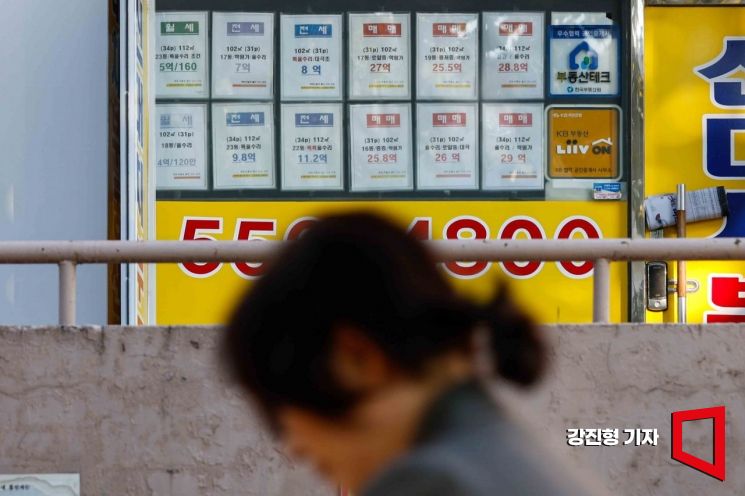 On the 24th, as apartment transactions shrink due to loan regulations and other factors, listings continue to accumulate. A real estate agency in Gangnam, Seoul, has flyers for sale and jeonse listings posted. Photo by Kang Jin-hyung
This year, the real estate market saw a surge in subscription enthusiasm due to intensified concerns over housing supply shortages, and buying sentiment increased further as expectations of interest rate cuts were reflected in the market ahead of time. As household debt also increased, the government took measures to manage the total debt volume through initiatives such as the ‘Stress DSR (Debt Service Ratio) Phase 2 Implementation’ and ‘Didimdol Loan Management Plan.’
On the 15th, Real Estate R114 announced the 'Real Estate System Changes in 2025,' stating, "Next year, steady policies to expand housing supply and manage household debt are expected, along with easing financial cost burdens and various tax benefits." Based on Real Estate R114 data, we have summarized the major real estate system changes coming next year.
50% Reduction in Early Repayment Fees on Loans
From January next year, early repayment fees on mortgage loans (Judaemae) and personal loans at major commercial banks will be reduced to half of the current level. This is because fees can only be charged within the actual costs incurred, such as loss costs and administrative expenses during early repayment. Early repayment fees are costs borne by borrowers when repaying loans before maturity, with the five major commercial banks charging about 1.2?1.4% for mortgage loans and 0.6?0.8% for personal loans.
Accordingly, to reduce the burden on borrowers, mortgage loan fees are expected to decrease to around 0.6?0.7%, and personal loan fees to about 0.4%. However, this will apply only to loan products handled from mid-January 2025 onward.
Tax Benefits for 1-Homeowners Acquiring Houses in Population Decline Areas and Unsold Houses in Non-Capital Regions
From January next year, existing one-homeowners who newly purchase houses in population decline areas or unsold houses in non-capital regions will be regarded as one-homeowners for capital gains tax and comprehensive real estate tax calculations, thus receiving the one-household one-home special exemption. Specifically, if a person newly acquires one house priced at 400 million KRW or less in a population decline area (excluding the capital area and metropolitan cities, but including border areas within the capital area and county areas within metropolitan cities), they will be considered a one-homeowner and receive tax benefits. This aims to encourage housing acquisition in population decline areas.
Additionally, benefits apply when acquiring unsold houses in non-capital regions with exclusive area of 85㎡ or less and acquisition price of 600 million KRW or less. This is intended to resolve unsold housing in non-capital regions and balance the housing market. Accordingly, the comprehensive real estate tax basic deduction is up to 1.2 billion KRW, and elderly or long-term holders can receive up to 80% tax credits. Moreover, capital gains tax is exempted up to 1.2 billion KRW, and long-term holding special deductions apply up to 80%.
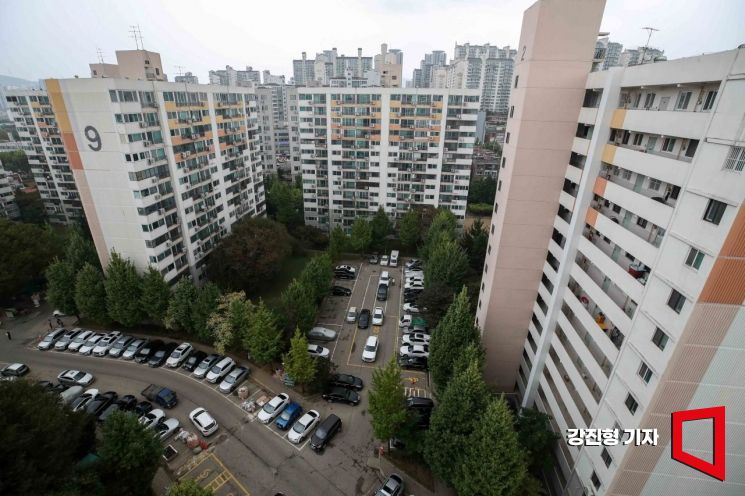 On the 15th, Seongsan Sijeong Apartment in Seongsan-dong, Mapo-gu, Seoul. Seongsan Sijeong Apartment is a complex completed in 1986, consisting of 33 buildings with up to 14 floors and 3,710 households. Photo by Jinhyung Kang aymsdream@
Relaxation of Income Requirements for Newborn Special Loans
From January next year, the income requirement for newborn special purchase and jeonse (lease) loans will be further relaxed for three years (2025?2027), increasing the combined annual income limit for couples from 130 million KRW to 250 million KRW. Additionally, if additional children are born during the special loan period, the preferential interest rate will be increased from the current 0.2 percentage points to 0.4 percentage points.
However, the housing requirements for purchase funds (house price up to 900 million KRW, loan limit 500 million KRW), jeonse funds (5 billion KRW or less in the capital area, 4 billion KRW or less in other regions, loan limit 300 million KRW), and asset requirements (purchase fund assets up to 4.69 billion KRW, jeonse fund assets up to 3.45 trillion KRW) remain unchanged. This applies only to households with births after January 1, 2025.
Expansion of Tax Support for Housing Subscription Savings
From January next year, income deduction benefits for housing subscription savings account holders with annual income of 70 million KRW or less will be extended not only to single-home household heads but also to their spouses. Income deductions are provided up to 40% of the payment amount, capped at 3 million KRW annually.
Also, for the Youth Preferential Housing Subscription Savings, the tax exemption on interest income will be extended to household heads and spouses. Eligible are single-home household heads with total salary of 36 million KRW or less or comprehensive income of 26 million KRW or less, with an interest income tax exemption limit of 5 million KRW.
Implementation of Private Urban Public Housing Complex Projects
Urban complex projects involve high-density development through special measures such as increased floor area ratio in areas located in city centers but with low profitability, where private-led redevelopment is difficult, thereby accelerating housing supply. Unlike general maintenance projects led by associations, public entities participate as project implementers. However, there has been resident opposition to the public land expropriation method, and the focus on housing construction limits the creation of urban hubs.
As a result, a bill to reorganize the project to be private-centered has passed. From February next year, private entities such as trust companies or REITs (Real Estate Investment Trusts) will be allowed to implement public urban complex projects currently carried out by LH (Korea Land and Housing Corporation) and others. Building coverage ratio and floor area ratio will be raised to the legal maximum. In particular, in quasi-residential areas, the floor area ratio will be increased by up to 140%, and in Seoul, it can be raised up to 700%. However, part of the development profits from the increased floor area ratio must be supplied as public housing.
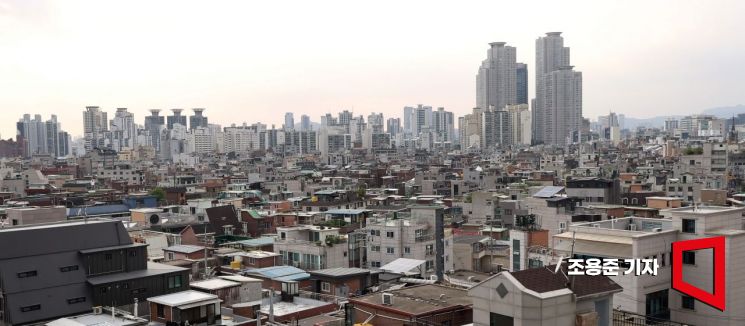 Seoul Walking Column - A residential complex in downtown Seoul where apartments and houses coexist. Photo by Jo Yongjun jun21@
Mandatory Compliance with ‘Zero Energy’ Standards for New Private Buildings
From June next year, the energy performance of newly constructed apartment complexes will be strengthened to the zero-energy grade 5 level. Although eco-friendly construction standards for private apartment complexes have been applied since October 2009, the key point is that from June 2025, the standards will be strengthened to zero-energy grade 5 level. Previously, primary energy (hydroelectric, thermal, nuclear, etc.) electricity consumption was limited to 120 kWh per square meter annually, but the new standard requires consumption within 100 kWh, strengthening the standard by about 17%. The remaining electricity must come from renewable energy sources such as solar power.
Additionally, airtightness performance of entrance doors and windows (performance minimizing indoor air leakage) must be rated grade 1 without exception. The Ministry of Land, Infrastructure and Transport expects housing construction costs to increase by about 1.3 million KRW per household (based on 84㎡ exclusive area) due to these stricter standards, but energy costs will be reduced by about 220,000 KRW annually, allowing recovery of additional construction costs in about 5.7 years.
Reconstruction Possible Without Safety Inspection
From June next year, apartments over 30 years old since completion will be allowed to undergo reconstruction without safety inspections. Also, the term ‘Reconstruction Safety Inspection’ will be changed to ‘Reconstruction Inspection,’ and the procedure will be revised so that passing the reconstruction inspection is only required before the project implementation plan approval. Currently, if the safety inspection is not passed, the project cannot even start, including drafting maintenance plans.
This deregulation is expected to lower the entry barrier for reconstruction and shorten the reconstruction period by up to nearly three years, contributing to increased housing supply. Furthermore, electronic methods will generally be applied to resident decision-making processes in reconstruction and other maintenance projects, significantly speeding up decision-making.
Cancellation of Rental Business Registration for Malicious Landlords
The short-term registered rental type, which applies a mandatory rental period of six years to non-apartment properties, will be reinstated from June next year. This reintroduction aims to revitalize the supply of non-apartment housing, which plays a role as a housing ladder for low-income households. The mandatory rental period is increased from the previous four years to six years, considering tax fairness with the right to request contract renewal.
Additionally, registration cancellation will be possible for malicious landlords who habitually fail to return rental deposits, causing guarantee companies to make subrogation payments. Cancellation applies to malicious landlords who have had two or more subrogation payments by guarantee companies and have not repaid the full guarantee debt even after six months. Rental business operators will lose tax benefits immediately upon cancellation, and previously received tax benefits will be reclaimed.
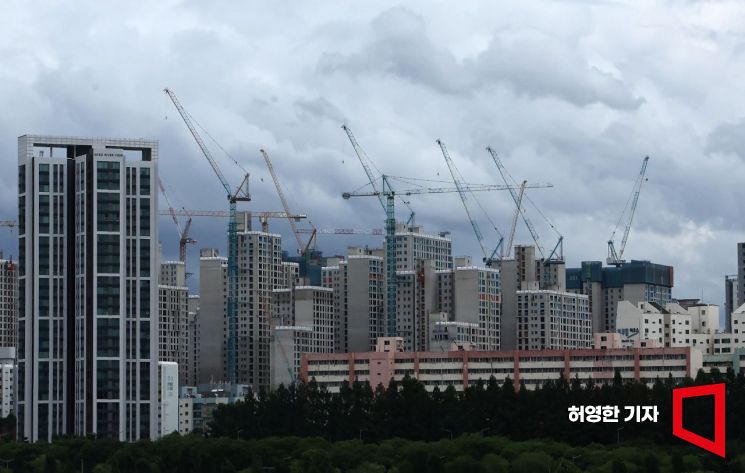 When crossing the Banpo Bridge in Seoul, you can see new apartments, old apartments, and apartments under construction all at once in the Sinbanpo area. The new apartments on the left are Acro Riverview Sinbanpo, the low old apartments on the right are Sinbanpo 2nd Complex, and the apartments under construction in the back are the Maple Xi construction site. Photo by Huh Younghan younghan@
Implementation of Stress DSR Phase 3
From July next year, with the implementation of Stress DSR (Debt Service Ratio) Phase 3, household loan limits will be reduced, and all financial sector loans will be regulated. Stress DSR is a system that calculates loan limits by applying a certain level of additional interest rate (stress rate) when calculating DSR, considering the possibility that borrowers using variable interest rate loans may face increased principal and interest repayment burdens due to interest rate hikes during the loan period.
Phase 1 was implemented in February 2024, and the currently implemented Phase 2 started in September 2024. Phase 3 will apply to mortgage loans, personal loans, and other loans in banks and secondary financial institutions subject to DSR, with a stress rate of 1.5 percentage points (expected in 2025).
© The Asia Business Daily(www.asiae.co.kr). All rights reserved.
![Clutching a Stolen Dior Bag, Saying "I Hate Being Poor but Real"... The Grotesque Con of a "Human Knockoff" [Slate]](https://cwcontent.asiae.co.kr/asiaresize/183/2026021902243444107_1771435474.jpg)

















