An artificial intelligence technology that mimics human cognitive processes to understand image transformations and simultaneously achieve visual generalization and specificity has been developed in Korea. This technology is expected to be utilized in fields such as medical image analysis, autonomous driving, and robotics, where AI understands images to classify and detect objects.
KAIST announced on the 13th that Professor Junmo Kim’s research team from the Department of Electrical Engineering has developed a visual AI model called ‘STL (Self-supervised Transformation Learning)’ that can learn transformation-sensitive features autonomously without transformational labels.
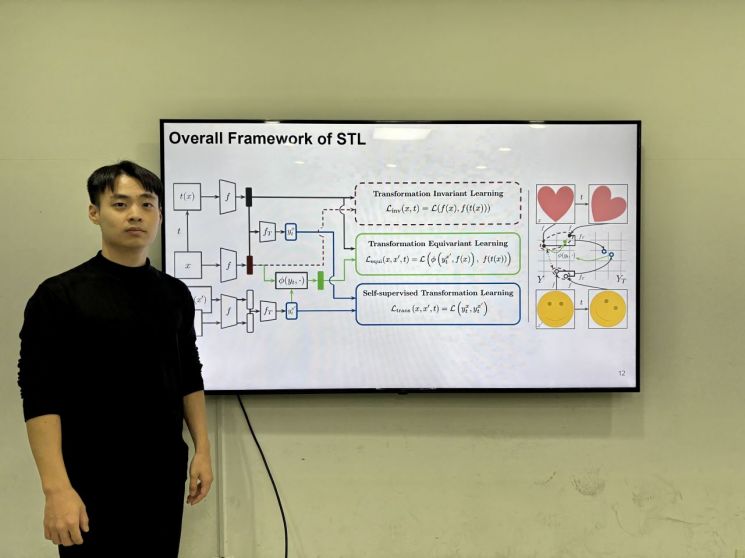
STL learns image transformations by itself, exhibiting a higher ability to understand visual information compared to conventional methods where humans explicitly provide the types of image transformations during training. Additionally, STL learns detailed features that models trained by existing methods cannot comprehend, showing up to 42% better performance than previous approaches.
For example, in computer vision, learning robust visual representations through data augmentation by image transformation is effective for acquiring generalization ability. However, it tends to overlook visual details caused by transformations, posing limitations as a universal visual AI model.
In contrast, STL is designed to learn transformation information without transformation labels, enabling it to learn transformation-sensitive features without labels. It allows optimized learning while maintaining the learning complexity compared to existing training methods.
Experimental results show that STL accurately classifies objects and recorded the lowest error rate in detection experiments. Furthermore, the representation space generated by STL is clearly clustered according to the intensity and type of transformations, reflecting the relationships between transformations well.
Professor Junmo Kim stated, "STL presents new possibilities for learning transformation-sensitive features through its ability to learn complex transformation patterns and effectively reflect them in the representation space. The technology to learn transformation information without labels will play a key role in various AI application fields.”
Meanwhile, the research results (paper), with PhD candidate Jaemyung Yoo from the Department of Electrical Engineering at KAIST as the first author, are scheduled to be published this month in the prestigious international journal ‘Neural Information Processing Systems (NeurIPS) 2024.’
© The Asia Business Daily(www.asiae.co.kr). All rights reserved.
![Clutching a Stolen Dior Bag, Saying "I Hate Being Poor but Real"... The Grotesque Con of a "Human Knockoff" [Slate]](https://cwcontent.asiae.co.kr/asiaresize/183/2026021902243444107_1771435474.jpg)















