Closing of Central Economic Work Conference
"More Aggressive Fiscal Policy to Be Implemented Next Year"
China plans to focus all efforts on expanding domestic demand to revive its economy next year. It is expected to continue policies such as increasing the fiscal deficit ratio and issuing ultra-long-term special government bonds, as well as providing liquidity through measures like lowering the reserve requirement ratio (RRR) and interest rates.
According to China Central Television (CCTV), the Chinese Communist Party and government held the Central Economic Work Conference in Beijing on the 11th and 12th, attended by President Xi Jinping and other leaders, to decide the economic policy direction for next year.
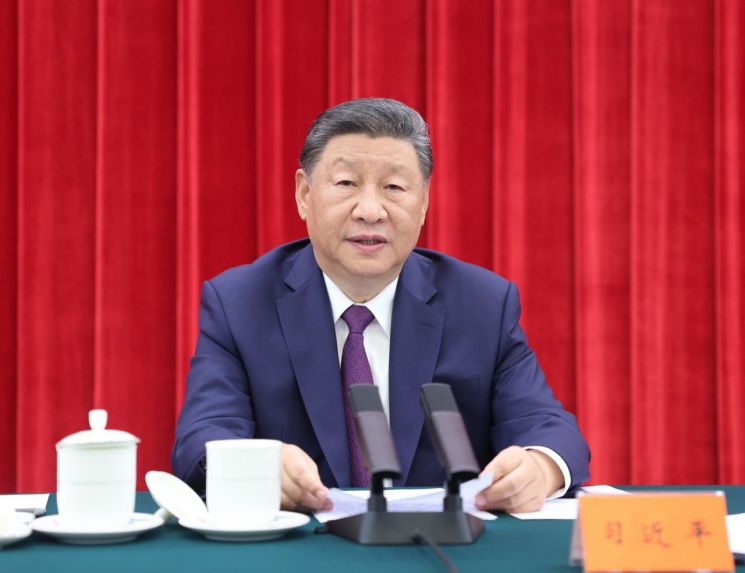
The conference concluded that "a more proactive fiscal policy must be implemented next year," emphasizing the need to "raise the fiscal deficit ratio, increase the issuance and use of ultra-long-term special government bonds and local government special bonds, and improve the structure of fiscal expenditure." It also stated that an "'appropriately accommodative' monetary policy should be implemented by timely lowering the RRR and interest rates to maintain ample liquidity," and that "the central bank should seek to expand its macroprudential and financial stability functions."
Earlier, on the 9th, the Politburo of the Chinese Communist Party, chaired by Xi Jinping, changed the monetary policy stance from "neutral" to "appropriately accommodative" for the first time in 14 years.
China is facing difficulties due to a prolonged real estate downturn, local government debt, and sluggish consumption. Additionally, the election of Donald Trump as U.S. president, who has announced plans to impose high tariffs on China, has put exports at risk of worsening. During his campaign, Trump pledged to impose an additional 60% tariff on all Chinese imports. After the election, on the 25th of last month, he declared a 10% tariff on China citing drug issues.
Since the end of September, China has implemented policies including a 1 trillion yuan long-term liquidity injection, interest rate cuts, stock market stabilization, and real estate market support. Next year, it is expected to accelerate economic stimulus by raising the fiscal deficit ratio to the 3% range. Economists predict that the Chinese government will increase the budget deficit ratio to as much as 4% of GDP to boost the economy. However, the conference did not specify the exact fiscal deficit ratio or timing for interest rate cuts.
Zhang Ziwei, Chief Economist at Pinpoint Asset Management, said the conference suggests that the Chinese government will set a growth target around 5% for this year as well. He stated, "The increase in the fiscal deficit ratio and interest rate cuts were expected. The direction is clear, but the issue is the scale of the stimulus package, which is likely to be finalized after the U.S. announces tariffs on China." China appears to be waiting for Trump’s confirmation of tariffs before determining the specific size of the stimulus.
The key priorities for 2025 remain summarized in nine points, the same as last year, but with changes in order of priority. Domestic demand, which was the second priority last year, was mentioned first this time. The conference stated, "We will comprehensively expand domestic demand and carry out special actions to stimulate consumption."
Bruce Pang, Chief Economist at JLL, said the conference results indicate that the authorities’ focus is shifting from the industrial sector to consumption and investment. He explained, "It emphasizes the need to strengthen domestic demand to better navigate external uncertainties." However, Larry Hu, Head of China Economics at Macquarie Group, said, "I do not think the government will directly give money to consumers. It is more likely that the government will increase spending."
Regarding "key area risks" such as the real estate market slowdown, local government debt, and problems in local financial institutions, China stated it will "maintain the bottom line of preventing systemic risks while vigorously promoting the halt and recovery of the real estate market decline."
On the current situation, it diagnosed that "as the adverse effects brought by changes in the external environment deepen, our country (China) still faces considerable difficulties and challenges in economic operation." The economic policy goals for next year were presented as 'Wenzhong Qiujin (?中求?), Yijin Cuon (以?促?), Shouzheng Chuangxin (守正?新), Xianli Houpo (先立后破), Xitong Jicheng (系?集成), and Xietong Peihe (?同配合).' These mean "pursuing progress while maintaining stability, promoting stability through progress, upholding correctness while innovating, establishing the new before dismantling the old, integrating systematically, and coordinating and cooperating." The first three?Wenzhong Qiujin, Yijin Cuon, and Xianli Houpo?follow last year’s "12-character policy," while Shouzheng Chuangxin, Xitong Jicheng, and Xietong Peihe are newly added.
China traditionally announces its economic growth targets at the annual Two Sessions held in March. However, CNBC reported that there is widespread expectation that China will maintain its GDP growth target at about 5% for next year as well.
© The Asia Business Daily(www.asiae.co.kr). All rights reserved.
![Clutching a Stolen Dior Bag, Saying "I Hate Being Poor but Real"... The Grotesque Con of a "Human Knockoff" [Slate]](https://cwcontent.asiae.co.kr/asiaresize/183/2026021902243444107_1771435474.jpg)















