Policy Interest Rate Cut by 0.25%P
Deposit Interest Rate Reduced from 3.25% to 3.0% Per Annum
The European Central Bank (ECB) has implemented its third consecutive interest rate cut. This move is analyzed as a response to growing concerns about an economic recession and increased economic uncertainty due to tariff threats from U.S. President-elect Donald Trump.
On the 12th (local time), the ECB held a monetary policy meeting and lowered the deposit rate from 3.25% to 3.0% per annum, and the main refinancing rate from 3.4% to 3.15% per annum, each by 0.25 percentage points. The marginal lending rate was also cut from 3.65% to 3.4% per annum.
Among these three policy rates, the ECB primarily operates monetary policy based on the deposit rate. Since the ECB pivoted (policy direction change) last June, the deposit rate has been lowered by a total of 100 basis points (1bp = 0.01 percentage points).
After initiating a monetary easing cycle by cutting policy rates by 0.25 percentage points in June, the ECB held rates steady in July. Subsequently, it cut rates three times consecutively in September, October, and on this day. As a result, the gap between the ECB’s main refinancing rate and that of the U.S. has widened to 1.5 to 1.75 percentage points.
The ECB stated, "Although growth recovered in the third quarter, growth appears to have slowed in the current quarter," and added, "Over time, the effects of the restrictive monetary policy will gradually fade, supporting domestic demand recovery."
The economic growth forecast was also revised downward. The ECB projected the Eurozone (20 countries using the euro) growth rate at 0.7% for this year and 1.1% for next year, each lowered by 0.1 and 0.2 percentage points respectively from previous estimates. The consumer price inflation rate was adjusted down to 2.4% this year and 2.1% next year, each 0.1 percentage points lower than prior forecasts.
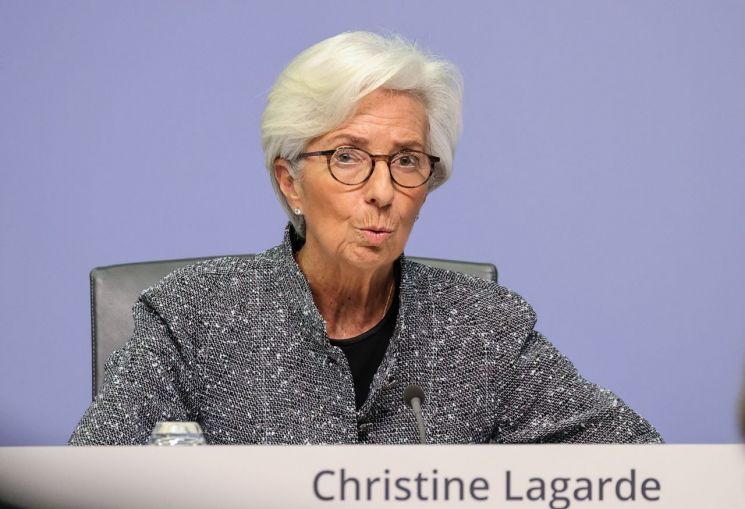
ECB President Christine Lagarde said at a press conference that "growth risks have tilted downward," and assessed that "current rates are restrictive." Regarding the future path of interest rates, she indicated that "the direction of movement is very clear," suggesting further rate cuts.
Regarding trade policies such as tariff threats from President-elect Trump, who will take office in January next year, she said, "In the short term, it is likely to cause net inflation," and noted that various factors including trade flows and the possibility of retaliation make the overall impact uncertain.
© The Asia Business Daily(www.asiae.co.kr). All rights reserved.

















