When President Yoon Suk-yeol denied charges of treason by defining martial law as an act of governance on the 12th, major foreign media outlets also focused on the content of his statement. Many foreign media noted that it remains uncertain what the outcome of the National Assembly's impeachment vote on the 14th will be, but they agreed that the statement will certainly intensify public calls for President Yoon's immediate resignation and impeachment. There was also criticism that he reversed his apology from just last week and justified the declaration of martial law.
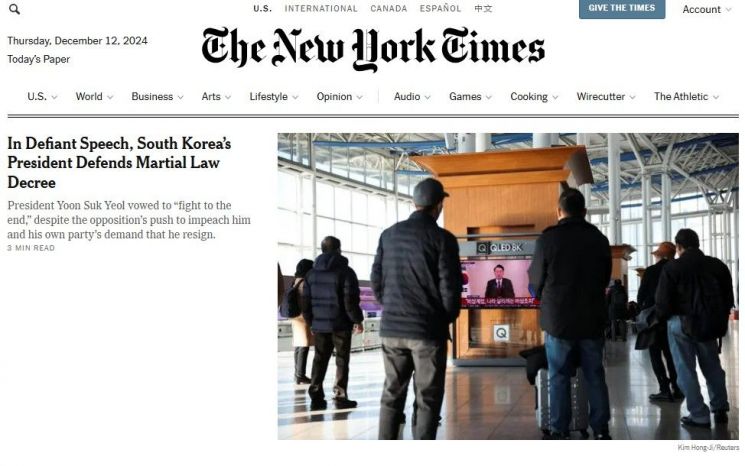
Major foreign media, including the Associated Press (AP), paid attention to President Yoon’s TV address released that day, particularly his remarks such as "How can the president’s constitutional decision and act of governance be considered treason?" and "I will fight to the end."
The AP reported, "President Yoon claimed that martial law does not constitute treason," adding, "Such a statement will deepen divisions even within the ruling People Power Party." The outlet described Yoon’s statement as a "180-degree reversal," pointing out that just last week, President Yoon apologized and entrusted all matters, including his term, to the party. It also reported that immediately after the statement, the main opposition party, the Democratic Party of Korea, dismissed it as 'extreme delusion' and 'a declaration of war against the people.'
AFP also reported that President Yoon "defended the shocking decision to declare martial law and deploy troops to the National Assembly," noting that "allies in Seoul were stunned by the dramatic events of December 3-4." The agency described the address as a "defiant speech" and highlighted the upcoming second impeachment vote in the National Assembly this week.
Bloomberg reported in an article titled "Despite increased impeachment prospects, South Korea’s president maintains a defiant stance" that "President Yoon said he tried to save liberal democracy through martial law." The outlet noted that "these remarks came amid a weakening of Yoon’s grip on power," adding that "even members within the ruling party have expressed support for impeachment." It also mentioned that unlike last week, Yoon’s statement did not trigger sharp market fluctuations, attributing this to the fact that political uncertainty would significantly decrease if the impeachment bill passes in the National Assembly. Essentially, the market is placing some weight on the possibility of the impeachment bill passing.
Homin Lee, Chief Macro Strategist at Lombard Odier Singapore, told Bloomberg, "It is still unclear how this defiant speech will affect the Saturday vote," but he assessed that "it will certainly intensify the widespread public voices supporting immediate resignation." U.S. CNN also analyzed that "the People Power Party did not support impeachment and wanted President Yoon to resign," and that "the chances of a successful impeachment attempt have increased."
The New York Times (NYT) said that President Yoon declared martial law to "warn the National Assembly not to obstruct his agenda" and that he had no intention of blocking the vote to lift martial law, but pointed out that "this contradicts recent testimonies from military officers." The UK’s Financial Times cited Professor Kang Won-taek of Seoul National University, who said that including this statement, evidence is mounting that President Yoon acted according to his beliefs in this incident, making impeachment inevitable.
Japanese media, including NHK, critically evaluated President Yoon’s justification of the martial law declaration. In Japan, the term "justification" is used negatively to describe speech or behavior that does not acknowledge one’s own mistakes or failures. NHK reported statements such as "Whether impeached or investigated, I will face it with confidence," and "The exercise of the martial law declaration right is an act of governance not subject to judicial review, like the exercise of pardon or diplomatic rights," using the term "justification."
The progressive-leaning Mainichi Shimbun also reported that "President Yoon criticized the opposition party by asking, 'Are they not anti-state forces trying to ruin the country?' and 'I tried to protect liberal democracy and the constitutional order,'" describing the martial law declaration as a "justification." The conservative-leaning Yomiuri Shimbun also reported that "President Yoon justified the purpose of martial law as alerting to a national crisis and protecting and restoring the constitutional order."
© The Asia Business Daily(www.asiae.co.kr). All rights reserved.

















