'IPTV Day' Event Held on the 12th
Production Costs Rise and Competitiveness Declines
Requests for Government Support and Regulatory Relief
Internet TV (IPTV) is being criticized at the 'IPTV Day' event for failing to grow due to being overwhelmed by global online video services (OTT) such as YouTube and Netflix, as well as being hampered by regulations.
On the 12th, Lee Byung-seok, Chairman of the Korea IPTV Broadcasting Association, expressed in his greeting at the event held at Hotel Naru Seoul M Gallery in Mapo-gu, "It is true that IPTV is facing an unprecedented existential crisis as it has been incorporated into an infinite competition system led by giant global platforms like YouTube and Netflix."
The chairman said, "The domestic IPTV industry is competing with global platforms while wearing sandbags on both legs due to outdated regulations under the Broadcasting Act enacted in 2000."
He added, "Global platforms freely roam the domestic market without any restrictions, leveraging economies of scale, financial power, and technological capabilities to widen the gap with domestic companies. It is time to undertake revolutionary institutional reforms to eliminate these long-standing regulations for the survival and sustainability of the domestic media market."
Im Hyun-kyu, Vice President of KT (Head of Management Support Division), in a special lecture, said, "I wonder if domestic IPTV growth can continue amid infinite competition with global operators," pointing out, "Due to the influence of global OTTs, content production costs have risen sharply, but domestic OTT competitiveness has declined, creating a structure where only global OTTs make money."
He said, "Besides OTT, free smart TVs similar to IPTV are also expected to see explosive user growth, and as the media competition structure is being newly reorganized, IPTV must transition to an artificial intelligence platform in the future. We ask for the authorities' support as a bulwark of media sovereignty."
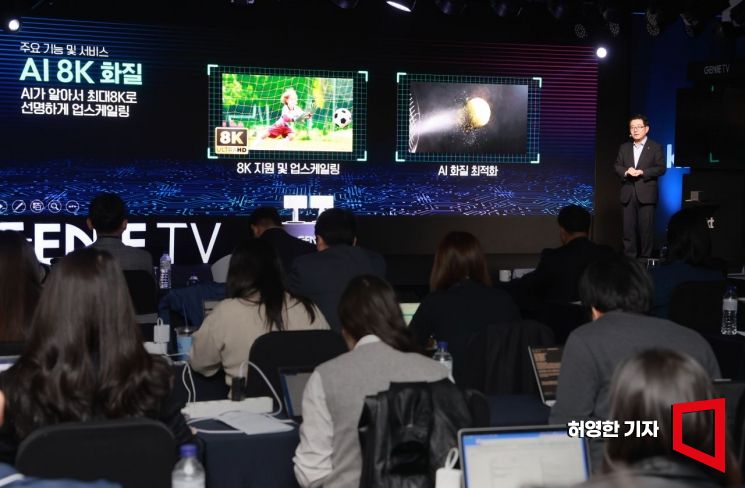 On the 5th of last month, KT unveiled the first on-device AI set-top box supporting 8K resolution for IPTV.
Professor Park Sung-soon of the Department of Media Contents at Paichai University, speaking as a presenter at the forum, expressed concern that cable TV subscription fee revenue decreased by 19% from 2020 to 2022, and that the paid broadcasting revenue growth rate entered the 1% range in 2022, indicating a complete stagnation in paid broadcasting growth.
However, he pointed out that the government missed opportunities to ease regulations at key moments such as the introduction of IPTV, CJ's expansion of broadcasting channel operator (PP) acquisitions, the merger of SK Broadband and CJ HelloVision, and KT's acquisition of D'Live. He added, "Although paid broadcasting entered a competitive system with the introduction of IPTV, past monopoly regulations on market share, fees, re-licensing, and licensing continue."
Professor Park emphasized that, in detail, the requirements for reviewing terms of use should be improved to examine only user rights and obligations, and that advertising and review regulations should also be lifted.
He stated, "Although OTT's influence is increasing, it is only regulated as a value-added telecommunications business operator. Paid broadcasting should strengthen ex-post regulations based on prohibited acts under the Broadcasting Act rather than ex-ante regulations based on guidelines."
Kang Do-hyun, 2nd Vice Minister of the Ministry of Science and ICT, said, "IPTV is a core platform that has led innovation in the broadcasting industry, and it is expected to lead further innovation even in this era of great transformation."
Vice Minister Kang said, "Just as IPTV made bold investments in the media market when it launched 16 years ago, I hope IPTV will promote coexistence and cooperation not only within IPTV itself but across the entire media market, sometimes yielding and sometimes taking the lead."
© The Asia Business Daily(www.asiae.co.kr). All rights reserved.


















