Supreme Court and Constitutional Court Recognize 'Political Question' Concept
But Affirm Limits Allowing Judicial Review
President Yoon Suk-yeol claimed in a national address on the 12th that the recent declaration of martial law is a "political act not subject to judicial review," drawing attention to how this stance might affect future investigations, court trials, as well as impeachment trials or constitutional complaints at the Constitutional Court.
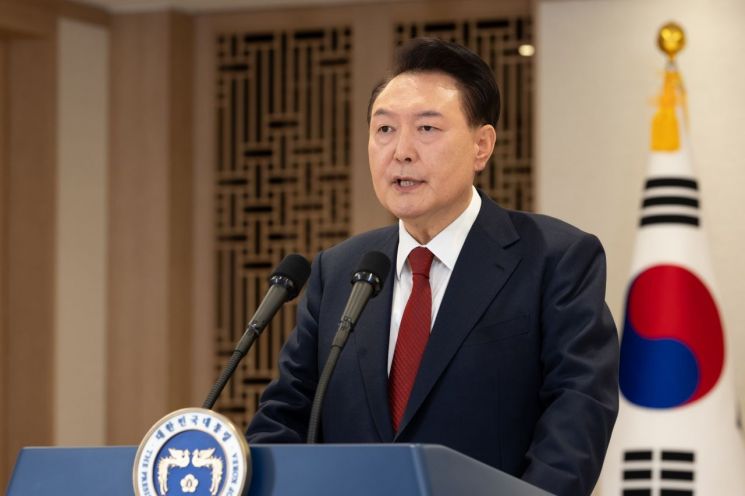 President Yoon Suk-yeol is delivering a national address at the Yongsan Presidential Office on the 12th. Photo by Yonhap News
With investigative agencies, including the prosecution, accelerating investigations that name him as the ringleader of rebellion, and the urgent situation where the National Assembly is likely to pass a presidential impeachment motion this weekend, this can be seen as a preemptive statement of defense that the defendant or respondent might use during future criminal trials or impeachment proceedings at the Constitutional Court.
If political acts are defined as "highly political national governance decisions that are difficult to subject to judicial review," then the exercise of the president's emergency powers, including martial law, could be considered a type of political act.
However, both the Supreme Court and the Constitutional Court have maintained a fundamental position that, while they do not deny the existence of highly political acts that should be subject to judicial restraint, judicial review is not impossible in cases where such acts clearly infringe upon citizens' fundamental rights or the authority of other constitutional institutions such as the National Assembly.
President Yoon argued that his declaration of martial law was a decision made under the judgment that it was the only way to protect South Korea's liberal democracy and constitutional order, and not an act of rebellion. He stated that the deployment of a small number of military personnel was not to suppress a riot but to maintain order when citizens, having seen the martial law broadcast, gathered at the National Assembly. He cited as evidence that the military was not put on full alert, that there were no measures such as cutting off water, electricity, or broadcast transmissions to the National Assembly, and that demands to lift martial law were immediately accepted.
This argument by President Yoon appears to suggest that if he is prosecuted for rebellion, the objective element of rebellion, "riot," and the subjective element, "intent to disrupt the constitutional order," were absent, thus negating the establishment of the crime of rebellion.
He is also expected to argue in the Constitutional Court's impeachment trial that the declaration of martial law was a measure to protect the constitutional order of the state against the Democratic Party's legislative dictatorship, thereby asserting that there was no "serious legal violation warranting the president's removal," which the Constitutional Court uses as a standard for impeachment judgments.
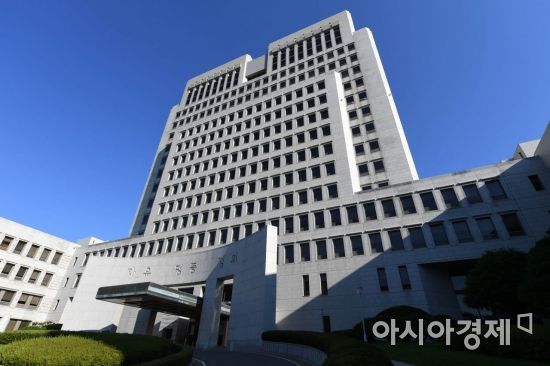
Regarding martial law, the Supreme Court ruled in 1979 that "if the president declares martial law based on a reasonable judgment considering all objective circumstances, such an act is of a highly political and military nature, and only the National Assembly, which has the constitutional right to demand the lifting of martial law, has the authority to judge the appropriateness of the declaration. Except in cases where the declaration is clearly invalid, it is inappropriate for judicial bodies such as courts to review whether the conditions for martial law were met or the appropriateness of the declaration, as this exceeds the inherent limits of judicial power."
However, in the 1997 rebellion case involving former President Chun Doo-hwan and others, the Supreme Court stated, "The president's declaration or expansion of martial law is an act of a highly political and military nature, so unless there are special circumstances where it is clearly recognized as violating the Constitution or laws, the judiciary does not have the authority to judge the fulfillment of conditions or appropriateness of the declaration. However, if the declaration or expansion of martial law was carried out to achieve the purpose of disrupting the constitutional order, the court can examine whether it constitutes a criminal act."
At that time, some justices expressed a minority opinion that "military rebellion and acts of rebellion are highly political acts that bring about changes to the state's constitutional order, and whether legal responsibility can be imposed or whether such political acts were justified afterward is a political and moral issue to be resolved through political processes within society. Given their nature, it is inappropriate for courts, which do not bear political responsibility, to review them judicially." However, this did not become the Supreme Court's official position.
In 2003, in the case involving former President Kim Dae-jung's inter-Korean summit and remittances to North Korea, the Supreme Court stated, "The fundamental principle of a constitutional state under the rule of law requires that all state acts and actions be conducted constitutionally and legally within the framework of the Constitution and laws. The judgment of constitutionality and legality essentially belongs to judicial authority. However, some state acts have a highly political nature, and it is undesirable for courts, which do not bear political responsibility, to interfere in politics by disregarding political appropriateness or legitimacy and conducting legality reviews, as this risks compromising judicial neutrality and independence. Therefore, courts themselves restrain the exercise of judicial review over such highly political state acts, called political acts."
Nevertheless, the Supreme Court added, "Even if the concept of political acts is recognized, excessive judicial restraint should not neglect or abandon the court's duty to guarantee fundamental rights and uphold the rule of law. Such recognition must be made with utmost caution, and the judgment must be made solely by the judiciary," affirming judicial review.
The Constitutional Court also recognized the concept of political acts in the 1996 case involving former President Kim Young-sam's emergency financial order related to the real-name financial system, while stating that it can conduct constitutional review if the act directly infringes on citizens' fundamental rights.
At that time, the Constitutional Court stated, "The president's emergency financial and economic order is a type of state emergency power activated by a highly political decision and thus belongs to so-called political acts that require respect. However, all state actions, including political acts, must adhere to the limitation of realizing citizens' fundamental rights. The Constitutional Court, as a state institution tasked with protecting the Constitution and citizens' fundamental rights, naturally has jurisdiction over cases where such acts directly infringe on citizens' fundamental rights."
In the 2004 administrative capital relocation case, the Constitutional Court acknowledged that "there exist state acts under our Constitution, such as the exercise of state emergency powers or dispatch of troops overseas, which require highly political decisions by the president or National Assembly and thus warrant judicial restraint out of respect for such decisions." However, it also stated, "Under the principle of the rule of law, a fundamental principle of our Constitution, the president, National Assembly, and other public authorities must be subject to the rule of law, and all state acts must adhere to the limitation of realizing citizens' fundamental rights. The Constitutional Court, as a state institution tasked with protecting the Constitution and citizens' fundamental rights, naturally has jurisdiction over cases where such acts directly infringe on citizens' fundamental rights."
The Constitutional Court further stated, "If the president's decision infringes on citizens' voting rights, even if it is a highly political decision, it is directly related to the infringement of citizens' fundamental rights and thus subject to the Constitutional Court's review," recognizing that the 'Special Measures Act for the Construction of a New Administrative Capital' infringed on citizens' voting rights.
Kim Sang-gyeom, professor emeritus at Dongguk University, said, "If the president's declaration of martial law is recognized as a type of political act, judicial review may be limited, but it cannot be said that judicial review is limited even when it exceeds constitutional limits by obstructing the exercise of authority by other constitutional institutions."
© The Asia Business Daily(www.asiae.co.kr). All rights reserved.
![Clutching a Stolen Dior Bag, Saying "I Hate Being Poor but Real"... The Grotesque Con of a "Human Knockoff" [Slate]](https://cwcontent.asiae.co.kr/asiaresize/183/2026021902243444107_1771435474.jpg)
















