Last Year Public Debt 1,673.3 Trillion Won
Debt-to-GDP Ratio 69.7% Record High
Impact of Increased Government Bonds to Cover Accounting Deficit

Last year, public sector debt surpassed 1,600 trillion won, approaching 70% of the Gross Domestic Product (GDP). Although the rapid increase in debt, which was close to an explosion due to a sound fiscal policy stance, has slowed down, the overall scale continues to grow.
According to the "2023 General Government Debt and Public Sector Debt" report released by the Ministry of Economy and Finance on the 12th, public sector debt (D3) last year was recorded at 1,673.3 trillion won. South Korea's official national debt statistics are managed in three types: national debt (D1), which is the sum of central government and local government debts, and general government debt (D2, D3, etc.). Public sector debt is the sum of general government debt plus the debt of 158 non-financial public enterprises. It increased by 84.6 trillion won (5.3%) from 1,588.7 trillion won in 2022. Compared to ten years ago, it has grown by 774.6 trillion won (86.1%).
The debt-to-GDP ratio rose by 1.3 percentage points from the previous year to 69.7%, marking an all-time high. Although the debt ratio had already exceeded 70% in 2022, the Bank of Korea revised the GDP base year in June, which led to a downward adjustment of the figures across the board. However, the upward trend remains. The debt ratio decreased in 2017 and 2018 compared to the previous years, reaching 55.5% in 2019, but it has increased every year since then. In particular, during the Moon Jae-in administration, the government significantly increased fiscal spending to respond to COVID-19, causing the debt ratio to rise by 6.7 percentage points in 2020.
Last year's debt grew as the government covered the national budget deficit. Looking at general government debt, which accounts for 70% of public debt, it increased by 60.1 trillion won from 1,157.2 trillion won in the previous year to 1,217.3 trillion won last year. Of this, 58.6 trillion won was due to an increase in government bonds to cover the general account deficit. Borrowings increased by about 800 billion won due to rising debt from private investment projects, and other unpaid amounts rose by 3 trillion won.
The debt-to-GDP ratio rose by 0.9 percentage points to 50.7%. This is the first time general government debt has exceeded half of GDP. Among non-reserve currency countries in the International Monetary Fund (IMF), Korea's ratio is the fourth highest after Singapore (174.8%), Iceland (62.2%), and Israel (61.4%). Non-reserve currency countries refer to those among the 37 advanced countries classified by the IMF that do not hold any of the eight major reserve currencies such as the dollar, euro, or yen. The average debt ratio of these countries is 53.7%, and the government expects Korea to surpass this average by 2026.
Debt of non-financial public enterprises stood at 545.4 trillion won, up 28 trillion won from 517.4 trillion won the previous year. About half of the increase was accounted for by Korea Electric Power Corporation and its power generation subsidiaries. Their debt rose by 12.9 trillion won as they increased borrowings and corporate bonds to pay for electricity purchases and facility investments. Korea Land and Housing Corporation's debt increased by 6.8 trillion won due to policy project expansion, and Korea Expressway Corporation's debt rose by 2.4 trillion won as it raised funds for construction.
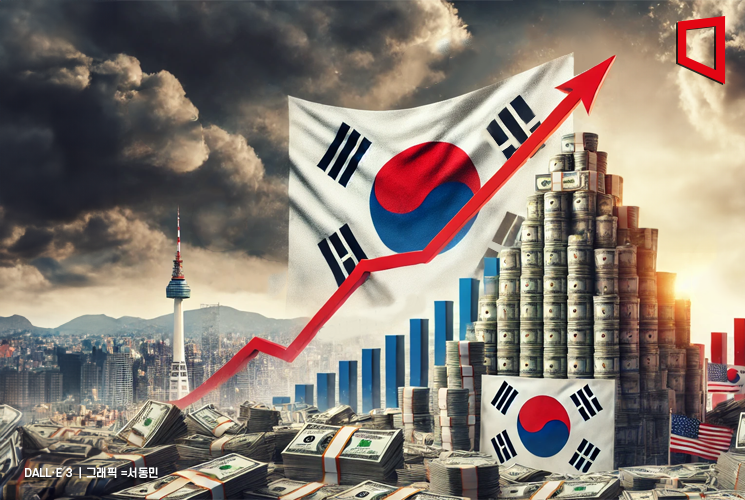
International organizations predict that Korea's debt ratio will continue to rise over the next five years. The IMF released a Fiscal Monitor report last October, forecasting Korea's debt ratio to reach 52.8% this year. It analyzed that the ratio will follow an upward curve each year, reaching 58.1% by 2029.
Kim Wansu, Director of Fiscal Soundness at the Fiscal Policy Bureau, said, "The increase in debt was large during the COVID-19 period, but it has decreased," adding, "I think efforts for government sustainability and expenditure restraint are gradually emerging."
© The Asia Business Daily(www.asiae.co.kr). All rights reserved.
![Clutching a Stolen Dior Bag, Saying "I Hate Being Poor but Real"... The Grotesque Con of a "Human Knockoff" [Slate]](https://cwcontent.asiae.co.kr/asiaresize/183/2026021902243444107_1771435474.jpg)
















