Prosecution Authority of Corruption Investigation Office Limited to Prosecutors, Police Chiefs
Only President Yoon and Former Minister Kim Yong-hyun Can Be Prosecuted by Prosecutors
Joint Investigation by Prosecution, Police, and Military Must Be Conducted Before Special Prosecutor Appointment
As the prosecution speeds up the investigation of the ‘December 3 Emergency Martial Law Incident’ together with the military prosecution, concerns are growing over overlapping investigations as the High-ranking Officials’ Crime Investigation Office (HOCI), the police, and the Ministry of National Defense have decided to operate a joint investigation headquarters (Joint HQ).
There are calls for a prompt joint investigation by the prosecution, police, and military to avoid confusion that could arise at the frontline investigation sites when such a critical national case is investigated separately by the Joint HQ and the prosecution’s special investigation team.
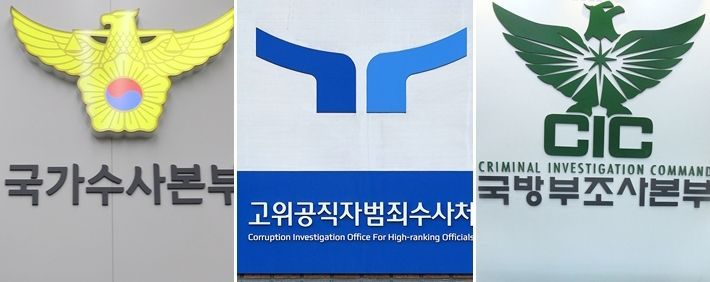 National Police Agency's National Investigation Headquarters, Corruption Investigation Office for High-ranking Officials, Ministry of National Defense Investigation Headquarters. Yonhap News Agency
According to the legal community on the 12th, the prosecution was completely unaware of the police and HOCI’s plan to launch the Joint HQ until the day before their announcement. Earlier, HOCI had requested the transfer of the case to both investigative agencies, but neither the police nor the prosecution responded. Amid discussions on forming a consultative body among the three investigative agencies at the suggestion of the Supreme Prosecutors’ Office, the announcement was suddenly made.
The launch of the Joint HQ appears to be the result of a consensus between the police and HOCI to complement each other’s weaknesses and prevent the prosecution from taking the lead in this investigation. The police have the authority to investigate treason but lack the power to request search warrants for forced investigations or to file arrest and detention warrants. When the police apply for warrants, the prosecution assesses their appropriateness and files them with the court.
In fact, there have been complaints within the police recently about the prosecution’s dismissal of search warrants requested by the police for the Special Warfare Command and the Capital Defense Command, calling it a ‘hijacking of the investigation.’ On the other hand, the prosecution stated that the warrants related to this emergency martial law case requested by the police are handled by a separate dedicated department of the Seoul Central District Prosecutors’ Office, not the prosecution’s special investigation team, and that the dismissal of warrant applications is because the military prosecutors dispatched to the special investigation team have already obtained warrants from the military court.
In the case of HOCI, like the prosecution, it has the authority to request search and arrest warrants, but it has not been able to resolve the chronic shortage of investigative personnel due to the continuous departure of prosecutors and investigators, and its investigative capacity has already shown limits, leading to calls for its abolition.
Above all, only the prosecution has the authority to indict key suspects related to this treason case, namely President Yoon Seok-yeol, who is identified as the leader of the treason, and former Minister of National Defense Kim Yong-hyun, who is considered a person performing important duties. Under the HOCI Act, HOCI can only prosecute high-ranking officials’ crimes and related offenses committed by the Chief Justice of the Supreme Court, Supreme Court Justices, Prosecutor General, judges, prosecutors, police officers of rank Superintendent General or higher, or their families. Except for police executives such as Police Chief Jo Ji-ho, even if the police or HOCI conduct investigations, they must hand over the investigation records to the prosecution, which makes the final decision on whether to prosecute.
The Democratic Party criticized the current investigation as an illegal investigation based on an enforcement decree created by Han Dong-hoon, the leader of the People Power Party, when he was Minister of Justice, arguing that under the amended Prosecutors’ Office Act following the adjustment of investigative authority between the prosecution and police, the prosecution cannot investigate treason. Justice Committee Chairman Jeong Cheong-rae even raised concerns that evidence obtained by the prosecution, which lacks investigative authority, could be excluded as illegal evidence in future trials. However, the recent court ruling granting the prosecution’s detention warrant for former Minister Kim clarified that under the Prosecutors’ Office Act, the prosecution has the authority to investigate crimes committed by the police and related offenses. It also clearly stated that the prosecution’s investigative authority over other co-conspirators in this case, including Police Chief Jo Ji-ho and many police executives accused of treason, exists under the law, not the enforcement decree, dispelling the controversy over investigative authority.
Meanwhile, as the prosecution, police, and HOCI conduct investigations separately, there have been cases where search warrants for the same location or detention warrants for the same suspects have been requested redundantly, or where searches and suspect detentions are carried out by different investigative agencies. The court has already dismissed overlapping warrant applications and urged investigative agencies to coordinate to avoid such situations.
The legal community points out that a joint investigation by the prosecution, police, and military prosecution should be conducted until a special prosecutor is appointed.
A lawyer who is a former senior prosecution official said, “Now is not the time for investigative agencies to compete to assert their presence but to focus on swift and efficient investigations,” adding, “A joint investigation by the police, prosecution, and military prosecution is the best option.”
Meanwhile, with the passage of the special prosecutor law to investigate President Yoon’s treason charges expected at the National Assembly plenary session on the afternoon of the 12th, the investigation is likely to enter a new phase. If the special prosecutor is properly launched, the current controversy over overlapping investigations is also expected to be resolved.
The newly proposed special prosecutor law for treason includes a provision that if the president does not appoint a special prosecutor within a set period, the eldest candidate among those recommended will be considered appointed, blocking any delay tactics. The recommendation of special prosecutor candidates excludes political parties and instead requires the Chief Justice of the Supreme Court Administrative Office, the President of the Korean Bar Association, and the President of the Korean Association of Law Professors to each recommend one candidate. However, an individual special prosecutor law may be subject to a presidential veto, which is a variable factor. The treason special prosecutor law is designed so that the appointment of the special prosecutor is completed within a week at the latest.
© The Asia Business Daily(www.asiae.co.kr). All rights reserved.
![Clutching a Stolen Dior Bag, Saying "I Hate Being Poor but Real"... The Grotesque Con of a "Human Knockoff" [Slate]](https://cwcontent.asiae.co.kr/asiaresize/183/2026021902243444107_1771435474.jpg)















