Opening of Emart Food Market Suseong Branch on the 13th
First Introduction of 'Grocery Hard Discount Store'
31 Years of Expertise in Product Procurement Combined
Minimizing All Costs to Invest Only in Product Prices
Emart is launching the 'Emart Food Market Suseong Branch,' a grocery specialty store in Daegu Metropolitan City that aims for 'constant low prices on groceries.' This is Emart's ambitious project to designate groceries as a core category and present a price innovation model to strengthen its core competitiveness in both online and offline distribution markets.
According to Emart on the 12th, the Emart Food Market Suseong Branch, opening on the 13th, is a new format store that brings together the company's 31 years of experience and product planning know-how. It positions itself as a 'grocery hard discount store' that sells food at the lowest prices all year round. An Emart official emphasized, "While some overseas stores have sales channel models that continuously offer low prices mainly on private brand products, this is the first attempt, both abroad and domestically, to specialize in groceries and implement a hard discount system throughout the year."
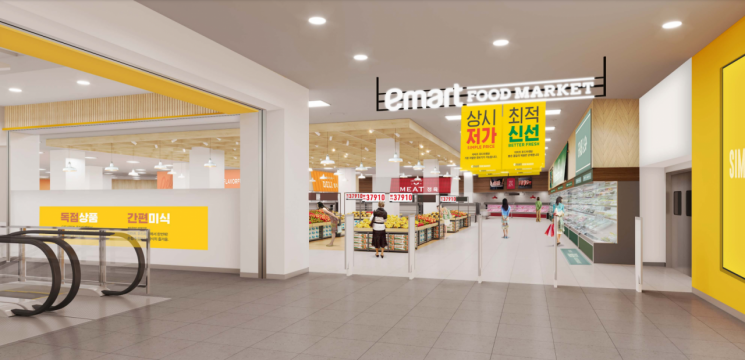
The Ultimate Grocery Store Aiming for Constant Low Prices
The total sales area of Emart Food Market Suseong Branch is 3,966㎡ (approximately 1,200 pyeong). Of this, 2,829㎡ (about 856 pyeong), which accounts for 86% of the directly managed area excluding tenants (core stores) and event spaces, is dedicated solely to grocery products.
While global hard discount store (HDS) retailers such as Aldi, a German discount supermarket chain, lead the ultra-low price market focusing on private brand products, Emart Food Market differentiates itself by specializing in fresh food. Product prices are operated at 20% to 50% lower than discount stores.
Representative fresh food products include onions sold at 1,480 KRW per 1kg, garlic at 2,980 KRW per 300g, napa cabbage and cabbage at 2,980 KRW each per head, and eggs at 5,980 KRW per carton. Additionally, domestic chilled pork belly is sold at 2,480 KRW per 100g, seasoned beef bulgogi at 9,980 KRW per 800g, domestic salted mackerel (medium) at 2,480 KRW per set (two fish), and large Jeju silver cutlassfish at 4,980 KRW per fish at constant low prices. Fruits with significant price fluctuations such as strawberries and tangerines will also be offered at seasonally lowest prices about 20-30% cheaper than discount stores.
To enhance price competitiveness, global production areas are actively utilized. For example, cleaned squid from Argentina (medium) is sold at 1,980 KRW per fish, four types of 5-dollar steaks (Australian) packaged in single servings (200-250g) are each priced at 6,980 KRW, and Australian Wagyu sirloin is sold at 3,980 KRW per 100g.
Considering that Suseong Branch is located in a neighborhood commercial area with many pedestrian customers, Emart adjusted the sales quantities of fresh foods. Meat, which is usually sold in 600g units at discount stores, is reduced to 400-500g, and packaging quantities of vegetables such as onions, green onions, cabbage, and mushrooms are reduced by more than 30%, while unit prices are lowered by up to 50%.
For key processed foods with high price sensitivity such as ramen, sesame oil, red pepper paste, tuna, milk, and wine, Emart plans to sell them at the lowest prices in the region through periodic market surveys and develop ultra-low price exclusive products. About 70 types of PNB (Private Network Brand) products developed with major partners in quantities and specifications suitable for the Emart Food Market format are also prepared under the 'Reasonable Low Price' series.
An Emart official stated, "We minimized store operating costs and focused solely on price investment so that customers can purchase groceries at overwhelmingly surprising prices," adding, "Our goal is to pursue price innovation from the customer's perspective to alleviate concerns about grocery prices as much as possible."

Customer-Centric 'Price Innovation'... Fun Shopping with Specialized Zones
Emart Food Market has achieved price innovation in three major aspects. First, it concentrated Emart's 31 years of accumulated product purchasing know-how. Competitive partners optimized for the new Emart Food Market format were selected, and major products were purchased through annual volume contracts to lower purchase prices. For meat and seafood, strategic collaboration was made with excellent partners in the Gyeongsang-do region, and for non-food items, discontinued and leftover stocks from partners were purchased in bulk and sold at ultra-low prices.
Second, marketing costs previously used for discount events were invested in product prices, and Emart's own margin was lowered to create a new distribution structure where customers can always purchase products at low prices. Lastly, all cost structures related to sales management were minimized through reduced store development investment, logistics route optimization, introduction of electronic price tags, improved display methods, and simplified on-site operations.
Earlier, Emart renewed and reopened the 'Starfield Market Jukjeon Branch' on August 30, aiming for a next-generation future store. This was an attempt at 'space innovation' to transform it into a community-based shopping mall combining rest, experience, and shopping beyond just grocery shopping. At the Suseong Branch, in addition to price innovation, specialized zones reflecting the commercial area and trends were placed throughout the store to expand customer experience.
For example, a 'Traders Zone' was created by gathering popular products from Traders, a warehouse-type discount store gaining attention in the high inflation era. Customers can purchase about 40 products, including Traders' private brand items such as T STANDARD premium bath tissue (38m×30 rolls, 23,480 KRW), olive oil (2ℓ, 29,980 KRW), garlic shrimp chips (490g, 4,780 KRW), as well as Traders exclusive products like Signature Toowoomba Pasta (183.5g×6 packs, 11,780 KRW) and Tiny Ping low-sugar Jjajang Tteokbokki (120g×6 packs, 12,480 KRW).
Additionally, customers can experience Emart's advanced product competitiveness at the Food Market through specialized zones such as the 'Mini Naturalism Zone' focused on organic and pesticide-free products, the 'Wine & Liquor Zone' specializing in alcoholic beverages including world beers, wines, and whiskeys, the 'Large Volume Meat Zone' offering cost-effective meat in customizable portions, and Emart's popular seafood corner 'Tuna Butcher Shop.'
Emart President Chae Yang said, "Emart Food Market Suseong Branch is the second next-generation future store Emart is launching after Starfield Market Jukjeon Branch," adding, "We will focus all capabilities on overwhelming product prices and quality to present 'price innovation' by selling groceries at constant low prices all year round."
© The Asia Business Daily(www.asiae.co.kr). All rights reserved.
![Clutching a Stolen Dior Bag, Saying "I Hate Being Poor but Real"... The Grotesque Con of a "Human Knockoff" [Slate]](https://cwcontent.asiae.co.kr/asiaresize/183/2026021902243444107_1771435474.jpg)
















